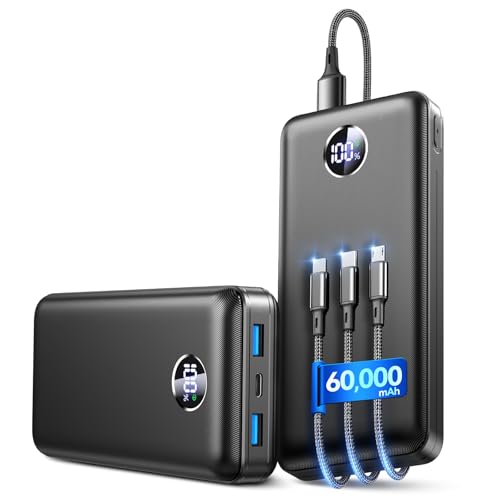
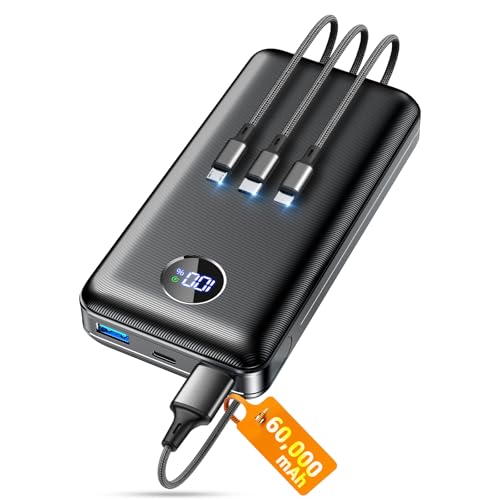
For most travelers, the best high capacity power bank is a 20,000 to 27,000 mAh model that stays under the common 100Wh airline carry-on limit: the Anker Prime 27,650mAh and Prime 26K sit right at the edge, the UGREEN Nexode 25,000mAh is a lighter mid-range option, and a 20,000 mAh bank covers people who just want several phone charges without extra weight.
Our top picks


As an Amazon Associate we earn from qualifying purchases at no extra cost to you.
At a Glance: High Capacity Power Banks
| Model | Stated capacity and output | Best for | Limits |
|---|---|---|---|
| Anker Prime 27,650mAh (250W) | 99.5Wh per reviewers; 250W output | Laptops plus phones, maximum capacity within the 100Wh limit | Premium tier and heavy |
| Anker Prime 26K (300W) | Rated 99.75Wh; 300W output | Power-hungry laptops and several devices | Premium tier |
| UGREEN Nexode 25,000mAh (200W) | 92.5Wh, about 520g per reviewers; 200W | Balanced weight and power | Mid to upper tier |
| Anker Laptop Power Bank 25K (165W) | Built-in retractable cables; four devices; about 594g | Cable-free travel | Heavier |
| INIU P63 (25,000mAh, 100W) | 90Wh; about 400g per a reviewer | Lower-cost large capacity | Lower output than premium |
| 20,000 mAh class (Anker Prime 20K, UGREEN Nexode 20K, INIU 45W, CUKTECH 45W, Baseus Blade HD) | About 74Wh; outputs vary from 45W to 220W | Phones, tablets, light laptop use | Smaller reserve |
What Capacity Really Means
Power bank capacity in mAh is not directly comparable across voltages. Watt-hours (Wh) are the fairer measure and the one airlines use. A rough conversion: milliamp-hours times 3.7 volts divided by 1,000 gives watt-hours. On that basis a 20,000 mAh cell is about 74Wh and a 27,000 mAh cell is about 100Wh. Usable energy delivered to your device is lower, often by 20 to 30 percent, because of conversion losses and heat.
A phone battery is roughly 12 to 20Wh, so a 74Wh bank gives several phone charges. A laptop battery is often 50 to 100Wh, so one large bank may refill a laptop only about once.
Airline Rules to Know Before You Buy
Roundups of travel power banks report these general points. Power banks must go in carry-on baggage, not checked baggage. Banks up to 100Wh are generally allowed. Banks between 100Wh and 160Wh typically need airline approval, and above 160Wh they are not allowed. Reporting from one 2026 roundup says international flights now often have a separate limit of two power banks per person, while US domestic limits depend on the airline. Some Asian and European carriers enforce stricter limits, especially above 20,000 mAh. Rules change, so read your airline’s current policy before flying. Those limits apply to the Wh figure printed on the unit, so check that the bank has it printed.
Current Picks by Need
Best maximum capacity: Anker Prime 27,650mAh (250W)
Reviewers report that this bank holds 99.5Wh, just under the 100Wh limit, and one roundup names it best overall. The maker lists 250W of output, which suits a laptop plus a phone. The drawbacks are weight and a premium-tier cost.
Best for laptops: Anker Prime 26K (300W)
Rated 99.75Wh, it also stays inside the common carry-on limit. The 300W stated output is the highest in this group, aimed at users who charge performance laptops.
Best balance: UGREEN Nexode 25,000mAh (200W)
Reviewers list it at 92.5Wh and 520g. It offers a good mix of capacity, output and weight without hitting the highest tier.
Best all-in-one: Anker Laptop Power Bank 25K (165W)
Reviewers mention built-in retractable cables, four-device charging and airline-compliant capacity. Weight is about 594g, so it is better for a bag than a pocket.
Best value large bank: INIU P63
One reviewer lists a 25,000 mAh, 100W, 90Wh model at about 400g. It is a sensible choice for phones, tablets and some laptops, but it is not meant for high-power laptops.
Best lighter alternative: 20,000 mAh class
Models such as the Anker Prime 20K and UGREEN Nexode 20K (reviewers cite 165W and 335g for the UGREEN with retractable cable) cover phones, tablets and a MacBook Air-class laptop once. Budget options named in reviewer lists include the INIU 45W 20,000 mAh, the CUKTECH 45W, Anker Zolo 20K and Baseus Blade HD.
Pick X If … Decision Table
| If you … | Choose | Why |
|---|---|---|
| Need one bank for a laptop and phone | Anker Prime 26K or 27,650mAh | High stated output and capacity at the airline limit |
| Want a lighter large bank | UGREEN Nexode 25,000mAh | Lower weight than the biggest models |
| Hate carrying cables | Bank with retractable cables | Cables are built in |
| Mostly charge phones | 20,000 mAh class | Enough for several charges at lower weight |
| Need to save | INIU or similar budget bank | Large capacity at a lower tier |
| Travel by air | Any bank at or under 100Wh | Fits common carry-on rules |
Budget Tiers Without Prices
- Budget tier: 20,000 to 25,000 mAh banks with 45W to 100W output.
- Mid-range tier: UGREEN Nexode and similar 20K to 25K banks with 165W to 200W output.
- Premium tier: Anker Prime 250W and 300W models with displays, high output and near-limit capacity.
Fit, Care and Safety Notes
- Output vs. need: check your laptop’s charger wattage; a bank with lower output may charge slowly or not at all while the laptop is in use.
- Cables: use cables rated for the power level, such as 100W or 240W USB-C.
- Recharge time: large banks take hours to refill, so a high input rating matters.
- Heat: do not cover a bank while it is charging or discharging.
- Damage: stop using a bank that swells, leaks or smells, and dispose of it at a battery recycling point.
- Storage: keep it at a moderate charge level in a cool, dry place for long periods.
- Certification: choose banks with the maker’s stated safety certifications and printed Wh rating.
Alternatives to Consider
- Portable power stations: much larger, with AC outlets, for camping or home backup. They are generally not permitted on planes.
- Two smaller banks: two 10,000 mAh banks can be easier to carry and share, though count limits may apply on some flights.
- Slim magnetic banks: good for daily phone use, covered in our iPhone power bank guide.
Matching Output to Your Devices
High capacity is only half the story. A big bank with low output still charges a laptop slowly, and a bank with high output but a single strong port may not share power well across devices. Check three numbers on the maker’s page: the maximum output of a single port, the total output when several ports are in use, and the input rating used to recharge the bank itself. A bank with 100W input can refill in a few hours, while one limited to 18W input may take most of a day.
Display and smart features are useful but not essential. Some premium banks show wattage per port and remaining energy, which helps you see whether a laptop is truly charging. Others add a built-in cable, which removes a failure point but may limit replacement options if the cable wears out. Reviewers also point to weight: a bank of 500g or more is noticeable in a daypack, so decide whether the extra reserve is worth carrying every day or only on longer trips.
Finally, think about how you will recharge. If you travel with a multi-port wall charger, a bank with high USB-C input pairs well with it. See our multi-port charger guide for how total wattage is divided between devices.
One more practical point is portability inside the bag. Large banks are dense, so keep them in an easy-to-reach pocket for security checks, where staff may ask to see them. Label the Wh rating if the print is faint, and keep a short note of your airline’s policy on your phone. If you travel as a family, one large shared bank is often lighter than several small ones, but spreading capacity across two banks gives you a backup if one fails or is taken for inspection.
Frequently Asked Questions
How many mAh can I take on a plane?
The limit is set in watt-hours, not mAh. About 27,000 mAh equals roughly 100Wh at 3.7V, which is the common carry-on limit. Check the Wh printed on the bank and your airline’s policy.
Is a 20,000 mAh power bank enough?
For phones, earbuds and a tablet, yes, it provides several charges. For a laptop, it depends on the laptop battery size and the bank’s output, and it may recharge a light laptop only once.
Can a power bank charge a laptop?
Many can, if they support USB Power Delivery at enough wattage. Check the laptop charger rating and pick a bank with equal or higher stated output.
Why does my bank not deliver its full capacity?
Capacity is measured at the cell voltage, and conversion to 5V or higher output wastes some energy as heat. Reviewers commonly report that usable capacity is around 70 to 80 percent of the printed figure.
Are high capacity power banks safe?
Quality banks from established makers include protections, but all lithium batteries carry some risk. Use certified products, keep them from heat, and stop using any bank that is damaged.
How long does it take to recharge a large power bank?
It depends on the input rating. Banks with high USB-C input can refill in a few hours, while basic models can take much longer. Check the maker’s stated recharge time.
More from Amazon
Programs that pair well with the guide above. Offers and eligibility are set by Amazon and may change.
Free shipping on eligible items, Prime Video and more. Eligible new members can start with a free trial.
Start a Prime free trialAudiobooks and podcasts to listen to on the go. Eligible new members can start with a free trial.
Try Audible freeAd-free music streaming. Eligible new subscribers can start with a free trial.
Try Music Unlimited freeA free business account with business pricing and bulk-buying tools for work, shop or home office.
Create a business accountAs an Amazon Associate we earn from qualifying purchases.