Key takeaways
- Compare the best TV antennas for free local channels by rated range, VHF and UHF coverage, amplifier design and mounting style for any home.
A TV antenna is still the simplest way to watch local news, live sports and network shows without a monthly bill. The catch is that the right model depends on your address: how far the broadcast towers are, which bands your stations use, and whether you can mount anything outside. The five picks below cover the main setups, from a passive flat panel for city apartments to an amplified outdoor antenna for homes at the edge of reception.
As an Amazon Associate, we earn from qualifying purchases.
Quick Answer
For most homes within about 35 miles of the towers, the Channel Master FLATenna is the easy starting point: it is passive, thin and needs no power. If signals are weaker, the amplified Mohu Leaf 50 or Winegard FlatWave Amped adds a low-noise amplifier indoors. For attic or roof mounting, the Antennas Direct ClearStream 4 and the amplified Winegard Elite 7550 reach farther.
How to Choose
Check your distance and bands first
Before comparing models, look up which stations serve your address and how far away the towers are. Most stations now broadcast on UHF, but some major networks still sit on high-VHF, and a few remain on low-VHF. An antenna that only covers UHF can miss those VHF stations entirely, so match the band coverage to the channels you actually want. Rated range figures are manufacturer estimates under ideal conditions; terrain, trees and building materials shorten real-world reach.
Indoor, attic or outdoor mounting
Height and a clear path matter more than raw gain. An indoor flat antenna works well near towers and in upper-floor rooms, especially placed in a window facing the transmitters. Moving the same class of antenna into an attic usually improves results, and a roof or mast mount gives the clearest path of all. If your lease or building rules rule out outdoor mounting, an amplified indoor model is the practical ceiling.
Amplified or passive
An amplifier helps when the signal arriving at the antenna is weak but usable, or when a long cable run and splitters eat into the signal on the way to the TV. It cannot create a signal that is not there, and in strong-signal areas an amplifier can overload a tuner and make reception worse. Low-noise designs are the ones worth paying for, since a noisy amplifier boosts interference along with the station.
Cable and connections
Every antenna here connects over standard coaxial cable to a TV tuner or a separate tuner box. Detachable cables are easier to replace or extend, and a longer included cable gives more freedom to reach a window. After connecting, run a channel scan, then rescan after any repositioning, since small moves can change which stations lock in.
The 5 Best TV Antennas
1. Channel Master FLATenna — Best Budget Indoor Pick
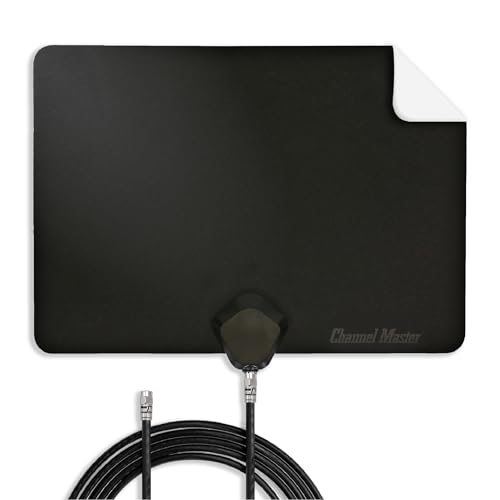
The FLATenna is a passive flat panel, which makes it the simplest antenna in this group: no amplifier, no power supply, nothing to configure. Channel Master rates it for reception up to 35 miles, a conservative figure that suits city and near-suburb homes where the towers are close. The panel is dual-sided in black and white, so it can blend against a wall or window frame, and the included 12-foot shielded RG6 coaxial cable detaches if it ever needs replacing. It covers both UHF and VHF bands and is rated for 4K broadcast and ATSC 3.0 NextGen TV signals, so it will not be the part of the setup that holds back a newer television.
Specs:
- Model: CM-4001HDBW
- Type: Indoor flat panel, passive (no amplifier)
- Rated range: Up to 35 miles
- Bands: UHF and VHF
- Cable: 12 ft shielded RG6 coaxial, detachable
- Finish: Reversible black or white
2. Mohu Leaf 50 — Best Amplified Flat Antenna

The Leaf 50 is the amplified version of the original paper-thin Leaf design. Its Jolt in-line amplifier is powered over USB or a wall adapter and is meant to pull in stations that a passive panel at the same spot would miss. Mohu rates the antenna for up to 60 miles, and it receives both UHF and high-VHF signals, which covers the band most major-network stations use. The 16-foot detachable cable gives more placement freedom than most flat antennas, and the reversible, paintable surface makes it easier to hide on a wall. For renters who cannot mount anything outside, this is the natural step up from a passive panel.
Specs:
- Model: MH-110584
- Type: Indoor flat panel, amplified
- Amplifier: Jolt in-line amplifier, USB powered
- Rated range: Up to 60 miles
- Bands: UHF and high-VHF
- Cable: 16 ft detachable coaxial
3. Winegard FlatWave Amped — Best Low-Noise Indoor Amplifier
Winegard takes a different approach to amplification: the preamplifier is embedded directly at the antenna elements, so the signal is boosted before cable losses and household interference can creep in. The company calls the design Clear Circuit technology and quotes an ultra-low noise figure of 1.0 dB, which matters because a quiet amplifier preserves weak stations instead of burying them in its own noise. The FlatWave Amped is a dual-band design covering high-VHF and UHF, rated for up to 60 miles, and the flat panel is finished in black on one side and white on the other. It is a strong fit for suburban homes where stations are present but marginal.
Specs:
- Model: FL5500A
- Type: Indoor flat panel, amplified
- Amplifier: Embedded Clear Circuit preamplifier, 1.0 dB noise figure
- Rated range: Up to 60 miles
- Bands: High-VHF and UHF
- Finish: Dual color, black and white
4. Antennas Direct ClearStream 4 — Best Indoor, Attic or Outdoor UHF

The ClearStream 4 uses four of the company’s patented loop elements in a rigid frame, and it is one of the few antennas here that can move between a wall, an attic and an outdoor mast as your situation changes. It is a UHF-only design covering 470 to 608 MHz, rated for reception at 70 miles and beyond, and it ships with reflectors and a 20-inch mast for outdoor mounting. Because it skips VHF entirely, it suits viewers whose local stations are all on UHF, which is now the common case in many markets. The multi-directional loop pattern also helps when towers are spread across more than one direction.
Specs:
- Model: ClearStream 4
- Type: Indoor, attic or outdoor loop antenna
- Rated range: 70+ miles
- Bands: UHF only, 470–608 MHz
- Included hardware: Reflectors and 20-inch mast
- Pattern: Multi-directional
5. Winegard Elite 7550 — Best Amplified Outdoor Antenna
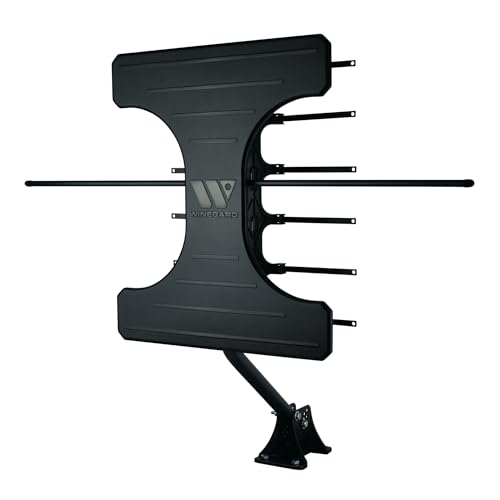
The Elite 7550 is a compact outdoor antenna with an embedded Boost ultra-low-noise amplifier, built for homes where indoor models run out of signal. It receives both high-VHF and UHF from up to 70 miles, and the amplifier is powered through an inline 5V inserter, which helps when the antenna feeds a long cable run. The box includes the mounting pipe, foot and hardware, so a roof, eave or attic install does not need a separate hardware hunt. It is directional, so aiming it at your main tower cluster matters, but for fringe-area homes that directionality is exactly what concentrates the gain where it is needed.
Specs:
- Model: WE7550A
- Type: Outdoor directional, amplified
- Amplifier: Embedded Boost ultra-low-noise amplifier with inline 5V power inserter
- Rated range: Up to 70 miles
- Bands: High-VHF and UHF
- Included hardware: Mounting pipe, foot and hardware
Who Should Skip a New TV Antenna
Skip the upgrade if your address sits in a deep valley, behind a ridge, or well beyond 70 miles from every tower cluster, because no consumer antenna reliably closes that gap. Also skip it if your must-watch channels are cable-only networks, since an antenna only receives free over-the-air broadcasts. And if a basic indoor panel already pulls in every local station cleanly, a bigger antenna adds cost and installation work without adding channels.
Frequently Asked Questions
Do these antennas work with a smart TV?
Yes. Any TV with a built-in digital tuner connects directly over coaxial cable, and that includes nearly all smart TVs. Older sets without a digital tuner need a separate converter or tuner box between the antenna and the TV.
Will an amplifier always improve reception?
No. An amplifier helps with weak-but-present signals and long cable runs, but it can overload the tuner when signals are already strong, which causes dropouts instead of fixing them. Homes close to the towers are usually better served by a passive antenna.
How do I know which bands my stations use?
Look up your address on a reception-mapping site before buying. The listing shows each station’s real channel and direction, and most stations are on UHF or high-VHF. If a must-have station is on low-VHF, you will need a larger antenna with long elements built for that band.
Can one antenna feed more than one TV?
Yes, with a splitter, but each split weakens the signal reaching every set. Homes feeding several TVs from one antenna often do better with an amplified model, since the amplifier offsets the splitter and cable losses.
Final Verdict
Start with the passive Channel Master FLATenna if your towers are close, and step up to the amplified Mohu Leaf 50 or Winegard FlatWave Amped when indoor signals are marginal. If you can mount in an attic or on a roof, the Antennas Direct ClearStream 4 covers UHF markets with room to spare, while the Winegard Elite 7550 adds amplification for fringe addresses. Match the band coverage to your stations first; that single check decides more than any range number on the box.
More from Amazon
Programs that pair well with the guide above. Offers and eligibility are set by Amazon and may change.
Free shipping on eligible items, Prime Video and more. Eligible new members can start with a free trial.
Start a Prime free trialAudiobooks and podcasts to listen to on the go. Eligible new members can start with a free trial.
Try Audible freeAd-free music streaming. Eligible new subscribers can start with a free trial.
Try Music Unlimited freeA free business account with business pricing and bulk-buying tools for work, shop or home office.
Create a business accountAs an Amazon Associate we earn from qualifying purchases.