Key takeaways
- Compare the best indoor air quality monitors for PM2.5, CO2, VOCs and radon, with sensor types, displays, apps and smart home support compared.
Indoor air problems are invisible. Cooking sends fine particles into the air for hours, a closed bedroom lets carbon dioxide climb all night, and radon seeps in without any smell at all. An indoor air quality monitor turns those hidden numbers into something you can act on: open a window, run the range hood longer, or switch on a purifier before the room feels stuffy.
The five monitors below cover very different jobs. One is the only consumer device here that tracks radon alongside particles and gases. One is a handheld analyzer built for spot checks and logged data. Others trade a built-in screen for app-based alerts inside Alexa or Apple HomeKit.
As an Amazon Associate, we earn from qualifying purchases.
Quick Answer
For most homes, the Airthings View Plus is the most complete monitor here: it is the only pick that adds radon to PM2.5, CO2 and VOC tracking. The IQAir AirVisual Pro suits data-focused buyers, the Qingping Air Monitor Lite fits Apple HomeKit homes, the Temtop M2000 2nd is the handheld spot-check tool, and the Amazon Smart Air Quality Monitor is the simple Alexa-friendly option.
What the Numbers on the Box Actually Mean
Not every monitor measures the same air. Before comparing models, it helps to know what each reading is and how it is sensed, because the sensor type decides both accuracy and upkeep.
PM2.5 and PM10 are particles small enough to stay airborne and reach deep into the lungs. Cooking, candles, wood stoves and outdoor smoke all raise them. Most monitors count them with a tiny laser scattering sensor, accurate enough for trends but prone to drift as dust coats the optics over the years.
CO2 is the ventilation gauge. People exhale it, so a rising number in a bedroom or office means stale air long before anyone feels drowsy. Better monitors use a dedicated NDIR infrared sensor; cheaper ones estimate CO2 from other gases, which is noticeably less reliable. Some NDIR sensors self-calibrate by assuming the lowest weekly reading equals fresh outdoor air, so a room that never airs out can slowly skew the baseline.
VOCs are gases released by paints, cleaning products, new furniture and cooking. Nearly all consumer monitors report VOCs as an index or a broad estimate rather than a precise concentration, so treat the number as a direction signal: rising, falling, stable.
Radon is the specialist reading. It is a radioactive gas that enters from the ground and is a leading cause of lung cancer in non-smokers. Only the Airthings pick below measures it, and radon needs days of averaging before the number means anything, so it rewards a monitor that stays in one place.
Formaldehyde (HCHO) appears in the Temtop below. It off-gases from pressed wood and resins, and its electrochemical sensor wears out faster than the others, one reason that unit suits periodic checks rather than permanent duty.
The Five Monitors, Matched to Five Different Jobs
Airthings View Plus: the radon and everything monitor
The View Plus is the most complete sensor package in this group: seven sensors covering radon, PM2.5, CO2, VOCs, temperature, humidity and air pressure. It connects over Wi-Fi, shows readings on a calm 2.9-inch e-ink style display you can customize, and runs on six AA batteries for up to about two years, so it can sit in a basement or hallway with no cable. The app keeps long-term history, which matters most for radon, where the meaningful figure is the average over weeks. It also works with Alexa and Google Assistant.
Specs:
- Sensors: radon, PM2.5, CO2, VOC, temperature, humidity, pressure
- Model: 2960
- Display: 2.9-inch customizable e-ink style display
- Connectivity: Wi-Fi, Alexa and Google Assistant support
- Power: 6 AA batteries, up to roughly 2 years per set
Choose it if radon is a possibility in your area, or if you want one battery-powered device covering every common reading.
IQAir AirVisual Pro: the data and forecast monitor
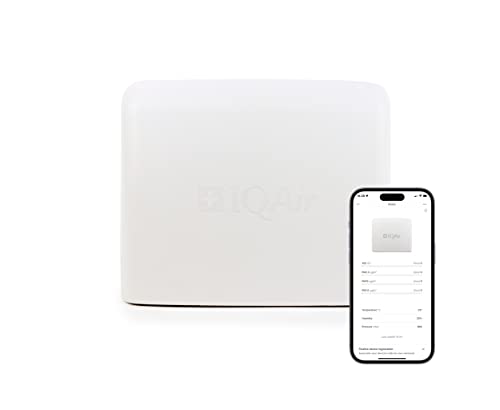
The AirVisual Pro pairs its indoor readings with outdoor air quality and forecasts from the IQAir network, shown side by side on a 5-inch color display. Indoors it tracks PM2.5 with a laser sensor plus CO2, temperature and humidity, and it builds historic data you can review in the app. That indoor-versus-outdoor comparison is its signature strength: it tells you whether opening the windows will help or make things worse, exactly the question that matters during wildfire smoke or high-pollen weeks. It is a plug-in desktop unit, so it belongs on a desk or shelf near where people sit.
Specs:
- Sensors: PM2.5, CO2, temperature, humidity, plus AQI and outdoor forecast
- Model: 360 10 00 06
- Display: 5-inch color display
- Connectivity: Wi-Fi, app history, IFTTT support
- Power: plug-in adapter
One caution: IQAir sells a newer hardware generation through its own store, while the Amazon listing is the long-running 360 series model above. The readings and display are the same core package, but confirm the model number on the listing if a specific newer feature matters to you.
Qingping Air Monitor Lite: the HomeKit and e-ink pick

The Air Monitor Lite covers the five everyday readings — CO2, PM2.5, PM10, temperature and humidity — on a crisp e-ink display, and it is the natural choice for Apple households because it works with Apple HomeKit as well as the Qingping app. The built-in rechargeable battery frees it from a permanent cable, and the e-ink screen stays readable without glowing at night, which makes it easy to live with in a bedroom. Independent AQ-SPEC evaluation has rated its particle accuracy strongly for a consumer device, which supports using its numbers for real ventilation decisions.
Specs:
- Sensors: CO2, PM2.5, PM10, temperature, humidity
- Model: CGDN1
- Display: e-ink
- Connectivity: Wi-Fi, Apple HomeKit and Qingping app
- Power: built-in rechargeable battery, USB charging
It skips VOCs and radon, so it is a ventilation and particles monitor rather than a full air audit. For bedrooms, nurseries and home offices, that narrower focus is usually the right trade.
Temtop M2000 2nd: the handheld analyzer for spot checks
The M2000 2nd is built like test equipment rather than a smart home gadget. It combines a Swedish SenseAir NDIR CO2 sensor (0 to 5,000 ppm), laser particle counting for PM2.5 and PM10, a British Dart electrochemical formaldehyde sensor (0 to 5 mg per cubic meter) and a Swiss Sensirion temperature and humidity sensor in one handheld body with a color TFT screen. It logs months of readings for USB export, has a settable audio alarm, and runs about eight hours on its 3,000 mAh battery. That profile suits move-in inspections, checking a classroom or rental, verifying that a new kitchen hood clears cooking particles, or screening a renovated room for formaldehyde.
Specs:
- Sensors: CO2, PM2.5, PM10, formaldehyde, temperature, humidity
- CO2 range: 0 to 5,000 ppm, NDIR sensor
- Display: color TFT screen with data logging and USB export
- Battery: 3,000 mAh rechargeable, about 8 hours of runtime
- Extras: adjustable audio alarm
Because it is handheld and battery-limited, it is not the tool for month-long averaging or for triggering smart home routines. It answers specific questions on specific days, and it answers them well.
Amazon Smart Air Quality Monitor: the Alexa household pick

Amazon’s monitor takes the opposite approach to a big display: there is none. It measures PM2.5, VOCs, carbon monoxide, temperature and humidity, then reports through the Alexa app, an Echo device, or the color-changing LED on its face. Its best trick is automation: Alexa routines can switch on a compatible purifier, fan or dehumidifier when a reading crosses a level you set. It is small, USB powered and deliberately simple, a sensible first monitor for an Alexa home.
Specs:
- Sensors: PM2.5, VOC, carbon monoxide, temperature, humidity
- Model: P3A7EN
- Display: none, LED status indicator and Alexa app
- Connectivity: Wi-Fi and Bluetooth, works with Alexa
- Power: USB
The gaps are CO2 and radon: there is no true CO2 sensor, so it cannot judge bedroom ventilation the way the Qingping or Airthings can. Buy it for particle and VOC awareness inside an Alexa home, not as a complete air audit.
How to Choose
Start with the question you need answered. Worried about a basement or ground floor? Only the View Plus measures radon. Sleeping badly in a closed bedroom? CO2 is the reading that matters, which means a true NDIR sensor: the View Plus, AirVisual Pro, Qingping Lite and Temtop qualify, and the Amazon monitor does not. Cooking smoke and allergies point to PM2.5, which every pick here covers.
Next, decide how you will look at the data. E-ink and color displays (Airthings, Qingping, IQAir, Temtop) let anyone read the air at a glance. App-only monitoring (Amazon) is fine when the real goal is automation rather than awareness.
Then think about power and placement. Battery models can sit where the air problem actually is; plug-in models drift toward wherever an outlet happens to be. Place any monitor at breathing height, away from windows and stoves, or the readings will describe the appliance instead of the room.
Who Should Skip an Air Quality Monitor
Skip buying one if the goal is cleaner air by itself. A monitor only measures; it removes nothing. If you already know the problem — a smoky stove, a musty basement — put the money toward the purifier, hood or dehumidifier first and add monitoring later.
Skip the category if a single afternoon of curiosity is all you need; a borrowed handheld will answer that. Skip the app-only Amazon model if your home runs on HomeKit or Google rather than Alexa, and skip every model here if you need certified measurements for a compliance report, because consumer sensors are screening tools, not legal instruments.
Frequently Asked Questions
Which reading matters most for a bedroom?
CO2, in most cases. A closed bedroom door lets carbon dioxide from two sleepers build up all night, and high overnight CO2 is the reading most often linked with groggy mornings. A monitor with a true NDIR CO2 sensor, such as the Qingping Lite or the Airthings View Plus, gives the clearest picture.
Do air quality monitors need calibration?
Particle and CO2 sensors drift slowly over time. Many CO2 sensors self-calibrate by assuming the lowest weekly reading equals fresh outdoor air, which only works if the room airs out regularly. Formaldehyde sensors wear fastest, one reason handheld analyzers like the Temtop suit periodic checks. Treat all of these as trend instruments and ventilate or re-zero them as the manual directs.
Can a monitor control my purifier automatically?
Yes, within its own ecosystem. The Amazon monitor can trigger Alexa routines that switch on a smart plug or a compatible purifier when PM2.5 or VOC levels rise. The Airthings and Qingping apps focus on alerts and history rather than direct control, and the IQAir and Temtop are measurement tools. If automation is the main goal, choose the monitor matching the smart home platform you already use.
Where should I place an indoor air quality monitor?
At breathing height, roughly three to six feet off the floor, in the room where people spend the most time. Keep it a few feet away from windows, exterior doors, stoves, humidifiers and purifier outlets, since each creates a pocket of unrepresentative air. Radon is the exception: keep the device in the lowest lived-in room, undisturbed, so long averages stay meaningful.
Final Verdict
Buy the Airthings View Plus if you want the broadest coverage, including radon, in a battery-powered unit that can live anywhere. Choose the IQAir AirVisual Pro when outdoor comparison and a big display matter most, the Qingping Air Monitor Lite for HomeKit homes and bedrooms, the Temtop M2000 2nd for spot checks with logged data, and the Amazon Smart Air Quality Monitor when Alexa automation matters more than a CO2 reading.


More from Amazon
Programs that pair well with the guide above. Offers and eligibility are set by Amazon and may change.
Free shipping on eligible items, Prime Video and more. Eligible new members can start with a free trial.
Start a Prime free trialAudiobooks and podcasts to listen to on the go. Eligible new members can start with a free trial.
Try Audible freeAd-free music streaming. Eligible new subscribers can start with a free trial.
Try Music Unlimited freeA free business account with business pricing and bulk-buying tools for work, shop or home office.
Create a business accountAs an Amazon Associate we earn from qualifying purchases.