Key takeaways
- Compare the best decibel meters for home, workshop and studio noise checks, with A and C weighting, data hold and logging picks explained in plain terms.
A decibel meter turns an argument about noise into a number. Whether you are documenting a loud neighbor, setting speaker levels in a home theater, checking whether a workshop tool crosses into hearing-protection territory, or keeping a classroom at a workable volume, a handheld sound level meter gives you a repeatable reading that a phone app can only approximate. Phone microphones are tuned for voices, not measurement, and their readings drift from model to model.
Every pick in this guide is the same kind of tool: a handheld digital sound level meter with a built-in microphone, an LCD readout and A-weighting at minimum. They differ in accuracy, weighting options, display quality and whether they can record readings over time. None of them is a certified compliance instrument, and the buying advice below is honest about that line. What they do well is consistent, affordable spot checks and logging for everyday decisions.
As an Amazon Associate, we earn from qualifying purchases.
Quick Answer
For most people, the TopTes TS-501B is the decibel meter to buy: it covers 30 to 130 decibels, switches between A and C weighting, and adds a big backlit screen. The Danoplus DP-441 suits anyone who needs logged records, while the Extech 407730 is the pick for longer-term workplace and facility checks.
1. TopTes TS-501B

The TS-501B is the most complete budget meter in this group. It measures from 30 to 130 decibels with a rated accuracy of plus or minus 1.5 decibels, and it is one of the few inexpensive meters that offers both A and C weighting, so it can show bass-heavy noise that A-weighting alone would understate. A long press of one button flips between the two weightings, and the fast and slow response settings handle both sharp impacts and steady background hum.
- Measurement range: 30 to 130 dB
- Accuracy: Plus or minus 1.5 dB
- Frequency range: 30 Hz to 8 kHz
- Weighting: A and C, switchable
- Response: Fast (125 milliseconds) and Slow (1 second)
- Display: 2.25-inch backlit LCD with analog bar graph
- Extras: MAX and MIN capture, data hold, temperature and humidity readout
- Microphone: Half-inch condenser with foam windscreen
- Power: 3 AAA batteries, included
- In the box: Meter, windscreen, batteries and carry case
- Weight: About 272 grams
The large screen is the everyday advantage: the digits stay readable across a room and the bar graph shows noise rising and falling in real time. The bonus temperature and humidity readout is genuinely useful in workshops and server corners. TopTes backs it with a three-year warranty, which is generous at this tier. It carries no formal IEC accuracy class, so treat it as a strong consumer meter rather than a compliance tool.
2. Tadeto SL720
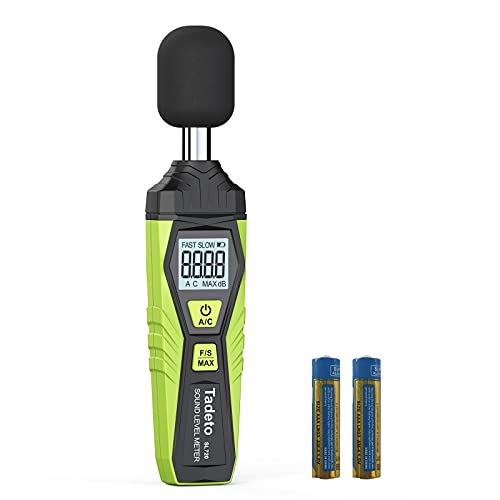
The Tadeto SL720 is the value pick for straightforward spot checks. It covers the same 30 to 130 decibel span as the TopTes and offers five selectable sub-ranges, which keeps the analog-style bar display working in a useful part of its scale. Both A and C weighting are on board, along with fast and slow response, MAX capture and data hold.
- Measurement range: 30 to 130 dB in five selectable sub-ranges
- Accuracy: Plus or minus 2.0 dB per the manual
- Frequency response: 31.5 Hz to 8 kHz
- Weighting: A and C, switchable
- Response: Fast and Slow
- Display: Backlit four-digit LCD with bar graph
- Resolution: 0.1 dB
- Power: 2 AAA batteries, included
- Extras: MAX reading hold, data hold, automatic shut-off
One honest note on the spec sheet: Tadeto’s own manual rates accuracy at plus or minus 2.0 decibels, even though some storefront copy quotes a tighter figure. Plan around the manual’s number and the SL720 still does its job well. It suits apartment noise logs, appliance comparisons and quick checks of fans, air conditioners and power tools, where knowing the level within a couple of decibels is enough to act on. The green variant is the one most commonly stocked.
3. RISEPRO HT-80A

The HT-80A is the simple pocket option. It strips the formula down to a single A-weighted measurement across 30 to 130 decibels, with MAX and MIN capture, data hold, a backlit display and automatic power-off. At roughly 116 grams it disappears into a jacket pocket or a toolbox tray, which makes it the meter most likely to actually be on hand when a noise question comes up.
- Measurement range: 30 to 130 dB
- Accuracy: Plus or minus 1.5 dB
- Resolution: 0.1 dB
- Weighting: A only
- Display: LCD with backlight
- Extras: MAX and MIN capture, data hold, low-battery indicator
- Power: 4 AAA batteries, not included
- Weight: About 116 grams
The limitations follow from the simplicity. A-weighting only means it understates low-frequency rumble from subwoofers, HVAC equipment and traffic, and there is no slow averaging mode for smoothing a fluctuating reading. For a landlord doing walk-through checks, a teacher watching classroom volume, or anyone who just wants a defensible number instead of a guess, it covers the basics at the lowest cost in this group.
4. Danoplus DP-441

The DP-441 is the pick when a single reading is not enough. It stores up to 43,000 measurements with timestamps, draws a live level graph on its color screen, and exports the log to a Windows computer over USB for spreadsheet review. A three-color alarm light shifts from green to yellow to red against limits you set, which makes it easy to leave running in a classroom, office or rental property and see at a glance whether levels stayed in bounds.
- Measurement range: 30 to 130 dB
- Accuracy: Plus or minus 1.5 dB
- Weighting: A and C
- Data logging: 43,000 records, viewable on the device
- Display: Color screen with live graph
- Alarm: Three-color indicator light with user-set limits
- Power: USB rechargeable battery
- Connectivity: USB to Windows PC, spreadsheet export, DC output
The trade-offs are software-side: the export tools are Windows only, and Danoplus states the accuracy figure itself rather than backing it with a formal standards class. For building a dated record for a landlord, a facilities file or a neighborhood noise dispute, though, logged evidence carries far more weight than a remembered number, and nothing else at this tier logs this much.
5. Extech 407730

Extech builds instruments for technicians, and the 407730 is the professional step up in this roundup. It measures 40 to 130 decibels on A weighting and 45 to 130 on C, with fast and slow response, a 2000-count display and an analog bargraph that refreshes every 40 milliseconds, fast enough to follow fluctuating machinery noise. Max Hold and Max/Min recording capture peaks during a test run, and an AC analog output lets it feed external recording or analysis equipment.
- Measurement range: 40 to 130 dB (A), 45 to 130 dB (C)
- Accuracy: Plus or minus 2 dB at 1 kHz under reference conditions
- Resolution: 0.1 dB
- Weighting: A and C
- Response: Fast (125 milliseconds) and Slow (1 second)
- Display: 2000-count LCD with 50 dB analog bargraph
- Output: AC analog output, tripod mount
- Microphone: Half-inch electret condenser, windscreen included
- Power: 4 AAA batteries, about 30 hours of use
- Extras: Max Hold, Max/Min recording, auto power-off after about 20 minutes
Facilities teams, safety officers doing preliminary surveys and serious hobbyists will appreciate the build and the stable readings. It costs more than the consumer meters here and still is not a certified Class 2 instrument, so formal compliance surveys need a calibrated meter with a certificate; Extech sells a NIST-traceable version of this model for workplaces that need documented calibration.
How to Choose
Start with weighting. A-weighting filters sound the way human hearing does and is the scale behind most noise rules, so it is the right default for neighbor noise, appliances and general checks. C-weighting keeps the low frequencies, which matters for subwoofers, engines, HVAC rumble and music. If your noise problem has a physical thump to it, insist on a meter with both, like the TS-501B, DP-441 or 407730.
Next, be realistic about accuracy. The meters here are rated between plus or minus 1.5 and 2 decibels, which is fine for comparisons and documentation but is not laboratory grade. None carries a certified IEC 61672 class rating, so for occupational compliance or legal evidence, budget for a calibrated Class 2 meter and a calibrator instead. Within this group, consistency matters more than the headline figure: the same meter, used the same way, gives comparable readings over time.
Then match features to the job. Data hold and MAX capture are enough for spot checks. Slow response smooths jumpy readings from traffic or crowds. If you need a record rather than a moment, logging is the deciding feature, and only the DP-441 offers it here. Finally, check the practical details: a backlit screen for dim rooms, a windscreen for outdoor use, and battery type, since AAA-powered meters are easier to keep running than rechargeable ones that may be flat when you need them.
Who Should Skip a Decibel Meter
Skip these meters if your readings have to stand up in a formal process. Workplace exposure surveys, court evidence and code enforcement call for a certified, recently calibrated instrument, and none of the five here replaces that. Skip the purchase entirely if you only need a rough sense of loudness once; a phone app is imprecise but adequate for deciding whether a party is louder than a vacuum cleaner. Skip the logging DP-441 if you will never connect it to a computer, and skip the A-only RISEPRO if bass noise is your whole problem.
Frequently Asked Questions
Are phone decibel apps accurate enough?
They are fine for rough comparisons, but phone microphones are designed for voice calls, vary widely between models and often clip at high levels. A dedicated meter uses a purpose-built microphone with a stated accuracy rating, so its readings are consistent from day to day, which is what makes a noise log or an appliance comparison meaningful.
What is the difference between A and C weighting?
A-weighting reduces low and very high frequencies to mimic human hearing, and most noise limits are written in A-weighted decibels. C-weighting keeps far more of the bass, so it reads higher on rumble from subwoofers, engines and ventilation systems. Comparing the two readings on the same noise tells you how much of it is low-frequency energy.
Can one of these meters support a noise complaint?
It can support your documentation: dated readings, especially logged ones from the DP-441, show a pattern rather than an impression. Enforcement officers, however, measure with their own calibrated equipment, so treat a home meter as evidence that a problem exists and a guide for when it happens, not as the deciding measurement.
Do decibel meters need calibration?
They drift slowly over time. Consumer meters like these are set at the factory and cannot be user-calibrated, which is acceptable for comparisons and logs. If your readings start to look inconsistent, compare the meter against a known steady source, and for any workplace program use a meter that supports an external acoustic calibrator check before each survey.
Final Verdict
The TopTes TS-501B is the decibel meter most people should buy: both weightings, a clear backlit screen, honest accuracy and a long warranty at a budget tier. Choose the Tadeto SL720 to spend less on simple spot checks, the RISEPRO HT-80A for a pocket meter that is always within reach, the Danoplus DP-441 when you need a logged, exportable record, and the Extech 407730 when you want technician-grade build and an analog output for more serious survey work.
Product and ASIN Reference
| Product | ASIN |
|---|---|
| TopTes TS-501B Sound Level Meter | B0B9BC4N2X |
| Tadeto SL720 Digital Sound Level Meter | B09G6HLNVV |
| RISEPRO HT-80A Decibel Meter | B01EZZ8B5Q |
| Danoplus DP-441 Data Logging Decibel Meter | B0DJT42M9K |
| Extech 407730 Digital Sound Level Meter | B000EWY67W |
More from Amazon
Programs that pair well with the guide above. Offers and eligibility are set by Amazon and may change.
Free shipping on eligible items, Prime Video and more. Eligible new members can start with a free trial.
Start a Prime free trialAudiobooks and podcasts to listen to on the go. Eligible new members can start with a free trial.
Try Audible freeAd-free music streaming. Eligible new subscribers can start with a free trial.
Try Music Unlimited freeA free business account with business pricing and bulk-buying tools for work, shop or home office.
Create a business accountAs an Amazon Associate we earn from qualifying purchases.