Key takeaways
- Analog conventional: Useful for VHF and UHF channels, but not enough for many current city and county systems.
- P25 Phase I: Common digital public-safety format and generally supported by modern digital scanners.
- P25 Phase II: More efficient two-slot TDMA operation; required for agencies using Phase II talkgroups.
- Trunking: The scanner follows a control channel and automatically changes frequencies as a conversation moves.
- Encryption: Unmonitorable by consumer scanners. Do not confuse a missing transmission with poor antenna performance.
The best police scanners in 2026 are the Uniden SDS100 for difficult digital systems and portable use, the Uniden SDS200 for a permanent desk or vehicle installation, and the Uniden BCD325P2 for a smaller, lower-cost scanner in areas that do not use simulcast-heavy networks.
Before buying, check your local public-safety system. A scanner can receive analog and many digital transmissions, but it cannot legally or technically decode encrypted talkgroups. Laws also vary by country, state, and municipality, particularly for scanner use in vehicles or while committing a crime.
Our top picks

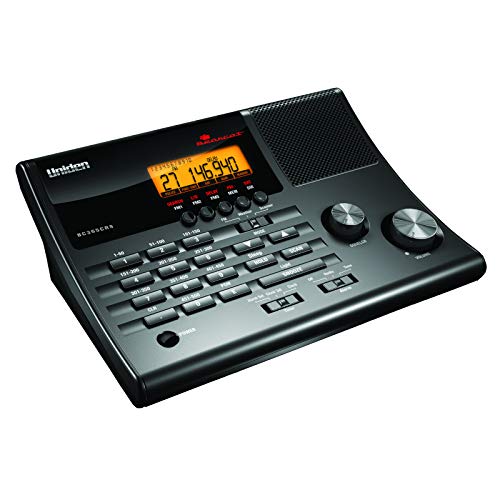

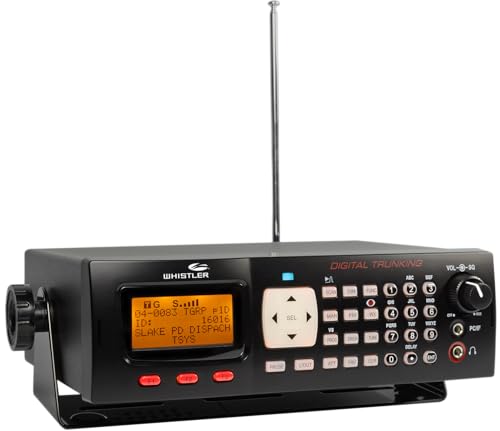
As an Amazon Associate we earn from qualifying purchases at no extra cost to you. Ratings are shown as listed on Amazon.
Best police scanners by situation
| Situation | Best fit | Why | Typical street-price range |
|---|---|---|---|
| Digital simulcast, travel, or uncertain system types | Uniden SDS100 | Software-defined receiver handles simulcast distortion better than conventional designs; GPS and location-based programming are available | $650–$750 |
| Home office, dispatch desk, or vehicle installation | Uniden SDS200 | Base/mobile design, Ethernet connectivity, large controls, and the same general digital-system compatibility as the SDS100 | $700–$800 |
| Analog and ordinary P25 systems on a budget | Uniden BCD325P2 | Compact handheld with Phase I and Phase II P25 support, trunking, and a lower purchase cost | $350–$450 |
| Whistler programming workflow or object-oriented scanning | Whistler TRX-1 | Portable digital scanner with a library-based setup and support for common analog and P25 systems | $400–$500 |
| Large antenna, fixed location, and extensive channel storage | Uniden BCD996P2 or SDS200 | Base/mobile form factor accepts external antennas and is easier to operate continuously | $450–$800 |
Uniden SDS100: best overall for difficult digital reception
The SDS100 is the safest choice when you do not know whether nearby agencies use a simulcast P25 network. Simulcast systems transmit the same signal from several towers at once. Conventional scanners can hear overlapping copies of that signal and produce garbled audio; the SDS100’s software-defined architecture is designed to reduce that problem.
It supports analog conventional channels, P25 Phase I and Phase II, and trunked systems. Its GPS receiver can activate and deactivate systems according to location, which is useful when traveling through several counties. The scanner is roughly 6 inches long and weighs about 1.4 pounds with its battery, so it is portable but not pocket-light.
The supplied rechargeable battery is commonly rated around 2,550 mAh. Realistic runtime is approximately 8–10 hours with ordinary scanning, and less when the display backlight, GPS, or weak-signal searching is used heavily. Carrying a spare battery or USB power bank is sensible for long monitoring sessions.
Limitations
The SDS100 costs substantially more than a basic analog scanner, and its many menu options can be intimidating. It is also not a universal solution: encrypted talkgroups remain unavailable, and an antenna upgrade cannot fix a fully encrypted channel.
Uniden SDS200: best fixed-location scanner
The SDS200 uses the same class of simulcast-focused receiver as the SDS100 but adds the advantages of a base/mobile chassis. It is about 7.3 inches wide, 5.7 inches deep, and roughly 1.7 inches high, with a weight near 2 pounds before accessories. A larger front panel makes frequent adjustments easier than on a handheld.
It is a strong choice for a home office, radio desk, or vehicle where continuous external power is available. Ethernet connectivity also makes it more practical for remote-control software and networked monitoring. The rear antenna connection allows a better outdoor or attic antenna than the small flexible antenna normally used with a handheld.
The trade-off is portability. The SDS200 needs a suitable power arrangement and is less convenient for walking, travel, or emergency carry. If you monitor only one nearby system from a desk, a less expensive scanner may provide similar results.
Uniden BCD325P2: best value when simulcast is not the problem
The BCD325P2 is a compact handheld that supports analog channels, P25 Phase I and Phase II, and trunked radio systems. It is approximately 5 inches tall and weighs about 10 ounces with batteries, making it easier to carry than the SDS models.
Its conventional receiver design can perform very well on single-site systems, ordinary repeater channels, and many non-simulcast networks. It also supports GPS-assisted location control when paired with a compatible GPS arrangement, although the overall experience is less modern than the SDS100’s integrated GPS and display.
This is the better financial decision when your local database shows conventional analog channels or a P25 network with one dominant tower. It is the wrong choice if nearby transmissions are consistently broken, robotic, or full of clipped syllables despite a strong signal—classic symptoms of simulcast distortion.
Digital versus analog compatibility
Analog scanners remain useful for aircraft, railroads, weather, utilities, amateur radio, and public-safety agencies that still use analog FM. However, many police and fire departments now rely on digital trunked networks. For new purchases, look for explicit support for P25 Phase I and Phase II trunking rather than simply “digital” on the box.
- Analog conventional: Useful for VHF and UHF channels, but not enough for many current city and county systems.
- P25 Phase I: Common digital public-safety format and generally supported by modern digital scanners.
- P25 Phase II: More efficient two-slot TDMA operation; required for agencies using Phase II talkgroups.
- Trunking: The scanner follows a control channel and automatically changes frequencies as a conversation moves.
- Encryption: Unmonitorable by consumer scanners. Do not confuse a missing transmission with poor antenna performance.
Why antenna performance matters more than advertised range
Scanner range is not a fixed number. Height, terrain, building materials, tower location, frequency, and antenna quality usually matter more than a manufacturer’s general coverage statement. A flexible handheld antenna is convenient, but a quarter-wave or tuned outdoor antenna can produce a major improvement at a fixed site.
For VHF-high channels around 155 MHz, a quarter-wave antenna is approximately 18 inches long. For UHF channels around 460 MHz, it is approximately 6.4 inches. These figures are starting points, not universal antenna specifications, because a broadband scanner may need to cover several bands.
Do not automatically buy the longest antenna. An antenna optimized for one band may overload the scanner with strong nearby signals or perform poorly elsewhere. In a city, a shorter antenna or attenuator can sometimes improve intelligibility by reducing interference. For a roof or attic installation, use low-loss coax, weatherproof connectors, proper grounding, and a lightning-protection plan.
Location-based programming and setup
Location programming is one of the biggest differences between an enjoyable scanner and a frustrating one. Uniden scanners can use the Sentinel software and the RadioReference database to select systems by ZIP code, service area, or GPS location. Whistler scanners use their own library-based programming workflow.
A reliable setup sequence
- Identify the local system. Search the relevant city or county in a current frequency database and note the system type, site frequencies, talkgroups, and encryption status.
- Confirm digital mode and trunking. A scanner supporting only analog FM will not follow a P25 trunked system.
- Update the database and firmware. Agencies change sites, talkgroups, and channel assignments. An old database can make a capable scanner appear defective.
- Load only nearby agencies first. A small favorites list makes troubleshooting easier and avoids stopping on distant or irrelevant traffic.
- Set location or range conservatively. A large range can fill the scan list with distant systems and make local calls seem infrequent.
- Test with the supplied antenna. Only then compare an aftermarket or external antenna, changing one variable at a time.
As a practical example, suppose a scanner scans 200 channels and pauses for 0.4 seconds on each active channel during a busy period. A full pass takes about 80 seconds before repeating. Removing irrelevant channels can reduce that cycle dramatically, so programming discipline can improve the apparent responsiveness more than buying a faster-looking model.
Battery life, durability, and ownership costs
Handheld scanner batteries are consumables. Expect capacity to decline after several hundred charge cycles, especially if the radio is routinely left hot in a vehicle. Keep a spare battery, avoid extreme heat, and use the correct charging method. A USB power bank is useful, but verify that the scanner supports the intended charging arrangement rather than assuming every USB port charges the battery.
The antenna connector, volume knob, keypad, belt clip, and display window are commonly stressed parts. Store the scanner in a case when traveling, do not use the antenna as a handle, and clean dust from the connector before attaching an external antenna. Moisture-resistant construction is helpful, but it does not make a scanner waterproof; protect it from rain, condensation, and salt air.
Final buying decision
Choose the SDS100 if you need a portable scanner and local P25 simulcast reception is uncertain. Choose the SDS200 for a permanent desk or vehicle installation, especially with an external antenna. Choose the BCD325P2 when the local system is compatible and non-simulcast, making its lower price and smaller size more valuable than advanced simulcast handling. Whistler’s TRX-1 remains worth considering if its programming ecosystem suits you and your local system is supported.
The best police scanners are not determined by channel count alone. Match digital and trunking support to your local system, use location-based programming to keep the scan list manageable, and treat the antenna and installation as part of the receiver rather than as optional accessories.