Key takeaways
- Small room up to 20 square metres: one Era 100, Move 2 or similar compact speaker is normally enough.
- Medium room from 20 to 40 square metres: use one Authentics 500, one Era 300 or two smaller speakers.
- Large open-plan room from 40 to 70 square metres: use two synchronized speakers or one large party speaker, positioned away from corners.
- Outdoor areas: choose a battery-powered speaker and plan for more output than indoors. Sound dissipates outdoors because walls do not reinforce bass.
The best smart speakers for parties are the JBL Authentics 500 for powerful indoor sound, the Sonos Move 2 for flexible indoor-outdoor use, and a pair of Sonos Era 300 speakers when wide stereo coverage matters more than portability.
Our top picks


As an Amazon Associate we earn from qualifying purchases at no extra cost to you. Ratings are shown as listed on Amazon.
Quick picks by party situation
| Party situation | Best fit | Why it works | Main compromise |
|---|---|---|---|
| Small room or apartment, 10–20 people | Sonos Era 100 | Compact, clear vocals, Wi-Fi and Bluetooth | Limited deep bass from one unit |
| Living room, 20–40 people | JBL Authentics 500 | High output, strong bass, Wi-Fi streaming and voice assistants | No built-in battery |
| Indoor-to-outdoor party | Sonos Move 2 | 24-hour battery, automatic tuning and IP56 protection | Not as loud or bass-heavy as a large party speaker |
| Large indoor space or backyard | JBL PartyBox Stage 320 | High volume, 18-hour battery and wide coverage | Large, heavy and less “smart” than Wi-Fi speakers |
| Immersive stereo listening | Two Sonos Era 300 speakers | Excellent stereo separation and room-filling spatial presentation | Expensive and intended mainly for sheltered indoor use |
What makes a speaker suitable for parties?
Maximum volume is only one part of the decision. A party speaker must maintain clean vocals and bass when several people are talking, cover a broad area without sounding harsh, and connect reliably when guests want to change music. Battery life, pairing options and protection from spills also matter more at a party than they do during ordinary listening.
Wi-Fi smart speakers generally offer better multi-room control, voice assistants and higher-quality streaming. Bluetooth party speakers are usually louder for the money and easier to use outdoors, but they may lack microphones, voice control and synchronized whole-home playback. The right choice depends on whether “smart” means voice control and multi-room audio, or simply convenient wireless music.
Best smart speakers for parties: detailed picks
JBL Authentics 500: best for loud indoor parties
The Authentics 500 is the strongest all-in-one choice for a living room, dining area or open-plan space. It has a three-way design with multiple drivers, Dolby Atmos support, Wi-Fi, Bluetooth and built-in voice assistant support. Its quoted 270-watt total output gives it considerably more headroom than compact smart speakers, while its dedicated bass drivers produce the low-end weight that party playlists need.
At about 44.5 cm wide and 9.5 kg, it is substantial but still manageable as a stationary speaker. It does not have a battery, so it needs to remain near a power outlet. That makes it unsuitable for a beach, garden or location where extension cables are inconvenient. For an indoor party of roughly 20 to 40 people, one unit can provide strong background-to-party volume in a medium-sized room. A second unit is preferable when the room is long, divided or crowded.
Sonos Move 2: best portable smart speaker
The Sonos Move 2 is the most balanced option for people who want one speaker that works in a kitchen, patio and living room. It supports Wi-Fi and Bluetooth, includes automatic room tuning, and offers up to 24 hours of battery life under stated conditions. Its IP56 rating protects against dust and powerful water jets, although it should not be treated as a waterproof speaker for swimming pools or heavy rain.
Move 2 weighs about 3 kg and is easy to carry using its integrated handle. Its bass is fuller than that of most compact smart speakers, but it cannot move as much air as a large PartyBox-style model. Use it for gatherings of up to around 20 people, or place two units at opposite ends of a patio for more even coverage. Sonos stereo pairing requires two compatible speakers on the same Wi-Fi system; two speakers usually sound better than one played at a higher volume.
Sonos Era 300: best for wide indoor coverage
The Era 300 is designed for room-filling sound rather than portability. Its angled drivers spread audio in multiple directions, and compatible content can use Dolby Atmos spatial audio. One speaker is a good choice for a medium room where guests move around, while a matched pair creates a much stronger left-right image.
Each Era 300 is roughly 26 cm wide and weighs about 4.5 kg. It has Wi-Fi and Bluetooth, but no battery, so it is an indoor, mains-powered product. Its wide dispersion helps when people are not sitting in one listening position, though a pair should be placed with space between them rather than side by side. Do not expect it to deliver the physical bass impact of a large party speaker without adding a Sonos subwoofer.
JBL PartyBox Stage 320: best for outdoor volume
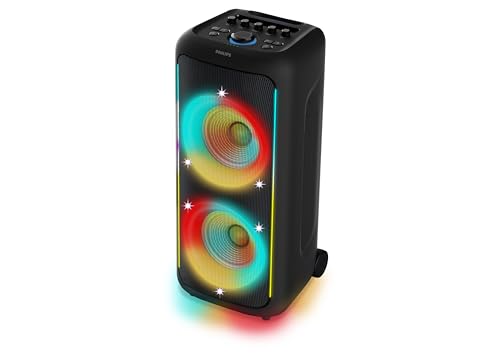
For a backyard, garage or larger gathering, the PartyBox Stage 320 is more suitable than most voice-assistant speakers. It offers up to 18 hours of quoted battery life, a built-in handle and wheels, Bluetooth connectivity, light effects and microphone or guitar inputs. Its IPX4 splash resistance helps with accidental splashes, but it is not dust-sealed and should be covered or moved indoors when weather changes.
The unit weighs approximately 16.5 kg, so it is portable in the practical sense rather than lightweight. Its output and bass are better suited to 30 or more people than compact smart speakers. It does not provide the same built-in Wi-Fi multi-room ecosystem as Sonos or the same voice-assistant experience as the Authentics range. Choose it when loudness and battery operation outrank hands-free control.
Room size, coverage and volume
Use the following as a planning guide rather than a precise laboratory limit:
- Small room up to 20 square metres: one Era 100, Move 2 or similar compact speaker is normally enough.
- Medium room from 20 to 40 square metres: use one Authentics 500, one Era 300 or two smaller speakers.
- Large open-plan room from 40 to 70 square metres: use two synchronized speakers or one large party speaker, positioned away from corners.
- Outdoor areas: choose a battery-powered speaker and plan for more output than indoors. Sound dissipates outdoors because walls do not reinforce bass.
Place speakers above floor level, with the front grille unobstructed. A corner can increase bass, but too much corner reinforcement often makes vocals muddy. For outdoor coverage, separate two speakers by several metres and reduce the volume of each rather than forcing one unit to its limit.
Battery life: a realistic calculation
Manufacturers quote battery life at moderate volume, often with lighting and heavy bass disabled. A useful planning rule is to budget for 60 to 75 percent of the headline figure. For example, an 18-hour party speaker may provide roughly 11 to 13.5 hours at louder party volume. If the event lasts six hours, that still leaves a reasonable margin; if it lasts all day, bring the charger or a replacement battery where the design supports one.
Cold temperatures, maximum bass, lighting effects and frequent Bluetooth reconnections can reduce runtime. Start with a full charge, disable light effects when they are unnecessary, and avoid leaving a battery speaker in direct sun or a freezing car.
Multi-speaker pairing: what to check
“Pairing” can mean several different things. Stereo pairing assigns left and right channels to two matching speakers. Party or broadcast mode sends the same mono or stereo program to multiple speakers. Wi-Fi multi-room systems usually synchronize more reliably than Bluetooth, particularly when speakers are spread through a house.
- For the best music image, use two identical speakers in stereo mode.
- For a long room or patio, use grouped speakers playing the same signal.
- Check whether pairing requires the manufacturer’s app, the same Wi-Fi network or a particular speaker generation.
- Do not assume different brands can synchronize without a third-party audio system.
- Test the group before guests arrive; firmware updates and Wi-Fi changes can interrupt setup.
Ownership details people often miss
The first parts to suffer are usually the grille, rubber feet, battery and charging port. Keep drinks on a separate surface, wipe dust from grilles with a dry or slightly damp cloth, and never use solvents on fabric or rubber. Do not charge a wet speaker, even if its exterior is water-resistant. IP ratings describe controlled testing conditions, not protection from every spill, pool dunk or storm.
Battery-powered models gradually lose capacity. Leaving a speaker permanently at 100 percent charge in a hot room can accelerate wear, while storing it completely empty for months can also cause problems. For seasonal use, store it cool and dry with a partial charge, then top it up before an event.
Final buying advice
Choose the JBL Authentics 500 if your party is mainly indoors and you want the strongest combination of bass, loudness and smart-home features. Choose the Sonos Move 2 when one portable speaker must move between rooms and outdoors. Choose two Era 300 speakers when wide indoor coverage and stereo immersion matter most. For a large outdoor gathering, the JBL PartyBox Stage 320 is the more practical answer, even though it is less intelligent in the smart-speaker sense.