Key takeaways
- Minimum pan diameter: many commercial units will not activate reliably with very small saucepans, often below about 4–5 inches.
- Effective heating diameter: a cooktop marketed for a 12-inch pan may concentrate most heat in a smaller central area.
- Maximum supported weight: include the pan, liquid, and food. A full stockpot can exceed the limit of a portable unit.
The best commercial induction cooktops are a 3,500-watt, 208–240-volt countertop unit for busy professional kitchens, a 1,800-watt 120-volt unit for light-duty service and mobile catering, or a built-in multi-zone system when several pans must be controlled at once.
For most restaurants, choose a commercial model with a stainless-steel body, a ceramic-glass cooking surface, at least 20 power settings, a temperature range of roughly 100–450°F (38–232°C), pan detection, overheat protection, and a serviceable cooling fan. The right choice depends less on the word “commercial” than on electrical capacity, peak workload, pan diameter, and whether the appliance will be moved daily.
Our top picks


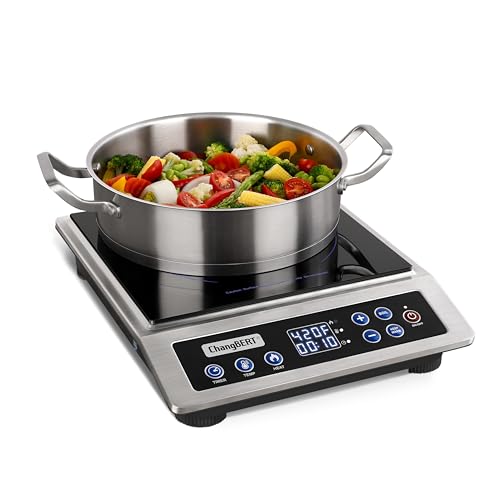

As an Amazon Associate we earn from qualifying purchases at no extra cost to you. Ratings are shown as listed on Amazon.
Best commercial induction cooktops by situation
| Kitchen situation | Best fit | Recommended specification | Why it suits the job |
|---|---|---|---|
| Food truck, pop-up, or occasional catering | Portable single-burner unit | 1,800W, 120V, 8–10-inch effective heating area | Works from a standard circuit and is easier to transport |
| Busy sauté or finishing station | High-output countertop unit | 3,000–3,500W, 208–240V, 10–12-inch heating area | Recovers heat faster and handles larger pans |
| Precise sauce, chocolate, or holding work | Temperature-controlled induction unit | 1,800–3,500W, low setting below 300W, probe or precise temperature modes | Reduces scorching and repeated manual adjustment |
| Several pans in a fixed line | Built-in multi-zone cooktop | Two to four zones, dedicated 208–240V circuit, flush installation | Provides a cleaner workflow and saves counter space |
| Institutional or high-volume kitchen | Heavy-duty modular induction range | 3,500–5,000W per zone, stainless chassis, replaceable controls and fans | Better suited to sustained service and planned maintenance |
Power output: watts matter, but recovery matters more
A 1,800-watt cooktop is adequate for boiling, reheating, single-pan sautéing, and demonstration cooking. Its practical limitation appears when a large cold pan or a substantial quantity of food is added: the surface temperature falls, and the unit needs time to recover.
A 3,000–3,500-watt unit is a better commercial baseline for continuous sautéing, wok-style work with a compatible flat-bottom pan, and boiling large pots. Some heavy-duty systems reach approximately 5,000 watts per zone, but that output normally requires hardwiring or a dedicated high-amperage circuit.
For a rough comparison, heating 8 liters of water from 60°F to 200°F requires about 2,950 kilojoules before accounting for losses. An ideal 1,800-watt burner would need approximately 27 minutes; a 3,500-watt burner would need about 14 minutes. Real times are longer because the pan, cookware base, and surrounding air absorb heat. This illustrates why higher wattage is valuable during rush periods even when the maximum temperature is similar.
Pan-size flexibility and cookware compatibility
Induction heats magnetic metal in the pan base, not the glass surface itself. A pan must contain iron or magnetic stainless steel and should have a flat, solid base. Aluminum, copper, glass, and most nonmagnetic stainless-steel pans will not work unless they have a magnetic base layer.
Check three dimensions before buying:
- Minimum pan diameter: many commercial units will not activate reliably with very small saucepans, often below about 4–5 inches.
- Effective heating diameter: a cooktop marketed for a 12-inch pan may concentrate most heat in a smaller central area.
- Maximum supported weight: include the pan, liquid, and food. A full stockpot can exceed the limit of a portable unit.
Large pans do not automatically receive even heat. If the induction coil is substantially smaller than the pan base, the center can brown while the edges remain cooler. For 10–12-inch sauté pans, select a unit with a similarly sized heating area or use a pan designed with a highly conductive, even base.
Commercial models from brands such as Vollrath, CookTek, Garland, and Hatco cover different combinations of portable, countertop, built-in, and high-output designs. Always compare the specified pan diameter and load rating rather than relying on the brand name alone.
Temperature control: power levels are not the same as temperature control
Basic induction cooktops regulate heat by cycling power on and off. This can work well for boiling and sautéing, but a low setting may pulse noticeably, which is less desirable for delicate emulsions, custards, or chocolate.
Look for separate controls for power and temperature, fine adjustment in small increments, and a low-output mode that remains stable without repeatedly boiling and stopping. Some commercial units accept a temperature probe or offer sensor-based control. These features are useful when a recipe must stay within a narrow range, but they do not eliminate the need to stir and monitor the food.
A practical control test is to ask whether the unit can do all three of these tasks:
- Bring a full pot to a boil without an excessive wait.
- Maintain a gentle simmer without repeated flare-ups.
- Hold a low temperature with an empty or nearly empty pan without triggering overheat protection.
Electrical requirements and installation
A 1,800-watt, 120-volt cooktop draws about 15 amps at maximum output, so it may consume the full capacity of a standard 15-amp circuit. Avoid sharing that circuit with a fryer, refrigerator, microwave, or other high-load appliance.
At 3,500 watts, a 240-volt unit draws about 14.6 amps; at 208 volts, it draws about 16.8 amps. The exact circuit, plug, breaker, and disconnect requirements depend on the model and local electrical code. A licensed electrician should confirm the installation before a high-output unit is placed into service.
Do not use an extension cord unless the manufacturer specifically permits it and the cord is correctly rated. In a permanent kitchen, hardwired or properly receptacled equipment is safer and less likely to suffer voltage drop. Leave clear space around ventilation openings: induction transfers heat efficiently to the pan, but its internal electronics and cooling fan still need airflow.
Safety features worth paying for
- Automatic pan detection: stops or reduces output when cookware is removed.
- Overheat protection: protects the electronics and cooking surface when airflow is blocked or a pan runs dry.
- Residual-heat indication: warns staff that the glass remains hot from the pan.
- Lockout controls: prevents accidental changes during service or cleaning.
- Low-voltage and fault monitoring: helps protect the unit from unsuitable power conditions.
- Non-slip feet or a secure mounting kit: reduces movement when a heavy pan is stirred.
Induction reduces open-flame and radiant-burn hazards, but it is not risk-free. The pan, food, steam, splashing oil, and glass surface can still cause burns. Staff should also know that a pan may remain hot after the unit stops heating.
Cleaning, durability, and ownership costs
The smooth glass surface is easier to clean than burner grates, but only if spills are handled before they bake onto the surface. Turn the unit off, allow it to cool, wipe away grease with a soft cloth, and use a manufacturer-approved glass cleaner for stubborn residue. Never flood the control panel or immerse a countertop appliance.
The parts most likely to wear first are cooling fans, touch controls, power switches, and the glass surface. Fan noise, intermittent shutdowns, error codes, and reduced output can indicate blocked ventilation or an aging fan. Keep flour, grease, and dust away from air intakes, and clean filters where the design provides them.
Do not slide cast-iron cookware across the glass, bang a stockpot onto it, or operate the unit with an empty pan at maximum power. These habits can scratch the surface, damage the coil assembly, or trigger thermal protection. A countertop unit also needs a dry, level surface; moisture entering through the underside is a common avoidable failure.
How to choose between 1,800W and 3,500W
Count the largest pan you use, the number of consecutive batches, and the available circuit. If service involves one pan at a time and the cooktop is moved regularly, 1,800W at 120V is usually the sensible compromise. If the unit will stay in a professional kitchen and must recover quickly between batches, the extra installation cost of 3,000–3,500W is often justified.
For example, a caterer using a burner for two 30-minute sessions per event may value portability more than peak output. A restaurant using it for six hours of sautéing may value recovery, fan durability, replaceable parts, and electrical stability more than a low purchase price. General market pricing ranges from roughly $100–$300 for basic portable commercial-style units, $400–$1,200 for stronger countertop equipment, and several thousand dollars for built-in or multi-zone commercial systems.
Bottom line
Choose a 1,800W, 120V portable cooktop for light service and mobile work; a 3,000–3,500W, 208–240V countertop model for demanding single-pan production; and a built-in multi-zone system for a permanent line. Whichever format you select, prioritize the correct pan diameter, dedicated electrical supply, stable low-temperature control, accessible ventilation, and replacement-part support. Those details have more effect on daily reliability than maximum wattage alone.