Key takeaways
- USB: Most reliable and cheapest. Best for a single fixed terminal where the printer sits next to the register or tablet. Every model above offers USB.
- Ethernet (LAN): Essential if you share one printer between two or more terminals or want stable kitchen/bar printing without Bluetooth dropouts. It also allows longer cable runs up to 100 meters.
- Wi-Fi / Wireless LAN: Ideal for mPOP or tablet-based setups with no Ethernet port, and for pop-up or market stalls. Requires stable router; avoid if your shop Wi-Fi is congested.
- Bluetooth: Common for iPad POS with Square or Shopify. Range is typically 10 meters. Choose Bluetooth Low Energy models for better tablet battery life.
- Cloud / USB-C & Lightning: Printers like the Star mC-Print series support direct iOS connection via Lightning/USB-C and Star CloudPRNT for online ordering integration. Useful if you print orders from Uber Eats or Shopify online directly.
The best receipt printers for most small businesses in 2026 are 80mm thermal models like the Epson TM-T88VII and Star Micronics TSP100III for high-volume retail, and compact 58mm thermal printers like the Star Micronics mC-Print2 or Epson TM-T20III for cafes, mobile setups and tight counters, with impact printers only needed if you must print duplicate carbon-copy receipts.
Our top picks

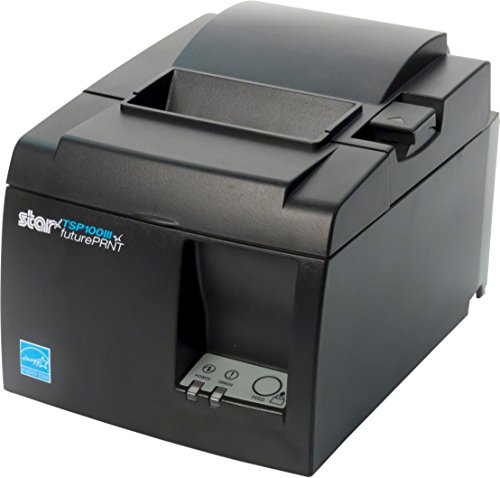

As an Amazon Associate we earn from qualifying purchases at no extra cost to you. Ratings are shown as listed on Amazon.
Thermal vs. Impact: Which Technology Fits Your Business?
Choosing between thermal and impact is the first decision because it affects cost, noise, and what you can print.
Thermal Printers (Direct Thermal)
Thermal printers use heat to print on chemically coated paper. They have no ink ribbon to replace, print quietly at 200-300mm per second, and produce crisp logos, barcodes and QR codes. The trade-off is that they require thermal paper, which can fade if stored in heat or direct sunlight for more than 6-12 months, and they cannot create duplicate copies on carbonless paper.
For 95% of retail, coffee shops, restaurants, salons and quick-service businesses, direct thermal is the right choice. It is faster, cheaper to run, and more reliable.
Impact Printers (Dot Matrix)
Impact printers like the Epson TM-U220 use a ribbon and pins to physically strike the paper. They are loud, slower at around 4-6 lines per second, and limited to basic text. Their single advantage is printing on multi-part carbonless forms – original plus one or two copies at once. If you run a kitchen with heat-resistant two-ply tickets, an auto repair shop that needs a customer copy and a file copy, or any operation that legally requires a press-printed duplicate, you need impact. For everyone else, thermal will save money and counter space.
Spec Comparison: Top Receipt Printers for Small Business
These models represent the most common choices for retail and hospitality POS systems in 2026 and are widely compatible with Square, Shopify POS, Lightspeed, Clover and traditional Windows-based POS software.
| Model | Printing Method / Width | Max Print Speed | Roll Size | Connectivity | Auto Cutter Life |
|---|---|---|---|---|---|
| Epson TM-T88VII | Thermal / 80mm | 500mm/sec | 83mm max diameter | USB, Ethernet, Wi-Fi, Bluetooth options | 3.0 million cuts |
| Star Micronics TSP100III | Thermal / 80mm | 250mm/sec | 83mm max diameter | USB, LAN, WLAN, Bluetooth | 2.0 million cuts |
| Epson TM-T20III | Thermal / 80mm | 250mm/sec | 83mm max diameter | USB + Ethernet or USB + Serial | 1.5 million cuts |
| Star Micronics mC-Print3 (MCP31) | Thermal / 58mm & 80mm | 250mm/sec | 83mm max diameter | USB, Lightning, Bluetooth, Ethernet | 2.0 million cuts |
| Bixolon SRP-350plusV | Thermal / 80mm | 400mm/sec | 83mm max diameter | USB, Serial, Ethernet | 1.8 million cuts |
| Epson TM-U220B | Impact Dot Matrix / 76mm | 4.7 lines/sec | 83mm max diameter | USB, Serial, Ethernet | 1.5 million cuts |
Key takeaway: 80mm thermal printers at 250mm/sec or faster will print a standard 15cm receipt in under one second. The Epson TM-T88VII’s 500mm/sec speed only matters if you regularly print long receipts with logos and promo codes during rush periods – otherwise 200-250mm/sec is indistinguishable to customers.
How to Choose: Connectivity, Print Speed and POS Compatibility
1. Connectivity Options
- USB: Most reliable and cheapest. Best for a single fixed terminal where the printer sits next to the register or tablet. Every model above offers USB.
- Ethernet (LAN): Essential if you share one printer between two or more terminals or want stable kitchen/bar printing without Bluetooth dropouts. It also allows longer cable runs up to 100 meters.
- Wi-Fi / Wireless LAN: Ideal for mPOP or tablet-based setups with no Ethernet port, and for pop-up or market stalls. Requires stable router; avoid if your shop Wi-Fi is congested.
- Bluetooth: Common for iPad POS with Square or Shopify. Range is typically 10 meters. Choose Bluetooth Low Energy models for better tablet battery life.
- Cloud / USB-C & Lightning: Printers like the Star mC-Print series support direct iOS connection via Lightning/USB-C and Star CloudPRNT for online ordering integration. Useful if you print orders from Uber Eats or Shopify online directly.
2. Print Speed vs. Reality
Manufacturers list maximum speed in mm per second, but effective throughput includes data processing and cutting time. For a 200mm receipt:
- 250mm/sec printer: ~0.8 sec print + 0.4 sec cut = ~1.2 seconds total
- 500mm/sec printer: ~0.4 sec print + 0.4 sec cut = ~0.8 seconds total
Over 100 transactions per hour, the faster printer saves about 40 seconds. That matters for grocery or high-volume QSR, but not for a boutique or salon where you print 20-30 receipts per day.
3. Roll Size and Paper Cost
Most 80mm printers accept rolls up to 83mm diameter. This equals about 65-85 meters of paper. A 58mm printer uses narrower rolls, typically 50-55 meters.
80mm paper costs slightly more per roll but gives you more printable area for logos, return policies and larger fonts. 58mm saves 25-30% on paper width and allows a smaller printer footprint (often 30% smaller in volume), which is valuable for food trucks and compact counters.
4. POS Compatibility
Before buying, confirm the printer is on your POS provider’s certified hardware list. Square and Shopify POS certify Star Micronics and Epson thermal models with specific interfaces (e.g., Shopify requires Ethernet or Bluetooth Star Micronics for iPad). Traditional Windows POS with drivers supports ESC/POS, the Epson command standard that nearly all thermal printers emulate. If you use a cloud-based iPad system, prioritize LAN or Bluetooth models that support ESC/POS or StarPRNT emulation to avoid driver issues.
Decision Matrix: Which Printer Fits Your Situation?
| Your Situation | Best Fit | Why |
|---|---|---|
| High-volume retail, supermarket, busy cafe (100+ receipts/day) | 80mm high-speed thermal: Epson TM-T88VII or Bixolon SRP-350plusV via Ethernet | Fastest speed, longest cutter life, shared network access |
| Small boutique, salon, low-volume shop (<50 receipts/day) | Budget 80mm thermal: Epson TM-T20III or Star TSP100III USB/Ethernet | Lowest ownership cost, reliable without overpaying for speed |
| iPad / tablet POS, Square or Shopify | Star Micronics TSP100III Bluetooth or mC-Print3 | Certified MFi/Bluetooth for iOS, easy setup without drivers |
| Tight counter, food truck, mobile business | Compact 58mm thermal: Star mC-Print2 | Smallest footprint, lower paper cost, front paper loading |
| Kitchen, auto shop needing duplicate copies | Impact printer: Epson TM-U220 | Only option for pressure-sensitive duplicate/two-ply slips |
Worked Calculation: True Cost Per Receipt
Hardware price is a general market range of $180 to $550 for thermal and $280 to $400 for impact, but consumables determine long-term cost. Here is a realistic cost per receipt for a cafe printing 80 receipts per day, 300 days per year (24,000 receipts):
Thermal 80mm example: A case of 30 rolls (80mm x 80m) costs roughly $45-$65. Each 80m roll yields about 380-420 receipts averaging 19cm long. That is ~12,000 receipts per case. Annual paper need is 2 cases = $90-$130. Ribbon cost is $0. Add electricity at under $5 per year. Cost per receipt is $0.0038 to $0.0054.
Impact example: Paper: 76mm plain rolls about $35-$50 per case of 30, yielding similar count. Ribbon: Epson ERC-38 ribbon rated for ~3-4 million characters, or about 4,000-5,000 receipts, and costs $8-$14. Annual ribbon need is 5-6 ribbons = $40-$84. Total consumables $75-$134 per year. Cost per receipt is $0.0031 to $0.0056, but you also absorb more downtime for ribbon changes and more frequent head cleaning.
Over three years, a $250 thermal printer plus $270-$390 in paper totals $520-$640. An impact printer totals a similar amount but is slower and louder. Unless you need duplicates, thermal has the lowest friction cost.
Durability and Ownership: What Actually Wears Out
Receipt printers are low-maintenance, but these are the failure points small businesses encounter:
- Thermal print head: Rated for 100-200 km of paper, or roughly 500,000-800,000 receipts. It fails gradually with faded vertical lines. Running cheap, dusty paper or failing to clean the head accelerates wear. Clean monthly with isopropyl alcohol and a cleaning card or swab.
- Auto cutter: Rated for 1.5 to 3 million cuts. A shop doing 100 cuts per day will hit 1.5 million cuts after about 40 years, but paper dust and adhesive labels from sticker rolls can jam the blade in months. Never use adhesive liner paper unless the printer is rated for it, and avoid pulling paper backward.
- Paper dust and humidity: Dust is the main enemy. It coats the sensor and head, causing misfeeds and light printing. Keep spare rolls sealed and store them below 30C and under 65% humidity. In kitchens, grease vapor coats the head faster – wipe weekly.
- Common mistakes: Using 58mm rolls in an 80mm printer without the divider guide causes the roll to wander and jam. Forcing a USB cable longer than 3 meters causes dropouts – switch to Ethernet for long runs. Leaving an impact ribbon in for more than 6 months dries the ink and wears the pins even if print looks normal.
For longevity, choose a model with a front-loading paper bay and jam-release lever, and enable the printer’s energy-saving sleep mode to extend head life when idle overnight.
Setup Checklist Before You Buy
- Measure your counter depth. Compact models are about 125-145mm wide vs. standard 145-180mm. Allow 100mm behind for paper roll change.
- Confirm your POS software’s required interface. If the list says Ethernet/Star CloudPRNT only, a USB-only model will not appear on the network.
- Decide on 58mm vs 80mm based on receipt content. If you print barcodes for returns or large loyalty QR codes, stick with 80mm for scan reliability.
- Order one extra roll size divider and an isopropyl cleaning kit with the printer to avoid emergency orders.