Key takeaways
- Whether the product may be applied over remaining rust and also over clean steel.
- Whether sanding, rinsing, or wiping is required after conversion.
- Which primers and topcoats are explicitly approved, especially epoxy and catalyzed urethane products.
The best rust converters for classic cars are Corroseal for broad, economical panel work, Eastwood Rust Converter for controlled DIY restoration, and Rust-Oleum Rust Reformer for small repairs; the right choice depends more on rust depth and the coating that follows than on the brand name.
Our top picks
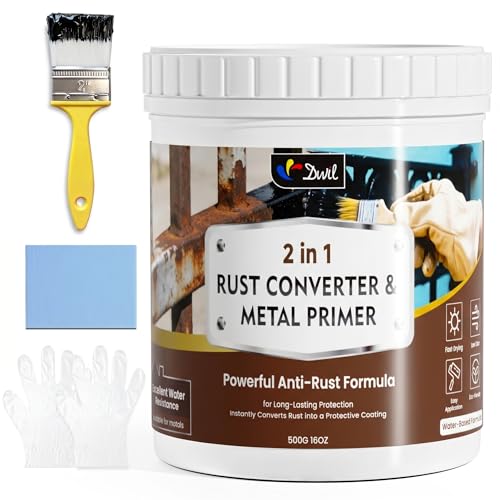


As an Amazon Associate we earn from qualifying purchases at no extra cost to you. Ratings are shown as listed on Amazon.
Quick comparison: leading rust converters
| Product | Active approach | Common package sizes | Approximate coverage | Typical dry or cure window | Best use |
|---|---|---|---|---|---|
| Corroseal Rust Converter | Water-based tannic-acid converter with polymer coating | 16 fl oz, 1 gal | About 200–250 sq ft/gal | Touch-dry roughly 1–4 hours; allow about 24 hours before demanding topcoats | Large areas of firmly attached surface rust |
| Eastwood Rust Converter | Water-based rust-converting polymer coating | Quart and gallon sizes are commonly available | About 100–125 sq ft/gal, depending on application | Usually several hours to dry; overnight curing is prudent before paint | Classic-car panels, frames, and controlled brush application |
| Rust-Oleum Rust Reformer | Water-based converter that forms a black protective coating | 10.25 oz aerosol, 8 fl oz and 1 qt liquid formats | Aerosol coverage is commonly up to about 15 sq ft per can | Dry in approximately 15 minutes to 1 hour; recoat timing varies by format | Small brackets, seams, wheel wells, and spot repairs |
| Loctite Extend Rust Treatment | Acid-based rust neutralizer and protective film | 8 fl oz, 1 qt, and gallon formats vary by market | Roughly 100–150 sq ft/gal as a planning range | Often blackens within minutes; allow several hours before painting | Localized rust where rapid chemical reaction matters |
Coverage and drying figures are planning values, not guarantees. Pitted metal absorbs more product, low temperatures slow water evaporation, and thick applications take substantially longer to become paint-ready. Always use the label for the exact package in your region.
How the chemistry changes the result
Water-based tannic-acid and polymer converters
Products such as Corroseal and many versions of Eastwood Rust Converter react with iron oxide and leave a dark polymer-rich film. They are relatively easy to brush, have modest odor, and suit large panels when rust is evenly distributed. Their weakness is that they do not make loose scale structurally sound. Any flaky corrosion left underneath can later lift the converter and the paint above it.
Acid-based treatments
Phosphoric-acid-style treatments, including products sold as rust neutralizers or metal-preparation solutions, convert some iron oxide into more stable iron phosphate. They can work quickly and are useful in seams and small areas, but residue control is more important. Excess liquid must be removed according to the instructions, and the metal must be completely dry before primer. Acid treatments are not a substitute for cutting out perforated metal.
Spray versus liquid application
An aerosol is convenient for brackets and awkward cavities, but it is expensive per square foot and easy to apply too thinly. Brush-on liquid gives better control on broad panels and lets you work the product into pits. A pump sprayer can be useful for large chassis parts only if its seals are compatible with the chemistry and it is cleaned immediately afterward.
Best choice by restoration situation
| Your situation | Most sensible choice | Why |
|---|---|---|
| First restoration, small rust spots, minimal equipment | Rust-Oleum Rust Reformer aerosol or liquid | Simple application, easy availability, and suitable package sizes reduce waste |
| Several doors, floors, or frame sections with stable surface rust | Corroseal or Eastwood Rust Converter in quart or gallon size | Lower cost per treated area and better brush control |
| Deep pits but no holes after aggressive cleaning | Thick liquid converter, followed by a compatible epoxy primer | Liquid reaches irregular surfaces more reliably than a quick aerosol pass |
| Blistering, perforation, swollen seams, or thin metal | None as a permanent repair; cut, weld, or replace metal | Converter can hide corrosion temporarily but cannot restore lost steel |
| Parts that will receive a specific coating system | Choose the converter approved by that primer or paint manufacturer | Adhesion and solvent compatibility matter more than theoretical coverage |
Surface rust versus deeper corrosion
Surface rust is orange or brown oxidation with solid metal underneath. After wire-brushing, scraping, or abrasive blasting, the remaining rust is thin and tightly attached. This is the ideal application for a converter.
Deep corrosion produces pits, layered scale, swollen seams, and often rust on the opposite side of the panel. A converter can stabilize the oxide in the pits, but it cannot fill them, rebuild panel thickness, or stop corrosion trapped between overlapping pieces. On a structural frame, suspension mount, brake component, or seat-belt anchorage, have the area assessed by a qualified automotive professional.
Do not apply converter over grease, undercoating, silicone, loose scale, or damp metal. “Bare metal compatible” also needs careful interpretation: most converters require some rust to react with, while a completely clean steel area may need a different metal-preparation or epoxy-primer procedure.
Application method that prevents most failures
- Expose the full repair area. Remove trim, seam sealer, underseal, and paint far enough beyond the visible rust to reveal its edge.
- Remove unstable corrosion. Use a scraper, wire wheel, abrasive disc, or blasting media. Stop when the remaining rust is firmly bonded and the surrounding steel is sound.
- Degrease without leaving residue. Use the cleaner specified by the product system. Avoid touching prepared metal with bare fingers.
- Control moisture and temperature. Aim for a dry surface above the product’s minimum temperature, commonly around 50°F/10°C. Avoid application when condensation is likely.
- Apply a thin, complete coat. Flooding pits with a thick layer can trap water and extend cure time. A second coat is preferable when the label allows it.
- Inspect after the reaction. A dark, even finish usually indicates coverage; bright orange islands, powdery scale, or missed pits require additional preparation and treatment.
- Prime only when fully cured. Use the recommended primer. If the surface remains tacky, cool, or soft, it is not ready for paint.
Worked coverage calculation: when a gallon is worthwhile
Imagine treating two floor pans measuring 4 by 3 feet each, plus a transmission tunnel measuring 5 by 2 feet. The nominal area is 34 square feet. Add 25% for edges, pits, overlaps, and waste: 34 × 1.25 = 42.5 square feet.
A gallon rated at 200 square feet theoretically leaves substantial product for later work. A 16-ounce container is one-eighth of a gallon, so its nominal coverage is about 25 square feet at that rating—less than this job requires. For the example, a quart or gallon is more practical than several small aerosol cans. The calculation changes if the panels are heavily pitted or the product requires two coats.
Paint readiness and topcoat compatibility
Converter films are not automatically universal primers. Some accept enamel or chassis paint directly; others call for primer first, and some are incompatible with two-component coatings unless completely cured and lightly abraded. Check three points before buying:
- Whether the product may be applied over remaining rust and also over clean steel.
- Whether sanding, rinsing, or wiping is required after conversion.
- Which primers and topcoats are explicitly approved, especially epoxy and catalyzed urethane products.
For a visible exterior panel, a converter is usually only one stage: corrosion removal, converter, compatible epoxy primer, filler where appropriate, surfacer, and paint. For a hidden frame area, a converter followed by a suitable chassis coating may be sufficient if the metal is sound and the system is compatible.
Ownership realities and common mistakes
The first thing that usually fails is not the chemical conversion but the preparation underneath it. Rust returns at seams, drain holes, folded flanges, and the back side of panels where abrasive tools cannot reach. Inspect both sides whenever possible, and keep drain paths open.
- Do not apply over loose scale and expect the black color to prove the repair worked.
- Do not leave water-based converter exposed as the final finish on a weather-exposed classic car.
- Do not pour unused product back into a contaminated container.
- Clean brushes and sprayers immediately; dried polymer can ruin them.
- Wear eye protection, gloves, and suitable respiratory protection for dust, solvent, and spray conditions.
- Buy enough for the whole job. Stopping halfway can leave untreated seams exposed to humidity.
Verdict
Choose Corroseal when coverage and economical treatment of broad, stable surface rust are the priorities. Choose Eastwood Rust Converter when you want a restoration-oriented liquid for careful brush work on panels or chassis parts. Choose Rust-Oleum Rust Reformer for small, accessible repairs where a convenient aerosol or small bottle matters. Consider an acid-based treatment such as Loctite Extend when its preparation and topcoat instructions fit your repair system.
For perforated or structurally weakened metal, the best rust converter is no converter: remove the damaged steel and repair the panel first. Conversion chemistry can stabilize sound metal with residual surface oxidation, but it cannot reverse corrosion that has already destroyed the car’s material.