Key takeaways
- For a compact sofa: Choose a C-shaped or slim square table about 35–45 cm wide and 45–60 cm deep. It can tuck beside or partly under the sofa without blocking the walkway.
- For a standard armchair: A round or square table 45–55 cm wide is usually more stable than a very narrow pedestal table, especially if you place a lamp or mug on it.
- For a low modern sofa: Look for a table 40–50 cm high rather than a conventional 55–65 cm model. The tabletop should not tower over the seat.
- For a bedside table: Match the top to the mattress height, usually within about 5 cm. Include a drawer or enclosed shelf if you need to hide chargers, glasses, or medication.
- For a small apartment: Prioritize a narrow footprint, vertical storage, and a base that can slide under seating. IKEA’s compact occasional-table range includes several useful space-saving formats, while Umbra makes small tables with more decorative silhouettes.
- For frequent everyday use: Choose a weighted base, a moisture-resistant top, and cable routing rather than a lightweight decorative stool.
The best side tables are sized to sit within easy reach without crowding the room: aim for a tabletop level with the sofa or chair cushion, keep bedroom tables roughly level with the mattress, and choose a footprint that leaves clear walking space around the furniture.
Our top picks

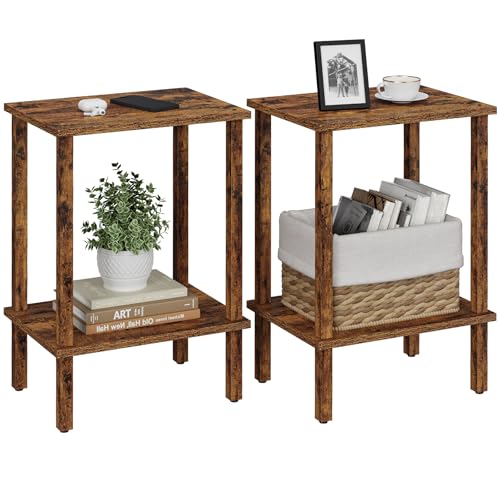


As an Amazon Associate we earn from qualifying purchases at no extra cost to you. Ratings are shown as listed on Amazon.
Quick picks by room and situation
- For a compact sofa: Choose a C-shaped or slim square table about 35–45 cm wide and 45–60 cm deep. It can tuck beside or partly under the sofa without blocking the walkway.
- For a standard armchair: A round or square table 45–55 cm wide is usually more stable than a very narrow pedestal table, especially if you place a lamp or mug on it.
- For a low modern sofa: Look for a table 40–50 cm high rather than a conventional 55–65 cm model. The tabletop should not tower over the seat.
- For a bedside table: Match the top to the mattress height, usually within about 5 cm. Include a drawer or enclosed shelf if you need to hide chargers, glasses, or medication.
- For a small apartment: Prioritize a narrow footprint, vertical storage, and a base that can slide under seating. IKEA’s compact occasional-table range includes several useful space-saving formats, while Umbra makes small tables with more decorative silhouettes.
- For frequent everyday use: Choose a weighted base, a moisture-resistant top, and cable routing rather than a lightweight decorative stool.
How tall should a side table be?
Measure from the floor to the top of the sofa cushion, chair cushion, or mattress. The ideal side-table surface is generally level with that measurement, or up to 5 cm lower. A table that is much lower forces you to lean; one that is substantially higher makes drinks, lamps, and books easier to knock over.
For a sofa, also measure the arm height. If the table is beside an armrest, a top close to the arm height creates a visually balanced arrangement and makes it easier to reach. If the table needs to slide over the seat, its underside must clear the cushion and arm structure. Allow at least 2–3 cm of clearance rather than relying on a nominal dimension.
For a bed, measure to the top of the mattress, not the bed frame. A 55 cm table beside a 65 cm mattress may be acceptable for a lamp, but it is less convenient for a phone or glass of water. Adjustable tables are useful when the bed height may change.
Best side tables compared by specification
| Table type | Typical size | Typical weight | Useful storage | Best use | Common compromise |
|---|---|---|---|---|---|
| Round pedestal | 45–55 cm diameter; 50–65 cm high | 4–10 kg | None or lower shelf | Armchairs and open seating areas | Can tip if the base is small or heavily loaded at the edge |
| Square drawer table | 40–55 cm wide; 40–55 cm deep; 50–65 cm high | 8–18 kg | One drawer plus shelf or cabinet | Bedside use and everyday sofa storage | Uses more floor area and needs drawer clearance |
| C-shaped table | 30–45 cm wide; 40–60 cm deep; 55–70 cm high | 3–9 kg | Usually none | Small rooms and laptop or snack use | Less stable when the top is loaded far from the base |
| Nesting tables | Large table 45–60 cm wide; smaller table 30–45 cm wide | 6–16 kg per set | Additional tabletop space | Guests and flexible layouts | More pieces to move and store |
| Storage ottoman table | 40–60 cm wide; 40–60 cm deep; 40–50 cm high | 6–15 kg | About 15–40 litres internally | Soft seating areas and concealed storage | Usually less suitable for hot drinks unless a rigid tray is added |
Choose the footprint before the style
A side table needs both its own footprint and a practical clearance zone. In a walkway, leave roughly 60 cm for comfortable passage; 45 cm is a tight minimum in a lightly used area. For a table beside a sofa, allow at least 5–10 cm between the table and upholstery so the frame, drawer, or tabletop edge does not rub.
Use this simple fit calculation: measure the available wall-to-walkway width, then subtract the desired clearance. For example, if the gap beside a sofa is 72 cm and you want 10 cm beside the sofa plus 50 cm for passage, the maximum table depth is 12 cm. That rules out a conventional bedside-style table and points to a slim C-table or wall-mounted shelf instead.
Do not judge footprint by the tabletop alone. A wide pedestal may look compact but still occupy a broad base, while a narrow-leg table may have a small base yet wobble under an uneven load. Check the largest dimension at floor level and the location of the feet.
Storage, materials, and cable management
Storage
Open shelves are convenient for books and baskets but visibly accumulate clutter. Drawers are better for remotes, cables, and personal items, although shallow drawers can waste space. A cabinet keeps the room neater but requires door swing clearance. For a bedside table, one drawer plus an open lower shelf is often more useful than two shallow drawers.
Tabletop materials
- Solid wood: Warm, repairable, and durable, but it can show water rings and may expand or contract with humidity. Use coasters and wipe spills promptly.
- Wood veneer: Offers a real-wood surface over a stable engineered core. It resists movement better than a wide solid-wood panel, but damaged veneer is difficult to patch invisibly.
- Laminated engineered board: Affordable and easy to clean. The vulnerable areas are exposed edges and swollen joints after prolonged water contact.
- Tempered glass: Visually light and resistant to ordinary moisture, but fingerprints are conspicuous and the edges can chip from hard impacts.
- Metal: Strong and easy to wipe down. Powder coating can eventually scratch, particularly where objects slide or a table rubs against a wall.
- Stone or ceramic: Excellent for heat and moisture resistance, but heavy. Verify that the frame is designed for the top’s weight before moving it.
For a lamp, books, and drinks, a useful target is at least 10 kg of evenly distributed capacity. If a table lists only a very low load rating, treat it as decorative furniture rather than a daily-use surface.
Cable management
Look for a rear cutout, an integrated cable channel, or a gap between the back panel and wall. A 25–35 mm cable opening accommodates most charging leads and lamp cords without forcing a sharp bend. Cable holes should have a smooth edge or a grommet; raw particleboard edges can abrade insulation over time.
For a bedside table, place the cable route toward the wall-side rear corner. For a sofa table, a side or rear opening is preferable because it prevents cords from crossing the walking path. Avoid routing cables through a drawer unless the table is specifically designed for it.
Decision matrix: which type fits your situation?
| Your priority | Recommended format | Target specification | Why it fits |
|---|---|---|---|
| Under £75 or equivalent | Open shelf or laminated-board table | 8–12 kg; 40–50 cm wide | Simple construction keeps cost down and limits failure points |
| Very limited floor space | C-shaped or wall-mounted table | 30–40 cm wide; 15–30 cm floor depth | Preserves walking clearance and can tuck under furniture |
| Frequent moving or rearranging | Light nesting or pedestal table | Under 8 kg per piece; rubber feet | Easier to reposition without damaging flooring |
| Children, pets, or heavy daily use | Low, wide four-leg table | At least 45 cm wide; 10 kg or more | Lower centre of gravity and greater resistance to tipping |
| Maximum concealment | Drawer-and-cabinet table | 20–30 cm internal storage depth | Keeps chargers and small objects out of sight |
Assembly and stability checks that matter
Assembly quality often determines whether a side table feels premium or irritating. Tighten all fasteners loosely at first, square the frame on a flat floor, and only then fully tighten them. If you tighten one corner before aligning the others, the frame can lock slightly out of square and wobble.
- Identify the load-bearing joints, usually where legs meet the top or lower frame.
- Install every screw by several turns before tightening any screw fully.
- Check that diagonal corner measurements are equal if the table has a rectangular frame.
- Place the table on its intended floor surface before making final adjustments.
- Add felt or rubber pads only after confirming that the wobble is not caused by a loose joint.
Test stability by pressing gently down on each corner, then place a typical load in the centre and near the edge. A table that rocks only when a heavy object is placed at the edge may be acceptable for books, but not for a lamp or a drink. Locking casters, adjustable feet, and a broad lower base are useful where floors are uneven.
Ownership costs and maintenance
Price is only part of the decision. A budget table in the general £30–£75 range may be sensible for occasional use, while a more substantial wood, metal, stone, or well-finished veneer table may cost roughly £100–£400 or more. Estimate cost per use before choosing: a £60 table used five times a week for three years provides about 780 uses, or approximately 8 pence per use before replacement. A £250 table used daily for ten years provides about 3,650 uses, or roughly 7 pence per use. The more expensive option can make sense when its finish, stability, and repairability are materially better.
Dust with a soft cloth and clean spills with a lightly damp cloth; do not saturate joints or leave standing water on veneer, laminate edges, or unfinished wood. Use coasters under drinks and felt pads under ceramics. The parts most likely to wear first are drawer runners, exposed veneer edges, cable grommets, and screw joints loosened by repeated movement. Re-tighten fasteners after several weeks, then inspect them every six to twelve months.
Common mistakes include choosing a table by height alone, ignoring drawer clearance, placing a heavy lamp on a narrow C-table, and assuming a stone top is automatically stable. Measure the furniture, walking route, and cable path first. That small amount of planning usually matters more than selecting between similar colours or finishes.