Key takeaways
- Best for most families: Pit Barrel Cooker Classic. Its hanging system uses the vertical space efficiently, and its fixed intake design reduces the learning curve. It is particularly good for ribs, chicken, pork shoulder, and brisket portions. The trade-off is limited fine adjustment: it is less convenient when you want to hold a narrow temperature range or switch rapidly between smoking and grilling.
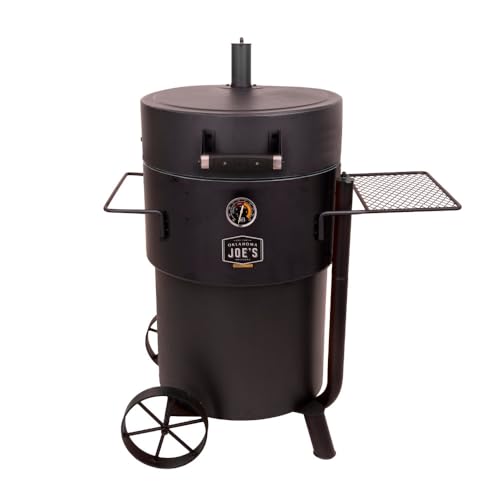
- Best conventional drum smoker: Oklahoma Joe’s Bronco. The Bronco behaves more like a traditional charcoal smoker, with an adjustable intake, exhaust, water-pan arrangement, and a cooking grate. That makes it easier to tune for different foods. It is heavy, but the wheels and cart-style design are more practical than carrying a lightweight drum across uneven ground.
- Best for large backyard parties: Oklahoma Joe’s Bronco Pro. Its additional cooking levels and larger body make it a better fit for several pork shoulders, a full brisket, or mixed foods. Choose it only if you have a permanent or semi-permanent location; its size makes storage and moving considerably harder.
- Best for airflow control: Hunsaker Vortex Drum Smoker. The vortex system distributes heat around the diffuser and lets the cook regulate oxygen with a controllable intake. It is a strong option for someone who already understands charcoal management and wants repeatable adjustments rather than a set-and-forget cooker.
- Best heavy-duty option: Gateway Drum Smoker. Gateway models are aimed at frequent cooking and high-volume barbecue. Their price is difficult to justify for occasional use, but the robust construction, large grate, and competition-oriented accessories make sense for caterers, clubs, and dedicated enthusiasts.
Best Drum Smokers for Backyard Barbecue
The Pit Barrel Cooker Classic is the best all-around drum smoker for most backyards, while the Oklahoma Joe’s Bronco Pro is the better choice for larger cooks, the Hunsaker Vortex Drum Smoker suits cooks who want precise airflow control, and a Gateway Drum Smoker is the serious high-capacity option.
Drum smokers are attractive because they combine the efficient fuel use of a vertical cooker with a relatively small footprint. Their differences matter, however: a thin steel drum may heat quickly but lose temperature in cold or windy weather, while a heavier insulated design holds a steady temperature at the cost of greater weight and a longer warm-up. The right choice depends less on maximum rack count than on how often you cook, how much food you prepare at once, and how much adjustment you want during a long barbecue.
Our top picks


As an Amazon Associate we earn from qualifying purchases at no extra cost to you. Ratings are shown as listed on Amazon.
Quick comparison of the leading drum smokers
| Model | Cooking area or capacity | Construction and airflow | Typical weight | Typical market range | Best for |
|---|---|---|---|---|---|
| Pit Barrel Cooker Classic | 18.5-inch barrel; about 8 racks of ribs hanging | 18-gauge steel drum; intake holes and exhaust vent | About 30 lb | $350–$500 | Simple, efficient family cooks |
| Oklahoma Joe’s Bronco | 284 sq in grate; 21-inch drum | Heavy-gauge steel; adjustable intake and exhaust | About 140 lb | $450–$600 | Versatile backyard cooking |
| Oklahoma Joe’s Bronco Pro | About 1,260 sq in across multiple levels | Heavy-gauge steel; multi-position airflow controls | About 180 lb | $700–$900 | Large cooks and entertaining |
| Hunsaker Vortex Drum Smoker | 55-gallon format; commonly supplied with a 22-inch grate | Heavy steel; vortex diffuser and adjustable intake | Roughly 100–120 lb, depending on configuration | $700–$1,000 | Temperature control and hanging meat |
| Gateway Drum Smoker | 55-gallon format; typically a 22-inch grate | Heavy steel; adjustable intake and exhaust | Roughly 110–140 lb, depending on model | $1,000–$1,500 | Frequent cooks and competition-style volume |
Capacity figures are not directly interchangeable. A grate-area number describes flat cooking space, whereas a hanging-rib count takes advantage of the drum’s vertical interior. Exact weight and included accessories vary by package and production year, so check the current specification sheet before ordering.
Our picks by cooking situation
- Best for most families: Pit Barrel Cooker Classic. Its hanging system uses the vertical space efficiently, and its fixed intake design reduces the learning curve. It is particularly good for ribs, chicken, pork shoulder, and brisket portions. The trade-off is limited fine adjustment: it is less convenient when you want to hold a narrow temperature range or switch rapidly between smoking and grilling.
- Best conventional drum smoker: Oklahoma Joe’s Bronco. The Bronco behaves more like a traditional charcoal smoker, with an adjustable intake, exhaust, water-pan arrangement, and a cooking grate. That makes it easier to tune for different foods. It is heavy, but the wheels and cart-style design are more practical than carrying a lightweight drum across uneven ground.
- Best for large backyard parties: Oklahoma Joe’s Bronco Pro. Its additional cooking levels and larger body make it a better fit for several pork shoulders, a full brisket, or mixed foods. Choose it only if you have a permanent or semi-permanent location; its size makes storage and moving considerably harder.
- Best for airflow control: Hunsaker Vortex Drum Smoker. The vortex system distributes heat around the diffuser and lets the cook regulate oxygen with a controllable intake. It is a strong option for someone who already understands charcoal management and wants repeatable adjustments rather than a set-and-forget cooker.
- Best heavy-duty option: Gateway Drum Smoker. Gateway models are aimed at frequent cooking and high-volume barbecue. Their price is difficult to justify for occasional use, but the robust construction, large grate, and competition-oriented accessories make sense for caterers, clubs, and dedicated enthusiasts.
What matters when comparing drum smokers
Cooking capacity
For a family of four, a single 18- to 21-inch grate is usually enough. A 12-pound brisket may occupy most of that surface, while ribs can be hung vertically or cut into sections. If you routinely cook for 10 or more people, prioritize multiple levels or hanging capacity rather than a single oversized grate. A larger drum also gives more clearance for a whole brisket and reduces the need to cook in batches.
Remember that capacity falls when you use a water pan, diffuser, rib racks, or disposable trays. Ask whether the advertised area includes every tier or only the main grate.
Steel thickness and heat retention
Steel thickness is one of the least consistently reported specifications in this category. Many budget drums use relatively thin 18-gauge steel, approximately 0.05 inch thick. Heavy-gauge commercial-style drums may use steel around 14 gauge, approximately 0.075 inch, or thicker components in the lid and base. The difference is modest on paper but noticeable in wind, winter temperatures, and long cooks.
Thicker steel does not automatically mean better barbecue. It increases weight and warm-up time, and a well-sealed thin drum can be more efficient than a poorly fitted heavy one. Inspect the lid fit, door seals, welds, ash pan, and cooking-grate support before focusing on gauge alone.
Airflow control and temperature stability
A drum smoker needs enough intake air to keep charcoal burning cleanly, but every extra opening is a potential leak. Adjustable intake valves are useful for bringing the cooker down to a target temperature and compensating for weather. A fixed-intake design is easier to operate but may require choosing the correct number of lit coals and avoiding unnecessary lid opening.
For stable cooking, look for a tight lid, a separate exhaust vent, an intake that can be closed nearly completely, and a diffuser or heat shield that prevents direct radiant heat from scorching the food. Temperature stability also improves when the charcoal basket keeps the fire compact and off the bottom of the drum.
Fuel efficiency
A typical 18- to 21-inch drum can often run a low-and-slow cook for roughly 8 to 14 hours on one charcoal basket, depending on weather, target temperature, charcoal type, and lid openings. Larger drums may consume more fuel, but their bigger baskets can provide longer unattended cooking. These are useful planning ranges, not guarantees.
As a practical example, suppose a cooker burns 8 pounds of charcoal during a 10-hour brisket cook. At a charcoal cost of $1.25 per pound, fuel costs about $10. If the same cooker burns 11 pounds because its lid leaks or the fire is repeatedly adjusted, the cost rises to about $13.75 per cook. The larger expense is usually time and food risk, so a well-sealed lid and predictable airflow are worth more than a small difference in purchase price.
Assembly time and ownership trade-offs
A basic Pit Barrel-style cooker may take 15 to 30 minutes to assemble because there are few parts. Cart-mounted models such as the Bronco commonly take 45 to 90 minutes, mainly because of wheels, handles, shelves, and hardware. Large commercial-style drums may take an hour or more, particularly when installing the charcoal basket, diffuser, thermometer, and accessory brackets.
Before the first cook, wash removable grates and accessories, check every fastener, and perform a short seasoning burn. The purpose is to remove manufacturing residue and coat bare interior surfaces with smoke and cooking oils. Do not coat a galvanized or unknown-metal interior with cooking oil; use a purpose-built smoker with a food-safe cooking chamber.
What wears out first
- Gaskets and lid seals: Heat and grease eventually harden them, causing uncontrolled air leaks.
- Cooking grates: Scraping and wet storage can remove porcelain coating or encourage rust on bare steel.
- Intake and exhaust hardware: Ash and grease can make sliding vents or threaded valves difficult to move.
- Charcoal baskets and diffusers: These experience the highest heat and may warp before the drum does.
- Thermometers: Built-in dial gauges can drift; verify one with a separate, known-accurate probe at grate height.
Empty ash only after the cooker is completely cold, keep ash dry, and avoid leaving a drum uncovered in rain. A cover protects paint and hardware, but it should not trap condensation against the metal. Never use a drum made from an unknown industrial container, especially one that may have held chemicals or petroleum products.
Bottom line
Choose the Pit Barrel Cooker Classic if you value low fuss, efficient fuel use, and hanging capacity. Pick the Oklahoma Joe’s Bronco if adjustable airflow and conventional grate cooking matter more than portability. Move up to the Bronco Pro for large gatherings, or select a Hunsaker or Gateway when precise airflow control and frequent heavy use justify the higher cost. For most backyard cooks, a tightly sealed 18- to 21-inch drum with a controllable intake offers the best balance of capacity, stability, fuel efficiency, and ownership effort.