Key takeaways
- Removable plates are the biggest convenience upgrade. They let you soak or wash the cooking surface without exposing the electrical housing to water.
- Nonstick coating wears first. Scratching, aerosol cooking sprays, abrasive sponges, and overheating an empty press shorten its life. Use silicone, wood, or heat-safe plastic tools.
- Hinge and latch parts take mechanical stress. Do not force the lid shut over a sandwich that is too tall. Let the hinge close naturally.
- Melted cheese is easier to remove while warm. Unplug the press, wait until it is safe to handle, then wipe residue with a damp soft cloth. Never submerge the appliance body.
- Grease channels need attention. Crumbs and oil collect around plate edges and underneath removable inserts, where a quick surface wipe will not reach.
The best panini presses for most kitchens are the Breville Sear & Press for adjustable height and thick sandwiches, the Cuisinart Griddler Elite for versatility and removable plates, and a compact 4-slice clamshell press for lower-cost everyday use.
Our top picks

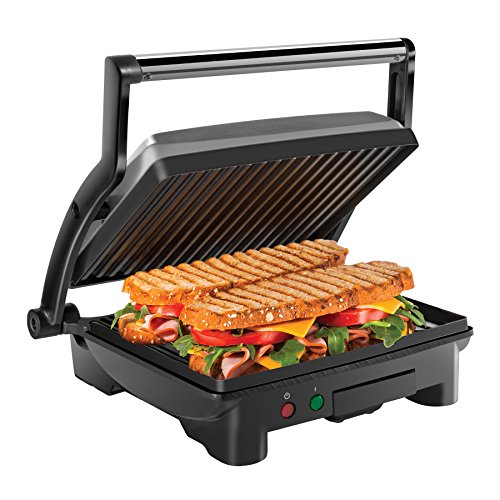


As an Amazon Associate we earn from qualifying purchases at no extra cost to you. Ratings are shown as listed on Amazon.
Best panini presses at a glance
| Pick | Best for | Cooking area | Power | Plate and hinge features | Typical price range |
|---|---|---|---|---|---|
| Breville Sear & Press | Thick, uneven sandwiches | About 11 x 9 inches | 1,800W | Removable ribbed plates; adjustable-height floating hinge | $180–$250 |
| Cuisinart Griddler Elite | Panini, grilling, and griddling | About 11 x 9 inches | 1,800W | Reversible removable plates; adjustable hinge; opens flat | $150–$220 |
| Hamilton Beach 4-Slice Panini Press | Value and family-size sandwiches | Roughly 10 x 8 inches | About 1,200W | Floating lid; fixed cooking plates on common versions | $35–$70 |
| Compact 2-slice clamshell press | Small kitchens and occasional use | About 8 x 6 inches | 700–1,000W | Fixed nonstick plates; limited hinge travel | $25–$60 |
Cooking areas and specifications vary by model revision, so check the manufacturer’s current dimensions before buying. The useful comparison is not wattage alone: plate coverage, heat recovery, hinge movement, and cleanup determine whether a press makes consistently crisp sandwiches or merely warms them.
Our picks by situation
| Your situation | What to choose | Why |
|---|---|---|
| You make panini several times a week | Breville Sear & Press | Strong heat, an accommodating hinge, and removable plates reduce frustration during repeated use. |
| You want one appliance for sandwiches and grilling | Cuisinart Griddler Elite | Reversible plates and a flat-opening design make it more flexible than a dedicated press. |
| You need four modest sandwiches at once | Large 4-slice clamshell press | A wider cooking surface improves throughput without requiring a full countertop griddle. |
| You have limited storage and make one sandwich at a time | Compact 2-slice press | It costs less and occupies less space, but sacrifices plate removal and thick-sandwich clearance. |
| You dislike hand-washing appliances | Press with dishwasher-safe removable plates | Being able to remove the plates is more useful than a slightly higher maximum temperature. |
Breville Sear & Press: best for uneven or thick sandwiches
The Breville Sear & Press is the strongest choice when your fillings are substantial: sourdough, roast vegetables, chicken, mozzarella, or a sandwich with several layers. Its floating hinge can rise over the food rather than forcing the top plate to press one side harder than the other. That matters because a rigid hinge can crush the front edge while leaving the back edge barely toasted.
The ribbed plates produce grill marks and allow some rendered fat or moisture to move away from the bread. The cooking surface is large enough for two generous sandwiches or several smaller ones. Removable plates also make it easier to clean around melted cheese, although you still need to wipe the appliance body and hinge by hand.
Its main drawbacks are size, weight, and price. A press in this class typically weighs around 13 to 15 pounds and needs a stable storage location. The ridges are attractive, but flat plates would provide more evenly browned contact across the whole slice. Choose it for performance and clearance, not for the smallest footprint.
Cuisinart Griddler Elite: best multifunction option
The Cuisinart Griddler Elite is the better head-to-head choice if panini are only one part of your cooking routine. Its removable reversible plates can provide ribbed and flat surfaces, and the appliance opens flat for a larger grilling area. You can use it for pressed sandwiches, burgers, vegetables, or pancakes instead of leaving a dedicated panini maker idle between uses.
That versatility comes with more parts to store and more surfaces to clean. Reversible plates must be seated correctly, and grease can collect around their edges. Its hinge is suitable for ordinary panini, but a very tall sandwich may still need to be assembled with restraint. For regular use, the ability to remove the plates is a major ownership advantage.
If you want one appliance rather than separate cookware, the Griddler Elite offers better value than comparing its price with a basic sandwich press. If you only make one thin ham-and-cheese sandwich occasionally, its extra functions and storage requirements are unnecessary.
Budget 4-slice presses: the practical compromise
A Hamilton Beach 4-Slice Panini Press or a similar large clamshell model is the sensible budget choice for households that want two sandwiches ready together. These presses commonly offer around 1,200 watts and a cooking area near 10 by 8 inches. They are less expensive than premium models and usually heat quickly enough for bread, sliced cheese, and moderate fillings.
The compromise is control. Fixed plates are harder to deep-clean, and many budget presses have only a basic ready light rather than precise temperature settings. Heat recovery can also be slower: after cold bread is added, the plates may lose enough heat that the second batch browns more slowly than the first. Leave a little space between sandwiches and avoid opening the lid repeatedly.
For thin, evenly filled sandwiches, these models are usually adequate. For ciabatta, thick focaccia, or fillings that vary greatly in height, spend more on a floating hinge.
Why plate size and hinge design matter
A stated “four-slice” capacity does not mean four large bakery slices. Estimate usable coverage by measuring the interior plate, not the outside of the appliance. A 10-by-8-inch plate provides 80 square inches of theoretical area, but borders and hinge clearance reduce the practical space. Two 5-by-4-inch sandwiches fit comfortably; four large 5-by-5-inch sandwiches will overlap or extend beyond the best-heated zone.
Hinge adjustment is equally important. A floating hinge allows the top plate to remain broadly parallel with a thick sandwich. A height lock or adjustable stop is useful when you want gentle contact rather than compression. If the hinge does not move, keep fillings below the hinge’s natural clearance and use ingredients that soften with heat rather than tall, loose stacks.
Ribbed plates drain some moisture and create grill marks, while flat plates brown more continuous surface area. For maximum crispness, select plates that are metal with a durable nonstick coating, and avoid using metal utensils that scratch the coating.
Heat recovery and crispness
Wattage is a rough indicator of heating capacity, not a guarantee of sandwich quality. A 1,800-watt press generally recovers heat faster than a 750-watt compact unit, especially when making several sandwiches consecutively. Temperature control, plate mass, and how tightly the lid contacts the food matter too.
For a crisp result, preheat fully, use bread that is dry on the outside, and apply butter or oil sparingly to the exterior. Wet fillings release steam and soften bread. Place cheese between ingredients rather than directly against the plate when possible; this reduces leakage and cleanup. After adding a cold sandwich, expect the first minute to be mostly reheating. Opening the lid during that period releases heat and lengthens the cooking time.
Cleanup, durability, and ownership realities
- Removable plates are the biggest convenience upgrade. They let you soak or wash the cooking surface without exposing the electrical housing to water.
- Nonstick coating wears first. Scratching, aerosol cooking sprays, abrasive sponges, and overheating an empty press shorten its life. Use silicone, wood, or heat-safe plastic tools.
- Hinge and latch parts take mechanical stress. Do not force the lid shut over a sandwich that is too tall. Let the hinge close naturally.
- Melted cheese is easier to remove while warm. Unplug the press, wait until it is safe to handle, then wipe residue with a damp soft cloth. Never submerge the appliance body.
- Grease channels need attention. Crumbs and oil collect around plate edges and underneath removable inserts, where a quick surface wipe will not reach.
For occasional use, a compact fixed-plate press is economical if you accept careful wiping. For weekly or daily use, removable dishwasher-safe plates can justify a higher purchase price. As a simple ownership calculation, a $180 press used twice weekly for three years costs about $0.58 per use before electricity; a $45 press used twice monthly over the same period costs about $0.29 per use. The cheaper appliance is not better value if difficult cleanup causes you to stop using it.
What to buy
Choose the Breville Sear & Press for the most reliable handling of thick, uneven sandwiches. Choose the Cuisinart Griddler Elite when reversible plates and flat-opening grilling make the appliance useful beyond panini. Choose a large budget clamshell press for simple family lunches, and a compact 2-slice model only when countertop and storage space matter more than flexibility.
Whichever type you choose, prioritize a hinge that accommodates your usual bread, plates large enough for your portions, fast heat recovery, and a cleaning method you will actually use. Those details have more effect on crisp, even sandwiches than a long list of preset programs.