Key takeaways
- Find the best camera lenses for portraits, travel, and everyday shooting. Compare five primes and zooms across Canon, Nikon, and Sony mounts.
As an Amazon Associate, we earn from qualifying purchases.
Short Answer
For most photographers, the best camera lens is the Canon EF 50mm f/1.8 STM: light, sharp, and bright enough for portraits and low light. Nikon DX shooters should start with the AF-S DX NIKKOR 35mm f/1.8G. Sony portrait shooters will get the most from the FE 85mm f/1.8. The Sigma 18-35mm f/1.8 Art suits APS-C shooters who want zoom flexibility with a fast aperture; the Tamron 28-75mm f/2.8 Di III VXD G2 covers nearly everything on a Sony full-frame body.
Table of Contents
- Short Answer
- How to Choose a Camera Lens
- 1. Canon EF 50mm f/1.8 STM Lens
- 2. Nikon AF-S DX NIKKOR 35mm f/1.8G Lens
- 3. Sony FE 85mm f/1.8 Lens
- 4. Sigma 18-35mm f/1.8 DC HSM Art Lens
- 5. Tamron 28-75mm f/2.8 Di III VXD G2 Lens
- A Note on Availability
- FAQ
- Conclusion
- Product and ASIN Reference
How to Choose a Camera Lens
A lens matters more than the camera body for most of the look of a photograph. The body records the image, but the lens decides how much light reaches the sensor, how sharp the details are, and how the background melts away behind a subject. Choosing well starts with the mount: a Canon EF lens fits Canon DSLRs, a Nikon F lens fits Nikon DSLRs, and a Sony E lens fits Sony mirrorless bodies. Mounts are not interchangeable without an adapter, so matching the mount to the camera you already own is the first filter.
The next choice is prime versus zoom. A prime has one fixed focal length, but the trade is a wider aperture, a smaller body, and usually sharper optics for the money. A zoom covers a range of focal lengths, which suits travel and events, but a constant-aperture zoom costs and weighs more than a kit zoom. Most photographers end up with one of each.
Focal length shapes the picture. A 35mm lens sees roughly what the human eye sees on a full-frame camera and behaves like a 50mm lens on a crop-sensor body. A 50mm lens is the classic all-rounder, while an 85mm lens is the portrait standard. A 28-75mm zoom spans wide-angle to short telephoto in one barrel. Aperture matters too: a lens marked f/1.8 gathers far more light than a kit zoom starting at f/3.5, giving faster shutter speeds indoors and softer backgrounds. Finally, consider weight: a heavy lens that stays in the bag is worse than a lighter lens that is always on the camera.
1. Canon EF 50mm f/1.8 STM Lens

The Canon EF 50mm f/1.8 STM is the lens most Canon DSLR owners should buy first. It is the classic “nifty fifty”: a compact prime with a bright f/1.8 aperture that makes portraits glow and indoor shots possible without a flash. On a full-frame body it sees the world much as the human eye does, and on an APS-C body it behaves like a short telephoto around 80mm, which is ideal for headshots. The stepping motor focuses quickly and quietly, which matters for video as well as stills.
Image quality is the reason this lens has stayed popular for a decade. The seven-blade circular aperture renders smooth, round background blur, and the lens is sharp in the center even wide open, improving further as you stop down. It is not a luxury lens: there is no image stabilization, no weather sealing, and no lens hood in the box. At about five and a half ounces it disappears on the camera.
Specs
- Focal length: 50mm (80mm equivalent on APS-C)
- Maximum aperture: f/1.8; minimum aperture: f/22
- Lens construction: 6 elements in 5 groups
- Aperture blades: 7, circular
- Minimum focusing distance: 1.15 ft (0.35 m); maximum magnification: 0.21x
- Angle of view: 46 degrees diagonal, 40 degrees horizontal, 27 degrees vertical
- Filter size: 49mm
- Autofocus: Stepping Motor (STM) with full-time manual override
- Weight: 5.6 oz (159 g); dimensions approx. 2.7 x 1.5 in
- Mount: Canon EF; model 0570C002
2. Nikon AF-S DX NIKKOR 35mm f/1.8G Lens
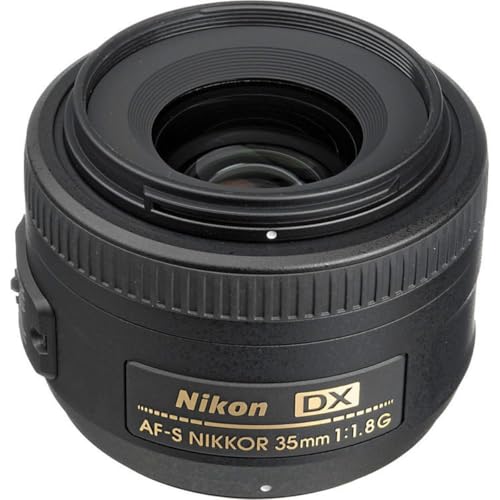
The Nikon AF-S DX NIKKOR 35mm f/1.8G is the everyday prime for Nikon DX DSLRs, filling the same role for Nikon shooters that the Canon 50mm fills for Canon owners. On a DX body its 35mm focal length behaves like a 50mm lens on full frame, which is the most versatile angle of view there is: wide enough for street scenes and interiors, tight enough for portraits and detail work. The f/1.8 aperture gathers plenty of light for dim restaurants, evening walks, and indoor events, and the rounded seven-blade diaphragm keeps out-of-focus highlights soft and natural.
Handling is a strong point. The Silent Wave Motor focuses quickly and almost silently, the lens weighs just over seven ounces, and a rubber seal around the mount helps keep dust and moisture out. Nikon includes the bayonet hood, a snap-on front cap, a rear cap, and a soft case in the box. Minimum focus is just under a foot, so close-ups are easy.
Specs
- Focal length: 35mm (52.5mm equivalent on DX)
- Maximum aperture: f/1.8; minimum aperture: f/22
- Aperture blades: 7, rounded
- Minimum focusing distance: 0.98 ft (0.3 m)
- Angle of view: 44 degrees with DX format
- Filter size: 52mm
- Autofocus: Silent Wave Motor (AF-S) with manual override
- Coating: Super Integrated Coating; rubber mount seal
- Weight: 7.05 oz (200 g); dimensions approx. 70 x 52.5 mm
- Mount: Nikon F (DX); model 2183; includes HB-46 hood, LC-52 cap, LF-1 rear cap, CL-0913 soft case
3. Sony FE 85mm f/1.8 Lens

The Sony FE 85mm f/1.8 is the portrait lens most Sony full-frame owners should buy before considering the far heavier and costlier f/1.4 options. Eighty-five millimeters is the classic portrait focal length: it flatters faces, compresses the background, and gives a comfortable working distance between photographer and subject. The f/1.8 aperture and nine-blade circular diaphragm produce smooth, creamy background blur, while the ED glass element keeps chromatic aberration under control for crisp edges and clean contrast.
Despite its full-frame coverage, the lens stays compact at about thirteen ounces, which keeps an A7-series body balanced for a full day of shooting. A customizable focus hold button on the barrel is handy for locking focus during a portrait session, and the dust and moisture resistant design adds confidence outdoors. Autofocus is driven by a double linear motor system that is fast and quiet.
Specs
- Focal length: 85mm
- Maximum aperture: f/1.8; minimum aperture: f/22
- Aperture blades: 9, circular
- Minimum focusing distance: 2.63 ft (0.8 m); maximum magnification: 0.13x
- Angle of view: 29 degrees
- Filter size: 67mm
- Autofocus: Double linear motor; customizable focus hold button
- Construction: ED glass element; dust and moisture resistant design
- Weight: 13.1 oz (371 g)
- Mount: Sony E; model SEL85F18/2; includes ALC-SH150 hood, ALC-F67S front cap, ALC-R1EM rear cap
4. Sigma 18-35mm f/1.8 DC HSM Art Lens

The Sigma 18-35mm f/1.8 DC HSM Art is a lens with no real rival: it is the first zoom for APS-C cameras to hold a constant f/1.8 aperture across its whole range. A Canon APS-C shooter gets wide-angle to normal coverage with the same bright aperture a prime would offer, in a single lens. At 18mm it handles landscapes and interiors; at 35mm it covers portraits and street photography. The five SLD glass elements and seventeen-element design keep sharpness high across the frame, and the Hyper Sonic Motor focuses quickly and quietly with full-time manual override.
The trade for that speed is size and weight. At about 1.8 pounds this is the heaviest lens in this roundup, and it is built for APS-C sensors, so it is not the right choice for a full-frame body. It is also a lens that rewards calibration: the fast aperture and shallow depth of field mean focus accuracy matters.
Specs
- Focal length: 18-35mm (28.8-56mm equivalent on APS-C)
- Maximum aperture: f/1.8 constant; minimum aperture: f/16
- Lens construction: 17 elements in 12 groups, including 5 SLD elements
- Minimum focusing distance: 11 in (28 cm); maximum magnification: 0.23x
- Angle of view: 76.5 to 44.2 degrees
- Filter size: 72mm
- Autofocus: Hyper Sonic Motor (HSM) with full-time manual focus
- Format: APS-C; USB Dock compatible
- Weight: 1.78 lb (810 g); dimensions approx. 4.76 x 3.07 x 3.07 in
- Mount: Canon EF; model 210101
5. Tamron 28-75mm f/2.8 Di III VXD G2 Lens

The Tamron 28-75mm f/2.8 Di III VXD G2 is the one-lens answer for Sony full-frame owners who want a fast standard zoom without the weight of a pro 24-70mm. Its constant f/2.8 aperture stays bright from wide angle to short telephoto, which keeps shutter speeds up indoors and backgrounds soft at the long end. The second-generation design is sharper than the original, especially at the edges, and the VXD linear motor focuses fast enough for moving subjects and quiet enough for video.
Close-up ability is a pleasant surprise. The lens focuses down to about seven inches at the wide end, with a maximum magnification ratio of 1:2.7, which is close enough for flowers, food, and detail shots that most standard zooms cannot manage. At about nineteen ounces it is noticeably lighter than competing f/2.8 zooms, and moisture-resistant construction helps it shrug off drizzle.
Specs
- Focal length: 28-75mm
- Maximum aperture: f/2.8 constant; minimum aperture: f/22
- Lens construction: 17 elements in 15 groups
- Aperture blades: 9
- Minimum focusing distance: 7.1 in (0.18 m) at 28mm; maximum magnification: 1:2.7
- Angle of view: 75 degrees 23 minutes to 32 degrees 11 minutes
- Filter size: 67mm
- Autofocus: VXD linear motor; Tamron Lens Utility support
- Construction: Moisture-resistant; fluorine coating
- Weight: 19 oz (540 g); length approx. 4.6 in
- Mount: Sony E; model A063; 6-year limited USA warranty
A Note on Availability
A few of these lenses show uneven stock, so check the listing before ordering. The Sony FE 85mm f/1.8 and the Nikon 35mm f/1.8G both showed only a small number left at some sellers. The Sigma 18-35mm f/1.8 Art is a long-running design, and tracker records show no current Amazon-sold offer at the last scan, with third-party sellers carrying it instead. The Tamron 28-75mm f/2.8 G2 shows mixed signals, so confirm the seller on the listing page.
FAQ
What is the best camera lens for beginners?
A 50mm f/1.8 prime is the best first lens for most beginners. It is light, affordable, and bright enough to shoot indoors without a flash. The Canon EF 50mm f/1.8 STM in this roundup is the classic example, and the Nikon 35mm f/1.8G plays the same role for Nikon DX shooters.
Can I use a Canon EF lens on a mirrorless camera?
Yes, with an adapter. Canon EF lenses mount on Canon RF mirrorless bodies through an EF-to-RF adapter, and they keep autofocus and aperture control. Third-party adapters also exist for Sony E-mount bodies, though autofocus speed can vary.
Is a prime lens better than a zoom lens?
A prime is usually sharper and brighter than a zoom at a similar size and weight. A zoom is more flexible and better for events, travel, and situations where changing lenses is impractical. Most photographers benefit from owning one of each rather than choosing a side.
What does f/1.8 mean on a lens?
The f-number describes the maximum aperture, or how wide the lens opening can get. A smaller number means a wider opening, more light, and a softer background. An f/1.8 lens gathers much more light than a kit zoom that starts at f/3.5, which is why fast primes excel in dim rooms and at dusk. The trade is a thinner plane of focus, so accurate focus matters more.
Conclusion
The best camera lens is the one that matches your camera, your subjects, and the way you like to shoot. The Canon EF 50mm f/1.8 STM and the Nikon 35mm f/1.8G are the smartest first primes for DSLR owners. The Sony FE 85mm f/1.8 is the portrait pick for Sony shooters. The Sigma 18-35mm f/1.8 Art gives APS-C photographers zoom flexibility with prime-like speed, and the Tamron 28-75mm f/2.8 G2 covers nearly every everyday situation on a Sony full-frame body in a single lens. Pick the mount that fits your camera and the focal length that fits your subjects.
Product and ASIN Reference
| Lens | ASIN |
|---|---|
| Canon EF 50mm f/1.8 STM Lens | B00X8MRBCW |
| Nikon AF-S DX NIKKOR 35mm f/1.8G Lens | B001S2PPT0 |
| Sony FE 85mm f/1.8 Lens | B07XF2HBKK |
| Sigma 18-35mm f/1.8 DC HSM Art Lens for Canon | B00DBL0NLQ |
| Tamron 28-75mm f/2.8 Di III VXD G2 Lens for Sony E | B09HMVJL47 |
More from Amazon
Programs that pair well with the guide above. Offers and eligibility are set by Amazon and may change.
Free shipping on eligible items, Prime Video and more. Eligible new members can start with a free trial.
Start a Prime free trialAudiobooks and podcasts to listen to on the go. Eligible new members can start with a free trial.
Try Audible freeAd-free music streaming. Eligible new subscribers can start with a free trial.
Try Music Unlimited freeA free business account with business pricing and bulk-buying tools for work, shop or home office.
Create a business accountAs an Amazon Associate we earn from qualifying purchases.