Key takeaways
- Compare five trail cameras for wildlife watching, from budget SD-card models to cellular pan-tilt cameras with solar power. Find the pick for your land.
- Top Pick: Specs
- Runner-up: Vikeri 4K 32MP Trail Camera
- Also consider: Reolink Go Ranger PT with Solar Panel
A trail camera waits quietly on a tree, a fence post, or a garden stake, and records whatever passes while no one is watching. A motion sensor wakes it in a fraction of a second, an infrared flash lights the scene without startling the animal, and the photo or clip is saved to a card or sent to a phone. For wildlife watchers, that means deer at dawn, foxes after dark, and birds at a feeder, all without a hide or hours of sitting still.
Choosing one is less about the highest megapixel count and more about matching the camera to the location. A camera near the house can be checked every few days, while a camera deep in the woods needs long battery life or a solar panel. A cellular model sends photos to a phone, while a simpler model costs less and needs no signal.
As an Amazon Associate, we earn from qualifying purchases.
Quick Answer
For most wildlife watchers, the GardePro A3S is the best starting point: simple, affordable, and dependable, with fast triggering and long no-glow night vision. If the camera will sit far from home, a cellular model such as the Tactacam Reveal X Gen 3.0 or the Moultrie Edge 2 Pro sends photos to a phone. For scanning a wide area, the Reolink Go Ranger PT adds pan-tilt movement and solar charging.
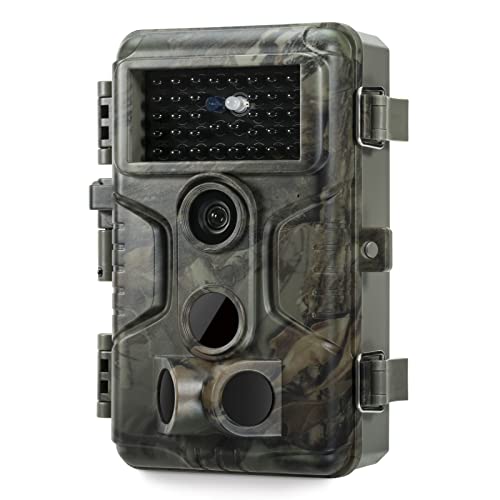
1. GardePro A3S
The GardePro A3S is the budget pick and the simplest camera here to live with. It is non-cellular and non-WiFi, so there is no app to set up, no data plan to pay for, and no signal to worry about. It records to a memory card, collected later to see what passed by. For a garden, a woodland edge, or a feeder station close to home, that is often all that is needed.
Its headline numbers are strong for the class. Photos reach 64 megapixels, video records at 1296p, and the trigger speed is rated at 0.1 seconds. Night vision uses no-glow infrared LEDs with a range of up to 100 feet. The camera uses a Sony Starvis sensor, and video is compressed in H.264. There is no remote viewing, and the listing does not state a screen size, card capacity, or battery count.
Specs
| Spec | Detail |
|---|---|
| Photo resolution | 64 megapixels |
| Video resolution | 1296p |
| Trigger speed | 0.1 seconds |
| Night vision | No-glow infrared, up to 100 feet |
| Sensor | Sony Starvis |
| Connectivity | Non-cellular, non-WiFi |
| Power | AA batteries, count not stated |
2. Vikeri 4K 32MP Trail Camera

The Vikeri 4K 32MP trail camera is the wide-angle pick, suited to watchers who want to cover a broad stretch of ground from one mounting point. Its lens covers 120 degrees, noticeably wider than a standard trail camera, so one camera can watch a whole clearing, a wide game trail, or a full garden width.
Photos reach 32 megapixels and video records in 4K, with 40 no-glow infrared LEDs for night vision. The trigger speed is rated at 0.1 seconds, and the body carries an IP66 rating for dust and water resistance. A 2.4-inch LCD screen allows on-the-spot review. It is a non-cellular camera, so it saves everything locally, and the listing does not state a battery count or a maximum card capacity.
Specs
| Spec | Detail |
|---|---|
| Photo resolution | 32 megapixels |
| Video resolution | 4K |
| Trigger speed | 0.1 seconds |
| Night vision | 40 no-glow infrared LEDs |
| Screen | 2.4-inch LCD |
| Weather resistance | IP66 |
| Connectivity | Non-cellular |
3. Reolink Go Ranger PT with Solar Panel

The Reolink Go Ranger PT is the most flexible camera in this guide, and the only one that can pan and tilt. Its lens turns through 360 degrees and tilts to follow movement, so one camera can scan a whole field, a pond edge, or a yard. Animal recognition helps it tell wildlife apart from wind-blown branches, and it connects over 3G and 4G LTE, so it works far from any WiFi network.
The camera records in 4K, and the bundle includes a solar panel, a 32GB memory card, and a SIM card. The panel tops up its rechargeable battery by day, and no-glow infrared keeps night recording discreet. A cellular plan is needed for the remote features, and the listing notes that this version is for use in the United States, Canada, and Mexico only.
Specs
| Spec | Detail |
|---|---|
| Photo and video resolution | 4K |
| Pan and tilt | 360-degree pan |
| Connectivity | 3G and 4G LTE cellular |
| Night vision | No-glow infrared |
| Detection | Animal recognition, smart motion activation |
| Power | Rechargeable battery with solar panel |
| Included | 32GB memory card and SIM card included |
4. Tactacam Reveal X Gen 3.0

The Tactacam Reveal X Gen 3.0 is the cellular pick for watchers who want photos on their phone without the complexity of a pan-tilt camera. It connects automatically over 4G LTE, choosing the strongest available carrier, and sends photos as animals pass. Built-in GPS records where each camera sits, useful for multi-camera setups.
Photos reach 4K and video records at 1080p, and the low-glow infrared flash keeps night captures discreet. The camera needs no memory card for basic use, since images are stored and delivered through the cellular service. A cellular plan is required for the remote features, it needs a steady mobile signal, and the listing does not state a numeric trigger speed.
Specs
| Spec | Detail |
|---|---|
| Photo resolution | 4K |
| Video resolution | 1080p |
| Connectivity | 4G LTE cellular, auto-connect |
| Night vision | Low-glow infrared flash |
| Memory card | Not required for basic use |
| Trigger speed | Fast, numeric value not stated |
5. Moultrie Edge 2 Pro

The Moultrie Edge 2 Pro is the most feature-rich cellular camera in this guide, aimed at watchers wanting the sharpest remote images and smartest filtering. It captures 40-megapixel photos and 1440p video with HD audio, and its trigger speed is rated at 0.3 seconds across a detection range of up to 100 feet. A no-glow flash keeps night recording invisible to animals.
AI false trigger elimination filters out empty frames caused by moving branches or shifting light, saving images and battery. On-demand control lets the owner trigger a photo or video and change settings remotely, while Live Aim shows the field of view on a phone during setup. GPS and onX Hunt integration place each camera on a map, and 8GB of built-in memory plus unlimited cloud storage means no memory card is required. The Edge 2 Pro runs on 16 AA batteries or a rechargeable Power Mag pack.
Specs
| Spec | Detail |
|---|---|
| Photo resolution | 40 megapixels |
| Video resolution | 1440p with HD audio |
| Trigger speed | 0.3 seconds |
| Detection range | Up to 100 feet |
| Night vision | No-glow flash |
| Connectivity | 4G LTE cellular, auto-connect |
| Storage | 8GB built-in memory, unlimited cloud |
| Power | 16 AA batteries or rechargeable Power Mag pack |
How to choose
Start with distance. If the camera sits within easy walking distance, a non-cellular model such as the GardePro A3S or the Vikeri saves money and never depends on a signal. On distant land, a cellular model such as the Tactacam or the Moultrie sends photos to a phone and cuts down on trips. A solar panel, included with the Reolink, matters most for cameras left untouched for months.
Next, weigh night vision and trigger speed together. No-glow infrared is the right choice for shy wildlife, since the flash is invisible, while low-glow models trade a faint red glimmer for a little more range. A trigger speed of 0.1 seconds catches fast animals at close range, while 0.3 seconds is fine for feeders and water holes. Finally, check the storage plan: card cameras need a card and a visit, while cellular cameras need a data plan and a steady signal.
Who should skip
Trail cameras are not the right tool for every job. Anyone who needs live video around a house should look at a home security camera instead, since trail cameras record short clips when motion triggers them rather than streaming continuously. A WiFi camera with a live feed suits desk-based bird feeder watching better than a camera that saves clips to a card.
Renters and anyone placing a camera on land they do not own should also pause. Many areas restrict cameras on public land or on a neighbour’s property, and a camera strapped to a tree can be stolen or damaged. Check local rules and get permission first.
Frequently asked questions
Do trail cameras need WiFi?
No. Non-cellular trail cameras such as the GardePro A3S and the Vikeri save photos and video to a memory card and need no network at all. Cellular models such as the Tactacam, Moultrie, and Reolink connect over a mobile network instead of WiFi, so they work far from any router where a mobile signal reaches.
How long do trail camera batteries last?
Battery life depends on the camera, the temperature, and how often animals trigger it. Simple non-cellular cameras running on AA batteries can last for months on a quiet trail, while cellular cameras use more power because they transmit photos. Cold weather shortens battery life, and a solar panel or a rechargeable pack helps on long deployments.
What is the difference between no-glow and low-glow infrared?
No-glow infrared uses LEDs that emit no visible light, so the flash is invisible to animals and people. Low-glow infrared emits a faint red glimmer when it fires, which can be visible at close range but often reaches a little farther. For shy wildlife, no-glow is the safer choice.
Do I need a data plan for a cellular trail camera?
Yes. Cellular trail cameras send photos over a mobile network, and the carrier or the camera maker charges a monthly plan for that service. Plans are sold per camera. Non-cellular cameras have no monthly cost beyond batteries and memory cards.
Final verdict
For most wildlife watchers, the GardePro A3S is the right first trail camera: simple, affordable, and fast. Watchers who want a wider view and sharper video should step up to the Vikeri 4K 32MP, while distant land calls for a cellular model. The Tactacam Reveal X Gen 3.0 covers the cellular basics well, the Moultrie Edge 2 Pro adds the sharpest images and smartest filtering, and the Reolink Go Ranger PT best scans a large area from one spot with solar power.
More from Amazon
Programs that pair well with the guide above. Offers and eligibility are set by Amazon and may change.
Free shipping on eligible items, Prime Video and more. Eligible new members can start with a free trial.
Start a Prime free trialAudiobooks and podcasts to listen to on the go. Eligible new members can start with a free trial.
Try Audible freeAd-free music streaming. Eligible new subscribers can start with a free trial.
Try Music Unlimited freeA free business account with business pricing and bulk-buying tools for work, shop or home office.
Create a business accountAs an Amazon Associate we earn from qualifying purchases.