Key takeaways
- Learn how to choose a weather station for home use, compare sensor types, displays, and connectivity, and find the right full station for your yard.
- Top Pick: Ambient Weather WS-2902 WiFi Smart Weather Station
- Runner-up: Ambient Weather WS-2000 Smart Weather Station
- Also consider: AcuRite Iris Weather Station 01535M
A home weather station turns guesswork into local facts. Instead of relying on a forecast for a town miles away, you can see the temperature, humidity, wind, and rainfall right outside your own door. That matters when you are deciding whether to water the garden or cover plants before a cold night.
Choosing one is less about finding the fanciest screen and more about matching the sensor, the display, and the connectivity to the way you will actually use it. A station that measures wind and rain is a different tool from a simple indoor thermometer. The five stations below all measure outdoor temperature, humidity, wind speed and direction, and rainfall, and each one pairs an outdoor sensor array with an indoor display.
As an Amazon Associate, we earn from qualifying purchases.
Quick Answer
Start with a full five-in-one style station that measures temperature, humidity, wind, and rain, with an outdoor sensor array and a clear indoor display. Choose Wi-Fi if you want phone access and online sharing, and choose a display-only model if you prefer a simple countertop readout. Mount the sensor in open air, away from walls and roofs, for the most useful readings.
Ambient Weather WS-2902 WiFi Smart Weather Station
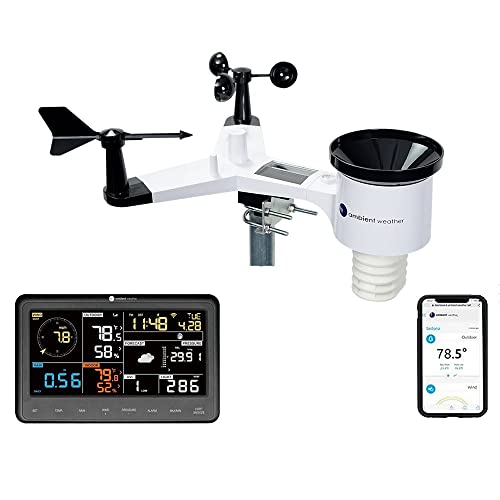
The Ambient Weather WS-2902 is the best-known starting point in this category. Its Osprey outdoor sensor array measures outdoor temperature and humidity, wind speed and direction, rainfall, ultraviolet light, and solar radiation, while the indoor console adds indoor temperature and humidity and barometric pressure. The color display is large enough to read from across a room.
Wi-Fi connectivity sets this station apart from simpler display-only models. Once connected, it can send readings to online weather networks, so you can check conditions from a phone when you are away from home. Mount the sensor array in open air on a pole above rooflines and fences, since a sheltered spot under an eave will hide the rain it is supposed to measure.
Specs
| Feature | Detail |
|---|---|
| Measures | Outdoor temperature, humidity, wind speed and direction, rainfall, ultraviolet light, solar radiation, barometric pressure |
| Display | Color display console with indoor temperature and humidity |
| Connectivity | Wi-Fi with online weather network sharing |
| Power | Solar powered sensor with battery backup, console uses mains power with battery backup |
Ambient Weather WS-2000 Smart Weather Station
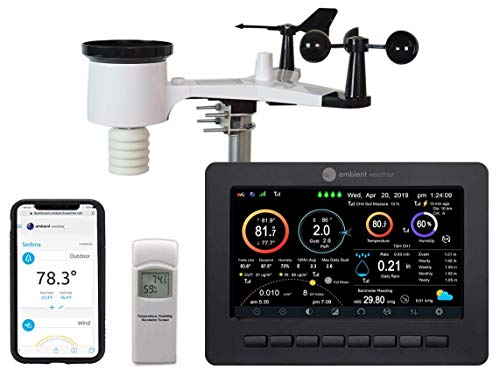
The Ambient Weather WS-2000 builds on the same sensor family as the WS-2902 but pairs it with a larger, more flexible console. Its display works more like a small tablet, with a customizable layout that lets you choose which readings get the most space.
This station is also the most expandable pick in this guide. It accepts additional sensors, so a household can later add extra temperature and humidity sensors for a greenhouse or a garage without replacing the whole system. Wi-Fi remote monitoring and alerts are included. The trade-off is a larger console that needs a home on a desk or shelf.
Specs
| Feature | Detail |
|---|---|
| Measures | Outdoor temperature, humidity, wind speed and direction, rainfall, ultraviolet light, solar radiation, barometric pressure |
| Display | Large customizable color display console |
| Connectivity | Wi-Fi with remote monitoring and alerts |
| Power | Solar powered sensor with battery backup, console uses mains power |
AcuRite Iris Weather Station 01535M
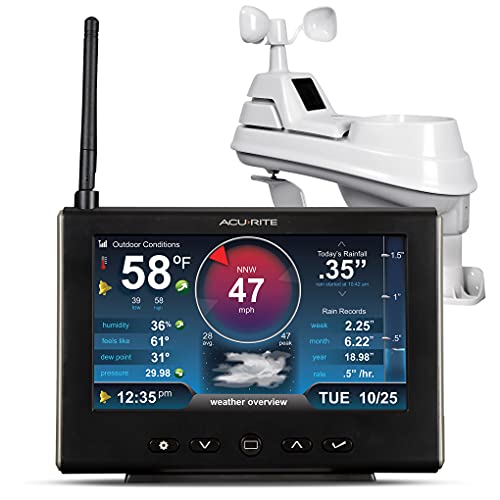
The AcuRite Iris 01535M is a strong choice for buyers who want a complete station without any online setup. Its five-in-one outdoor sensor measures temperature, humidity, wind speed and direction, and rainfall, and the high-definition display presents those readings alongside a built-in barometer and a forecast based on pressure trends. There is no account to create and no network to configure.
The display is bright, clearly organized, and easy to read at a glance, with indoor and outdoor readings side by side. That makes it well suited to a kitchen, hallway, or home office where the station serves as a quick reference. For a household that wants dependable local readings and a clear screen, with no interest in phone apps or online sharing, this is the simplest full station in this guide.
Specs
| Feature | Detail |
|---|---|
| Measures | Outdoor temperature, humidity, wind speed and direction, rainfall, barometric pressure |
| Display | High-definition display with built-in barometer |
| Connectivity | Wireless sensor link, no Wi-Fi connection |
| Power | Sensor uses batteries, display uses mains power with battery backup |
AcuRite Iris Weather Station 01512
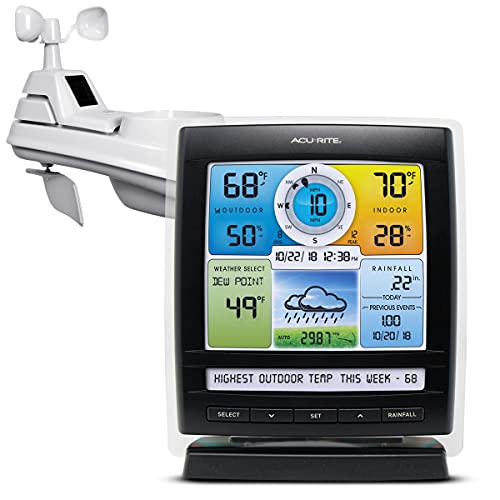
The AcuRite Iris 01512 is the long-running classic of this lineup. Like the 01535M, it pairs a five-in-one outdoor sensor with a color display, measuring temperature and humidity indoors and outdoors, wind speed and direction, and rainfall. The display includes a forecast based on barometric pressure, daily highs and lows, and a moon phase indicator.
This model is a good fit for a first weather station. It covers every core measurement, it does not ask the buyer to learn an app or an online dashboard, and its display is friendly enough for the whole household to use. The sensor is a single integrated unit, so mounting is a matter of fixing one array to a pole. The main limitation is that readings live on the display, so checking conditions from another room means walking to the console.
Specs
| Feature | Detail |
|---|---|
| Measures | Outdoor temperature, humidity, wind speed and direction, rainfall, barometric pressure |
| Display | Color LCD display with forecast icons |
| Connectivity | Wireless sensor link, no Wi-Fi connection |
| Power | Sensor uses batteries, display uses mains power with battery backup |
Ecowitt Wittboy Pro Weather Station HP2564

The Ecowitt Wittboy Pro HP2564 takes a different engineering approach. Its WS90 outdoor sensor has no moving cups or tipping bucket. Wind is measured ultrasonically, and rain is measured with a haptic sensor that detects the impact of drops, so there are fewer moving parts to wear out, jam, or freeze.
The indoor console is a seven-inch TFT display that shows temperature and humidity, wind, rain, light, ultraviolet index, and pressure at once. Wi-Fi support lets the station publish readings to online weather services, and the system can accept additional Ecowitt sensors. The sensor is solar powered with battery backup, and the stated transmission range reaches up to 150 meters with obstacles in the way and up to 300 meters in open space.
One honest caveat comes from the manufacturer itself. The haptic rain sensor can show a larger deviation than a traditional tipping bucket under some conditions, because raindrop size and wind speed affect the reading. For most home uses, such as knowing whether it rained and how hard the wind is blowing, the solid-state design is a practical and low-maintenance choice.
Specs
| Feature | Detail |
|---|---|
| Measures | Outdoor temperature, humidity, wind speed and direction, rainfall, light, ultraviolet index, barometric pressure |
| Display | Seven-inch TFT display console |
| Connectivity | Wi-Fi with online weather service support |
| Power | Solar powered sensor with battery backup, console uses mains power |
How to Choose
Start by deciding what the station must measure. A full home station should cover outdoor temperature, humidity, wind speed and direction, and rainfall, plus indoor temperature and humidity and barometric pressure on the console. If a model leaves out wind or rain, it is a thermometer with extras rather than a weather station.
Next, decide how you want to see the data. A large color display is best if the station will live in a kitchen or hallway and serve the whole household. A Wi-Fi model is best if you want phone access, alerts when you are away, or sharing with an online weather network.
Placement matters more than brand. Mount the outdoor sensor in open air, above fences and rooflines, with the rain gauge exposed to the sky and the wind sensor clear of trees and walls. A sensor tucked under an eave or against a warm wall will report the microclimate of that wall, not the weather in your yard.
Finally, think about power and upkeep. Solar powered sensors with battery backup need the least attention, while battery-only sensors need a calendar reminder for replacements. If you expect your interest to grow, favor a station that accepts extra sensors, so a greenhouse probe or a second outdoor sensor does not mean buying a whole new system.
Who Should Skip
A full weather station is not the right purchase for everyone. If you only want to know the indoor temperature and humidity in one room, a small indoor thermometer and hygrometer will do the job for far less money and effort. A household with no suitable outdoor mounting spot, such as a home with no yard, balcony, or accessible pole location, will struggle to get useful readings from one.
Renters should also pause before buying. Mounting an outdoor sensor usually means fixing a pole or bracket to a wall, fence, or roof, and that may not be allowed under a lease. Similarly, anyone who only checks the weather on a phone and never looks at a countertop display may be better served by a good forecast app, since the main advantage of a home station is local measurement.
FAQ
Do I need Wi-Fi for a home weather station?
No. A display-only station measures and shows local conditions without any network connection, and many households prefer that simplicity. Wi-Fi adds phone access, alerts away from home, and sharing with online weather networks.
Where should I mount the outdoor sensor?
Mount it in open air, on a pole above nearby fences, roofs, and trees, with the rain gauge exposed to the sky. Keep it away from walls that absorb heat, dryer vents, and sheltered eaves, since those spots distort temperature, wind, and rainfall readings.
How accurate are home weather stations?
Home stations are accurate enough for gardening, outdoor planning, and tracking local trends, but they are not laboratory instruments. Siting has the largest effect on accuracy, followed by sensor quality and maintenance, so spend your effort on placement first.
Do weather stations need much maintenance?
Most need only occasional attention. Solar powered sensors need their panels kept clean and their backup batteries replaced when they age, while battery-only sensors need fresh batteries on a regular schedule. Check the mounting hardware after strong storms and clear leaves and debris from the rain gauge.
Final Verdict
The right home weather station measures wind and rain as well as temperature and humidity, shows the results on a display you will actually look at, and sits in a clear, open position outdoors. The Ambient Weather WS-2902 is the safest all-round pick for most homes, the WS-2000 suits buyers who want a larger display and room to expand, and the two AcuRite Iris models serve households that prefer a simple display with no online setup. The Ecowitt Wittboy Pro HP2564 is the pick for buyers who value a solid-state sensor with no moving parts. Choose by how you will read the data and where you can mount the sensor.
More from Amazon
Programs that pair well with the guide above. Offers and eligibility are set by Amazon and may change.
Free shipping on eligible items, Prime Video and more. Eligible new members can start with a free trial.
Start a Prime free trialAudiobooks and podcasts to listen to on the go. Eligible new members can start with a free trial.
Try Audible freeAd-free music streaming. Eligible new subscribers can start with a free trial.
Try Music Unlimited freeA free business account with business pricing and bulk-buying tools for work, shop or home office.
Create a business accountAs an Amazon Associate we earn from qualifying purchases.