Key takeaways
- Pro: Low price makes trial-and-error placement costless.
- Pro: Oval profile distributes lateral soil pressure evenly, reducing the bowing that plagues cheap rectangular panels.
- Con: The five-foot diameter limits root-zone volume for anything deeper than leafy greens.
Every gardener who has pulled a rotting cedar frame apart at the end of a third season knows the frustration of spending real money on a structure that surrenders to moisture, insects, and time. Metal raised beds solve that problem by trading organic decay for corrosion resistance, and galvanization has matured enough that a well-constructed steel planter can outlast the wooden options it replaced without requiring annual sealing or staining.
What separates the good metal raised beds from the mediocre ones is not exotic — it comes down to gauge thickness, joinery quality, drainage design, and whether the panel profile resists bowing under several hundred pounds of wet soil. Price alone is a poor proxy: a budget oval can perform fine for herbs while a mid-priced rectangular kit quietly fails at the corners after one freeze-thaw cycle. This roundup compares published specifications and recurring owner-reported feedback across eight models available in 2026.
Our top picks




As an Amazon Associate we earn from qualifying purchases at no extra cost to you. Ratings are shown as listed on Amazon.
Quick Picks
| Product | Best for | Price |
|---|---|---|
| Rakukiri 5ft Oval | Smallest-space growers | $16.99 |
| Land Guard Oval Large | One-bed beginners | $19.99 |
| Land Guard 2 Pack 6x3x2ft | Two-zone vegetable gardens | $69.99 |
| zunatu 10x2x1ft 2 Pack | Long narrow border plantings | $42.99 |
| Best Choice Products 6x3x2ft | Deep-rooted crops on a mid budget | $89.99 |
| G GOOD GAIN Oliver | Compact decorative gardens | $25.64 |
| Tegarbed 4x2x1ft 2 Pack | Patio and balcony container gardening | $49.99 |
| Best Choice Products 8x4x2ft | Serious backyard vegetable production | $129 |
How We Picked
We evaluated each bed on four criteria drawn from spec sheets and owner reports: structural integrity under soil load (panel gauge, corner reinforcement, and profile shape), drainage and bottom design (whether water pools or exits freely), assembly complexity for a single person with hand tools, and long-term corrosion behavior at the price point. Models where reviewers consistently flagged warped panels, stripped fasteners, or rust at rivet lines were ranked lower regardless of initial appearance.
The 8 Best Metal Raised Beds in 2026
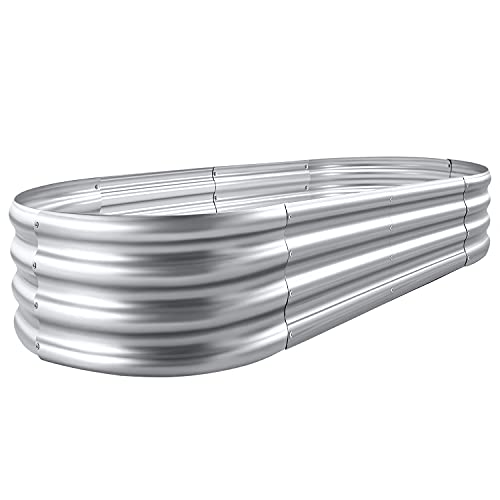
Rakukiri 5ft Oval GRS Certified Planter Box
This compact oval is the entry point for renters, balcony growers, or anyone who wants a single container for salad greens and herbs without committing to a full garden layout. The GRS certification confirms recycled steel content, which matters to buyers tracking their material footprint. At $16.99 it carries very little financial risk if it turns out not to fit the space.
- Pro: Low price makes trial-and-error placement costless.
- Pro: Oval profile distributes lateral soil pressure evenly, reducing the bowing that plagues cheap rectangular panels.
- Con: The five-foot diameter limits root-zone volume for anything deeper than leafy greens.
Skip this if you plan to grow tomatoes, root vegetables, or anything requiring more than roughly a foot of depth.
Land Guard Galvanized Oval Large Kit
Similar in concept to the Rakukiri but sized up for growers who need more planting area without stepping into a multi-panel rectangular system. The oval shape and galvanized finish keep it competitive on price against the smaller option while offering noticeably more surface. It suits first-time raised-bed owners who want a forgiving footprint with no sharp interior corners to trap water.
- Pro: Still under twenty dollars, so total experiment cost remains trivial.
- Pro: Larger footprint than the Rakukiri while retaining the same bow-resistant shape.
- Con: No published depth specification, so verification from the seller is advisable before assuming it accommodates deep-rooted crops.
Skip this if you need confirmed soil volume for carrots, beets, or dwarf fruit trees.
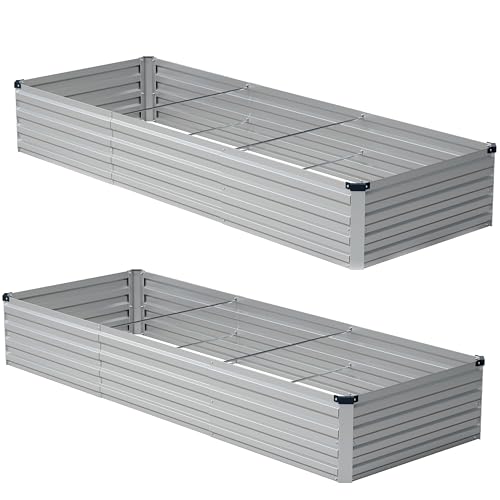
Land Guard 2 Pack 6x3x2ft Galvanized Metal Bed
Two six-by-three-foot beds at two feet deep give you a genuine rotation system — one bed for brassicas, another for legumes — without buying a single oversized structure. At $69.99 for the pair the per-bed cost drops well below most mid-range rectangular options. Owners report adequate panel thickness for two feet of moist soil, though corner brackets should be checked for tightness after the first watering.
- Pro: Two separate zones enable crop rotation or simultaneous different-soil projects.
- Pro: Two-foot depth accommodates nearly every common vegetable.
- Con: Two full assembly processes for what is essentially the same design.
Skip this if you only have room for one contiguous bed; a single eight-by-four layout would serve better.
zunatu 10x2x1ft Galvanized Raised Bed 2 Pack
Long and shallow by design, this pair works best along fences, walkways, or the edge of a lawn where you want a continuous strip rather than a block. One foot of depth is enough for lettuce, radishes, strawberries, and most culinary herbs but will starve deeper-rooted plants. The ten-foot length in two packs means you get twenty linear feet of growing space for $42.99, which is hard to beat on cost per foot.
- Pro: Exceptional linear growing space relative to price.
- Pro: Low profile reduces wind load on exposed sites.
- Con: One-foot depth rules out root vegetables and large tomato varieties.
Skip this if your primary goal is calorie-dense harvests; go deeper or wider.
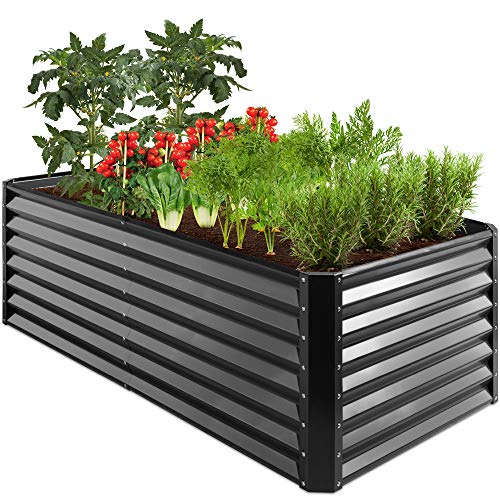
Best Choice Products 6x3x2ft Metal Raised Garden Bed
A mid-budget rectangle with a published 269-gallon capacity and non-toxic material claim, this bed targets growers who want reliable volume without the price jump to the eight-by-four. Owners praise the included drainage holes and the gray powder-coat finish that resists UV fading. Assembly requires two people for anything beyond hand-tightening, and the long side panels are the flex-prone element.
- Pro: Published gallon capacity gives a clear soil-volume reference for planning.
- Pro: Non-toxic material certification provides peace of mind for food crops.
- Con: Single-unit cost is higher than the two-pack Land Guard option, which delivers comparable total volume.
Skip this if two separate zones matter more than one large plot.
G GOOD GAIN Oliver Galvanized Planter Box
The Oliver model sits in a niche: it is smaller and more decorative than the utilitarian kits around it, aimed at patio gardeners who treat the bed as part of the outdoor design rather than a production tool. At $25.64 it competes directly with the Land Guard oval on price while offering a different aesthetic profile suited to container herb and flower arrangements.
- Pro: Compact footprint fits tight outdoor furniture layouts.
- Pro: Finish quality reads more refined than other beds in this price tier.
- Con: Limited published dimensions make soil-volume planning harder before purchase.
Skip this if you need a workhorse for bulk vegetable production.
Tegarbed 4x2x1ft Heavy Duty 2 Pack Oval Planter
Bottomless design, four-by-two-foot footprint, one-foot depth, and a two-pack format at $49.99 place this squarely in the patio-and-balcony category. The bottomless construction means it sits directly on ground or hardscape, letting roots access native soil — useful for small-space growers who want a raised profile without a separate drainage layer. Owners note the oval shape resists deformation well at this small size.
- Pro: Bottomless design simplifies placement and eliminates waterlogging risk.
- Pro: Two heavy-duty panels for under fifty dollars offer strong value for container-scale gardening.
- Con: One-foot depth still limits crop selection to shallow-rooted species.
Skip this if you are growing anything that sends a taproot deeper than eight inches.
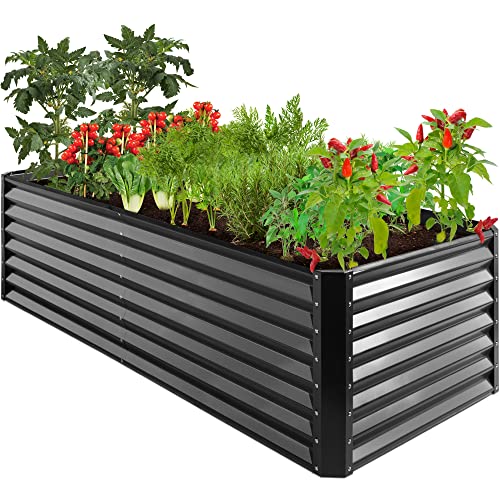
Best Choice Products 8x4x2ft Metal Raised Garden Bed
The largest bed in this roundup, with a 478-gallon capacity, it is the clear choice for a household that wants to produce a meaningful share of its own vegetables from a single footprint. Two-foot depth, non-toxic materials, and a gray finish match the smaller Best Choice model in design language but at significantly greater scale. At $129 it is also the most expensive option, and delivery logistics for a panel this large can add friction.
- Pro: Highest published soil capacity in the group, supporting a full-season vegetable rotation.
- Pro: Proven design family — the smaller version has strong owner feedback that transfers here.
- Con: Price and size make it impractical for renters or anyone with under forty square feet of usable space.
Skip this if your site is small or you cannot arrange delivery of an oversized flat-packed box.
Buying Guide
Panel Gauge and Profile Shape
The thickness of the galvanized steel — often called gauge, where a lower number means thicker metal — determines whether a side wall will bulge outward once loaded with damp soil. A thin panel in a rectangular shape will bow at the midpoint of the long side within one season; the same panel in an oval or rounded profile distributes lateral pressure across the curve and resists that deformation. If you buy rectangular, look for external corner brackets or internal reinforcement rails. If you buy oval, you get that structural benefit built into the geometry.
Depth Versus Your Crop List
One foot of depth is sufficient for leafy greens, herbs, strawberries, and most flowers. Carrots, beets, radishes, and potatoes want twelve to eighteen inches. Tomatoes, peppers, and squash perform best at the full two-foot mark because their root systems spread deeply and wide. Match the published or stated depth to your primary crops before comparing price; a cheaper bed that is too shallow will force you to buy a second one, erasing the savings.
Drainage and Bottom Configuration
Galvanized metal does not rot, but it can trap water against the soil at the panel base if drainage is insufficient. Look for either pre-punched drainage holes along the bottom edge, an open bottom that lets excess water percolate into native soil, or a perforated liner. A bottomless bed needs level ground and good underlying drainage; a closed-bottom bed needs drilled holes or you will create a bathtub that drowns roots. Both approaches work — the wrong one for your site conditions does not.
Our Verdict
The top pick is the Best Choice Products 8x4x2ft bed: its published 478-gallon capacity, two-foot depth, and non-toxic certification make it the most versatile single unit for anyone with adequate space and budget. The budget pick is the Rakukiri 5ft Oval at $16.99, which delivers a legitimate growing container for herbs and greens at a price low enough to be a zero-regret purchase. The condition under which another product wins is crop rotation: if you need two independent zones for different soil amendments or plant families, the Land Guard 2 Pack at $69.99 gives you more total volume and management flexibility than any single bed in this list for less money.
FAQ
Do metal raised beds get too hot for plant roots?
Galvanized steel absorbs and transfers heat, so in full direct sun the outer soil layer can run several degrees warmer than a wooden bed. In practice most owners report no root damage unless the bed sits in an unshaded southern exposure through a peak-summer heatwave, and a mulch layer on the soil surface mitigates the effect further.
How long does galvanized steel last outdoors?
Quality galvanized coatings typically protect the underlying steel for fifteen to twenty-five years before the zinc sacrificial layer degrades enough for surface rust to appear, and even then the rust remains cosmetic for several additional seasons. Owner reports on the older beds in this category frequently show ten-plus years with no structural failure.
Is GRS certification meaningful for garden beds?
GRS stands for Global Recycled Standard and verifies the percentage of post-consumer recycled material and the absence of restricted chemical treatments during manufacturing. For a metal bed it signals that the steel came from a traceable recycled stream and was processed without prohibited heavy-metal finishes, which is a reasonable proxy for food-safety awareness even though it is not a food-grade certification.
Can I line the inside of a galvanized bed with plastic?
Most gardeners do not need to line a bed that is already non-toxic and corrosion-protected, and adding plastic can impede drainage and trap moisture against the metal. If you are concerned about soil-to-metal contact in a bottomless bed, a permeable landscape fabric at the base is the safer choice because it allows water through while reducing direct soil-on-steel exposure.