Key takeaways
- The phrase solar panels for charging batteries covers two jobs that look similar but behave very differently.
The phrase solar panels for charging batteries covers two jobs that look similar but behave very differently. One is a small trickle charger that keeps a car, boat, tractor, or motorcycle battery topped up while it sits unused. The other is a larger kit that actually feeds a camper, RV, or off-grid battery bank with usable daily energy. Buy a 12 watt panel for the second job and it will never keep up, and buy a 200 watt kit for the first and you have paid for capacity you will not use.
This guide is for people who need a panel and controller that connect to a 12 volt battery, with the controller doing the work of protecting the battery from overcharge. The seven kits here run from 12W maintainers to a 200W RV-oriented set. Solar power banks that charge phones are not part of this comparison, since they solve a different problem. Heading into 2026, the main buying question is simply how many watts you need and whether the controller between the panel and battery fits that job.
Quick Picks
Our top picks




As an Amazon Associate we earn from qualifying purchases at no extra cost to you.
| Product | Best for | Key spec from the title |
|---|---|---|
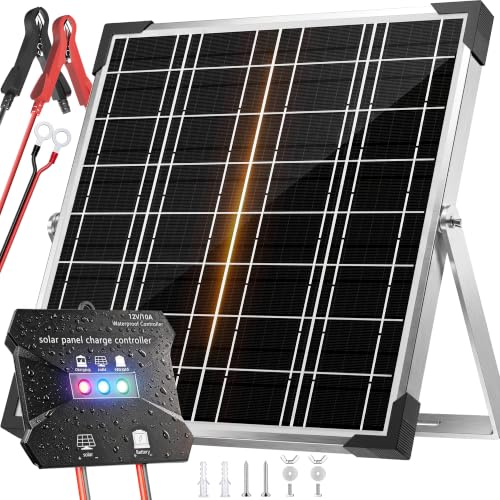
| SOLPERK 20W kit | Seasonal car, boat, or motorcycle maintenance | 20W 12V, MPPT controller, IP67, adjustable mount |
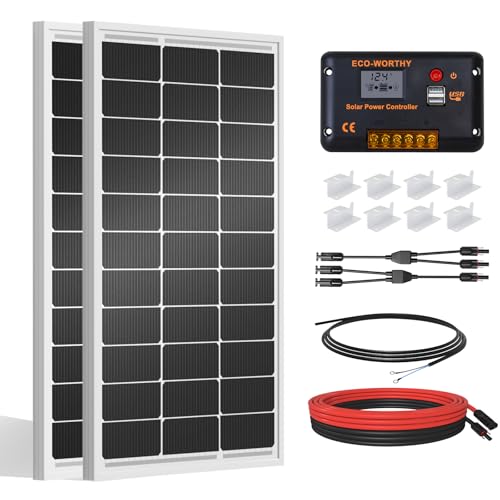
| ECO-WORTHY 200W kit | RV or camper battery charging | 200W, 12V/24V, monocrystalline, 30A PWM controller |
| Hoysicy 100W kit | Mid-sized battery upkeep on RVs and boats | 100W 12V, 20A controller, 16.4 ft cables |
| Voltset 20W kit | Trickle maintenance with safety protections | 20W 12V, smart controller, waterproof |
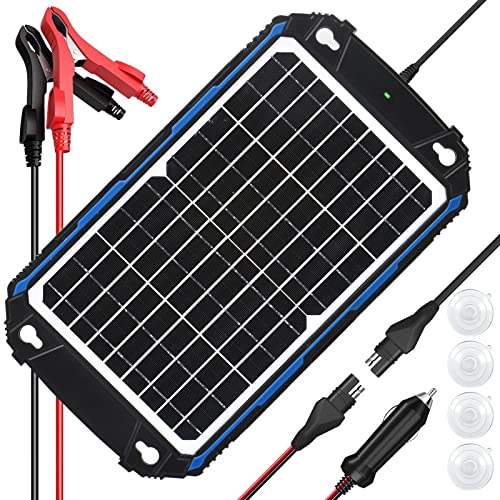
| SUNER POWER 12W | Smallest, lightest maintainer | 12W 12V, built-in MPPT controller, waterproof |
| 20W MPPT maintainer | Buyers who want listed protections | 20W 12V, 8 protections, IP68 |
| SOLPERK 30W kit | A bit more power in a small package | 30W 12V, MPPT controller, waterproof |
How to Choose
Match watts to the job
A 12W to 30W panel is designed for maintenance. It offsets the slow self-discharge of a battery that is parked, and it can keep a lightly used vehicle from going flat over a winter. It will not run a refrigerator or charge a heavily drained battery in a reasonable time. A 100W panel starts to feed real loads on a small boat or utility trailer, and 200W is the sort of size an RV or camper owner needs for lights, a fan, and device charging. Count your daily watt-hours before choosing, and remember that real output falls short of the panel’s label in clouds or low sun. A simple rule of thumb is to list every device you plan to run, multiply each by the hours per day, and then compare the total to what a panel of that size can plausibly deliver in a few hours of good sun. If the numbers do not come close, size up instead of hoping.
Understand MPPT versus PWM controllers
The controller sits between the panel and battery and decides how charge is delivered. PWM controllers are simpler and work well when the panel and battery voltages are close, which is why a 30A PWM unit comes with the large ECO-WORTHY set. MPPT controllers are marketed as more efficient because they track the panel’s best operating point, and several small kits here mention them. Do not pay extra for the label alone; on a 20W maintainer the real difference is small, and a well-built basic controller beats a poorly made fancy one.
Check battery chemistry and voltage
Every title in this group states 12V, and the ECO-WORTHY adds 24V, but battery chemistry matters too. A lead-acid battery wants a charge profile suited to it, and a lithium iron phosphate battery needs a controller that supports that profile. Titles do not always spell this out, so read the product page and the manual before connecting the panel to a lithium pack. Mismatched settings can undercharge the battery or stress it over time.
Look at the weatherproofing and cabling
Panels live outdoors, so the listed ingress codes of IP67 and IP68 are worth noting. Look as well at the length of the included cables, such as the 16.4 ft extension on the Hoysicy kit, because a short lead forces you to leave the panel where it is shaded or in the way. Budget kits tend to cut corners on mounting hardware and cable quality, so plan to add your own brackets and sealed connectors if the panel will stay out all year. Dirt and bird droppings on the glass also cut output, so a panel that is easy to reach for a wipe-down will perform better over time than one bolted out of reach.
The 7 Best Options
SOLPERK 20W Kit
The 20W SOLPERK kit is a 12V battery charger and maintainer with an MPPT controller, IP67 waterproofing, and an adjustable mount bracket. It is aimed at boats, cars, and similar vehicles that sit idle for weeks. The bracket helps you tilt the panel toward the sun, which matters more at this wattage than most buyers expect.
- Strength: the adjustable bracket lets you angle the panel for better sun exposure.
- Strength: the IP67 waterproofing suits boats and exposed dashboards.
- Trade-off: 20W is only a maintenance level of power.
Skip it if you plan to run any real load from the battery.
ECO-WORTHY 200W Kit
The ECO-WORTHY set is the largest in this group, with 200 watts of monocrystalline panel capacity, 12V or 24V compatibility, and a 30A PWM charge controller. The title names RV, camper, and similar uses. It is the only kit here that looks designed to supply meaningful daily energy, rather than just stop a battery from drifting down.
- Strength: 200W gives real charging capacity for an RV or camper.
- Strength: 12V and 24V support gives you flexibility for system design.
- Trade-off: it needs more roof or ground space than the compact maintainers.
Skip it if you only need to keep a seasonal battery from going flat.
Hoysicy 100W Kit
The Hoysicy kit offers 100W of monocrystalline panel, a 20A solar charge controller, and 16.4 ft of extension cable for RV, marine, and boat use. It sits between the small maintainers and the large kit, so it suits a mid-sized battery that sees light daily use.
- Strength: 100W gives a noticeable step up in charging power.
- Strength: the 16.4 ft cables let you place the panel away from the battery.
- Trade-off: 100W will still struggle with heavy loads or very large banks.
Skip it if you need more than 100W of output or the smallest, easiest mount.
Voltset 20W Kit
The Voltset is a 20W, 12V trickle maintainer kit with a smart charge controller, a waterproof build, and safety protections. It targets car, boat, RV, and marine owners who want to keep a battery healthy with minimal effort. The listing emphasizes protection features more than raw power.
- Strength: the smart controller and listed safety protections add confidence for unattended use.
- Strength: waterproofing suits outdoor mounting.
- Trade-off: the title does not state an ingress code, so the weatherproofing level is unclear.
Skip it if you need a bigger panel for daily loads.
SUNER POWER 12W
The SUNER POWER charger is a 12W, 12V panel with a built-in MPPT controller and waterproof construction, billed as a Pro maintainer. It is the smallest panel in the group, and the integrated controller keeps the setup simple.
- Strength: the built-in controller reduces wiring and parts.
- Strength: 12W is easy to place on a dashboard or small mount.
- Trade-off: 12W is the lowest output here and can struggle on cloudy days.
Skip it if your battery is large or heavily used.
20W MPPT Maintainer with 8 Protections
This unbranded 20W, 12V kit uses an MPPT controller with eight listed protection functions and an IP68 waterproof code. It is aimed at RVs, trailers, and similar vehicles. The IP68 claim is the highest waterproof code mentioned in this group.
- Strength: the IP68 code suggests strong water resistance.
- Strength: eight protection functions are listed, a useful feature for unattended charging.
- Trade-off: no brand name appears, so support and warranty are harder to evaluate.
Skip it if brand reputation and service matter to you.
SOLPERK 30W Kit
The 30W SOLPERK adds power over the 20W version, with a 12V battery maintainer, MPPT controller, and waterproof design for cars, RVs, boats, and motorcycles. It is a reasonable step up for a battery that sees a little more use or sits in lower sunlight.
- Strength: 30W gives more headroom than the 12W and 20W options.
- Strength: it comes from the same maker as the 20W kit, easing the choice.
- Trade-off: it is still a maintenance-level panel, not a main power source.
Skip it if you plan on charging a camper bank from scratch.
Which One Fits Your Situation
You store a boat or classic car over winter
The SOLPERK 20W kit or the Voltset 20W kit keeps the battery topped up with minimal fuss. Pick the SOLPERK if you want the adjustable bracket, or the Voltset if listed safety protections matter most.
You live in a camper part-time
The ECO-WORTHY 200W kit is the only one with enough wattage to matter. Pair it with a battery bank sized to match, and check the 30A controller limit against your plans. Because the kit is built for RV and camper use, it makes the most sense where you can mount panels on a roof or prop them on the ground facing the sun.
You need something small for a tractor or motorcycle
The SUNER POWER 12W is compact and has a built-in controller, which keeps the setup tidy on a small vehicle. Its low output means you should expect it to hold a charge rather than rebuild a drained battery.
You want a middle option for a boat or trailer
The Hoysicy 100W kit gives more output than the maintainers and includes long cables for flexible placement. The SOLPERK 30W is a lighter option if 100W is too much. In either case, leave room to add a second panel later if your needs grow, since many owners underestimate how quickly small loads add up.
Common Mistakes
- Buying a maintainer-class panel and expecting it to power appliances.
- Skipping the controller and wiring a panel directly to a battery.
- Mounting the panel flat in shade or at a poor angle.
- Ignoring battery chemistry when connecting to lithium packs.
- Using undersized wire or short cables that force the panel into a bad location.
Related guides
- Sony Wh-1000Xm5 Vs Bose Quietcomfort Ultra Headphones
- Outdoor Night Vision Home Security Cameras
- Carbon Fiber Folding Electric Wheelchairs
Frequently Asked Questions
How many watts do I need to keep a car battery charged?
A panel in the 10W to 30W range is typically enough to offset slow self-discharge on a parked vehicle. Larger or heavily used batteries need more.
Can I connect a panel straight to my battery?
It is not wise. A charge controller protects the battery from overcharge, and all the kits in this guide include one.
Is MPPT really better than PWM?
MPPT can extract more energy in some setups, but on small maintenance panels the difference is limited. PWM works well when panel and battery voltages are close.
Will a 12V panel work on a 24V system?
Only the ECO-WORTHY title lists 12V and 24V support. Check the voltage specification of any other kit before connecting it to a higher-voltage bank.
More from Amazon
Programs that pair well with the guide above. Offers and eligibility are set by Amazon and may change.
Free shipping on eligible items, Prime Video and more. Eligible new members can start with a free trial.
Start a Prime free trialAudiobooks and podcasts to listen to on the go. Eligible new members can start with a free trial.
Try Audible freeAd-free music streaming. Eligible new subscribers can start with a free trial.
Try Music Unlimited freeA free business account with business pricing and bulk-buying tools for work, shop or home office.
Create a business accountAs an Amazon Associate we earn from qualifying purchases.