Key takeaways
- Compare the best binoculars for bird watching, from ED glass picks with wide fields of view to a budget pair, with close focus and eye relief explained.
Birding asks more of a binocular than almost any other hobby. The subject is small, fast, often backlit, and usually visible for a few seconds before it drops behind leaves. A hunting binocular is built to scan open ground at distance; a birding binocular has to find a warbler in a dark thicket at dawn, hold it steady while you pick out wing bars and an eye ring, and do the same thing again forty times before breakfast. That is why the five models below cluster around one configuration, 8×42, with a single 10×42 included for birders who work shorelines and raptor watches. They differ in glass quality, field of view, close focus and weight, and those differences decide which one belongs around your neck.
As an Amazon Associate, we earn from qualifying purchases.
Quick Answer
For most birders, the Nikon Monarch M5 8×42 is the pick: ED glass, long eye relief and a light waterproof body that disappears on a morning walk. The Athlon Midas G2 UHD runs it close with a wider view, the Vortex Diamondback HD 10×42 adds reach for shorebirds, and two Celestron models cover ED value and tighter budgets.
Start With the Two Numbers on the Box
Every binocular is named by two figures, magnification and objective lens diameter in millimetres, and for birding the trade between them is the whole game. An 8×42 makes the bird appear eight times closer through 42 mm front lenses. Divide the second number by the first and you get the exit pupil, the width of the light beam reaching your eye: 5.25 mm on an 8×42, which stays bright at dawn and dusk when birds are most active. A 10×42 shrinks that beam to 4.2 mm and narrows the field of view, so the image is bigger but dimmer and harder to hold still.
That is why experienced birders default to 8x. The wider view finds the bird faster, the brighter image reads plumage colour more honestly in shade, and the lower magnification hides hand shake on a windy ridge. Ten power earns its place only when distance is the problem: ducks on a reservoir, waders on mudflats, raptors crossing a valley. Keep that split in mind, because the picks below are organised around it rather than around price tiers.
What Actually Decides a Birding Binocular
Field of view is the width of the scene visible at 1,000 yards, and it is the spec birders feel most. A warbler does not sit in the centre of your view waiting; you hear it, point the binocular roughly, and hunt. Every extra degree of view is extra time on the bird. The widest glass here shows more than 420 feet across at 1,000 yards, the narrowest about 335 feet, and that gap is obvious in woodland.
Close focus matters more than newcomers expect. Butterflies, dragonflies and feeder birds all reward a binocular that focuses down to six or eight feet instead of thirteen. Eye relief, the distance your eye can sit behind the eyepiece, decides comfort for glasses wearers: around 17 mm or more keeps the full view visible with spectacles on. ED glass, short for extra-low dispersion, controls the purple and green fringing that otherwise smears the edges of a backlit bird, and dielectric and phase coatings on the prisms lift brightness and contrast. Finally, weight: a full morning around the neck separates a 22-ounce binocular from a 25-ounce one more honestly than any spec sheet.
The Five Picks, Role by Role
Nikon Monarch M5 8×42: The Default Recommendation

The Monarch M5 is the binocular to buy when you want one answer. Its ED glass and dielectric-coated, phase-corrected prisms produce the clean, high-contrast view that makes separating a Bay-breasted from a Blackpoll warbler realistic in flat light. Eye relief of 19.5 mm is the longest here, so glasses wearers lose nothing, and at 22.2 ounces it is light enough to forget on a strap. The 6.4-degree field is the narrowest of the 8×42 group, the one honest compromise, but the image quality inside that field is why this model anchors the list.
Specs:
– Magnification and objective: 8×42
– Glass: ED (extra-low dispersion)
– Field of view: 6.4 degrees, 335 feet at 1,000 yards
– Eye relief: 19.5 mm
– Close focus: 8.2 feet
– Weight: 22.2 ounces
– Sealing: waterproof and fogproof, rubber-armored
– Model: 16767
Athlon Optics Midas G2 UHD 8×42: The Wide-View Alternative
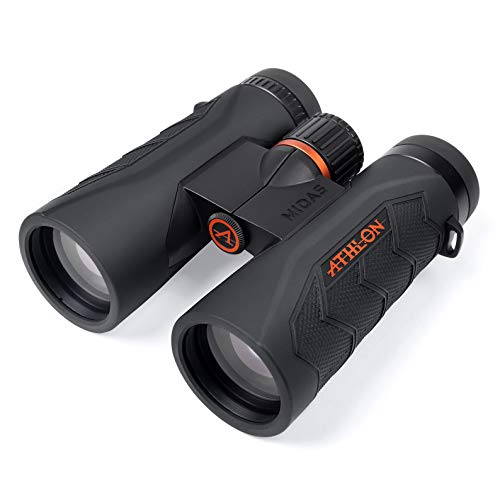
If finding the bird is your bottleneck, the Midas G2 UHD argues for itself with an 8.1-degree field of view, the widest in this roundup by a clear margin. Its ED glass pairs with an ESP dielectric prism coating that Athlon rates for very high light reflection, so the wide view stays bright rather than merely big. The magnesium chassis keeps it rigid, close focus reaches 6.5 feet for insects and feeder work, and the 17.2 mm eye relief suits most glasses wearers. At 25 ounces it is the heaviest pick here, the cost of that big, well-corrected image.
Specs:
– Magnification and objective: 8×42
– Glass: ED (extra-low dispersion), ESP dielectric prism coating
– Field of view: 8.1 degrees, 426 feet at 1,000 yards
– Eye relief: 17.2 mm
– Close focus: 6.5 feet
– Weight: 25 ounces
– Sealing: waterproof, magnesium chassis
– Model: Midas G2 UHD 8×42 (Black)
Vortex Optics Diamondback HD 10×42: The Reach Pick

The Diamondback HD is the one departure from 8x, included for birders whose problem is distance rather than darkness. Ten magnification pulls shorebirds and raptors noticeably closer, and the HD optical system with fully multi-coated lenses and phase coating keeps that bigger image clean. The close focus of 5 feet is a surprise bonus for a 10x glass. Two cautions come with the format: the 15 mm eye relief is tight for glasses, and the narrower 6.5-degree field plus extra shake make woodland work harder. Vortex includes a GlassPak harness case and covers the binocular with its unlimited, unconditional lifetime warranty.
Specs:
– Magnification and objective: 10×42
– Glass: HD optical system, phase coating
– Field of view: 6.5 degrees, 341 feet at 1,000 yards
– Eye relief: 15 mm
– Close focus: 5 feet
– Weight: 21.3 ounces
– Sealing: waterproof, fogproof and shockproof
– Model: DB-215
Celestron Nature DX ED 8×42: ED Glass, Sensible Compromises

The Nature DX ED takes the standard Nature DX design and upgrades the objective lenses to ED glass, which is the single change that matters most for backlit birds. The result sits between the budget and premium tiers: a 7.5-degree field that beats the Nikon, fully multi-coated BaK-4 prisms with phase coating, and 17.8 mm of eye relief. It is a little heavier than the Monarch M5 and its close focus of 6.5 feet is genuinely useful at feeders. For a birder stepping up from an entry-level porro prism, this is the upgrade that shows immediately.
Specs:
– Magnification and objective: 8×42
– Glass: ED objective lenses, BaK-4 prisms with phase coating
– Field of view: 7.5 degrees, 393 feet at 1,000 yards
– Eye relief: 17.8 mm
– Close focus: 6.5 feet
– Weight: 24.9 ounces
– Sealing: waterproof and fogproof, rubber-armored
– Model: 72332
Celestron Outland X 8×42: The Starter and Spare Pair
The Outland X is the honest budget option: BaK-4 prisms and multi-coated optics rather than full ED glass and dielectric coatings, in the same friendly 8×42 format. The 7-degree field and long 18 mm eye relief make it easy for beginners and glasses wearers, and it is light enough for a car glovebox or a loaner pair for guests. Its limits are real: close focus stops at 13.1 feet, so it is a bird glass, not a butterfly glass, and contrast in deep shade trails the ED models. As a first binocular or a second pair that lives by the kitchen window, it does the job without drama.
Specs:
– Magnification and objective: 8×42
– Glass: BaK-4 prisms, multi-coated optics
– Field of view: 7.0 degrees, 368 feet at 1,000 yards
– Eye relief: 18 mm
– Close focus: 13.1 feet
– Weight: 22.6 ounces
– Sealing: waterproof and fogproof, rubber-armored
– Model: 71346
How to Choose
Decide your habitat first. Woodland and garden birders should take an 8×42 with the widest field they can get, which points to the Athlon Midas G2 UHD or the Celestron Nature DX ED. Open-country birders who scan water and sky can trade field for reach with the Vortex Diamondback HD 10×42. If you wear glasses, filter by eye relief before anything else: the Nikon Monarch M5 at 19.5 mm and the Outland X at 18 mm are the safe choices, and the Vortex at 15 mm is the risky one. If most of your birding happens in the first and last hour of light, prioritise ED glass and prism coatings, because that is where the Monarch M5 and Midas G2 earn their keep.
Who Should Skip This Class of Binocular
Skip the 42 mm roof-prism class if your birding is mostly pelagic or seawatching: a spotting scope on a tripod outperforms any handheld binocular at those distances. Skip it if you mainly watch from a vehicle or hide and never walk, because a heavier 10×50 or 12×50 becomes practical once your arms stop carrying it. Photographers who already carry a long lens may find a compact 8×25 or 10×25 pocket binocular the better companion, accepting a dimmer dawn image for a fraction of the weight. And if your interest is really the night sky, the specialised large-aperture models in an astronomy roundup serve that purpose better than anything here.
Frequently Asked Questions
Is 8×42 or 10×42 better for bird watching?
For most birders, 8×42. It gives a wider field of view for finding birds, a brighter image at dawn and dusk, and less visible hand shake. Choose 10×42 when your birding is dominated by distance, such as shorebirds, waterfowl on open water and raptor migration, and accept the narrower, dimmer view as the trade.
What does ED glass actually do for a birder?
ED, or extra-low dispersion, glass reduces chromatic aberration, the coloured fringing that appears around high-contrast edges. On a backlit bird against a bright sky, that fringe can smear exactly the fine plumage detail you are trying to read. ED glass keeps edges cleaner, which is why four of the five picks here use it.
Can I use these binoculars with glasses on?
Yes, provided the eye relief is long enough. Look for roughly 17 mm or more and keep the eyecups twisted down. The Nikon Monarch M5 offers 19.5 mm and the Celestron Outland X 18 mm, both comfortable with spectacles; the Vortex Diamondback HD, at 15 mm, may crop the edges of the view for some glasses wearers.
How close can a birding binocular focus?
Close focus in this group ranges from 5 feet on the Vortex Diamondback HD to 13.1 feet on the Celestron Outland X. Anything under about 8 feet doubles as a tool for butterflies, dragonflies and feeder birds at a window. If close-up nature viewing matters to you, treat close focus as a headline spec, not a footnote.
Final Verdict
Buy the Nikon Monarch M5 8×42 if you want the single best balance of image quality, eye relief and weight for everyday birding. Take the Athlon Midas G2 UHD when a wide field of view is your priority, the Vortex Diamondback HD 10×42 when your birds are usually far away, the Celestron Nature DX ED as the value step into ED glass, and the Outland X as a starter or spare. Every model here is waterproof, fogproof and built for years of mornings outside; match the format to your habitat and the glass will do the rest.

More from Amazon
Programs that pair well with the guide above. Offers and eligibility are set by Amazon and may change.
Free shipping on eligible items, Prime Video and more. Eligible new members can start with a free trial.
Start a Prime free trialAudiobooks and podcasts to listen to on the go. Eligible new members can start with a free trial.
Try Audible freeAd-free music streaming. Eligible new subscribers can start with a free trial.
Try Music Unlimited freeA free business account with business pricing and bulk-buying tools for work, shop or home office.
Create a business accountAs an Amazon Associate we earn from qualifying purchases.