Key takeaways
- Plugging a US hair dryer into an adapter in Europe. It receives 230V and can burn out within seconds. Use the hotel’s dryer or a dual-voltage model switched to 230V.
- Stacking adapters. Plugging one adapter into another, or a power strip into an adapter, overloads small contacts and causes heat.
- Running everything from USB. Five devices on a 30W shared USB budget each get only a few watts. Charge the laptop from the AC socket with its own charger instead.
- Forgetting it in the wall. Adapters are the item most often left behind in hotels. A bright color helps.
The best universal power adapter for most travelers is a single-body adapter with slide-out US, UK, EU and AU plugs, a grounded AC socket and at least one USB-C port of 20W or more, such as the Epicka Universal Travel Adapter or the Zendure Passport line, because it covers outlets in more than 150 countries and charges a phone without a separate brick. If you also carry a laptop, choose a version with a 45-65W USB-C port, or pair a basic adapter with your own GaN charger.
A universal adapter changes plug shape, not voltage. Getting that distinction right, along with knowing which plug types your trip needs, prevents most travel-charging problems.
Our top picks


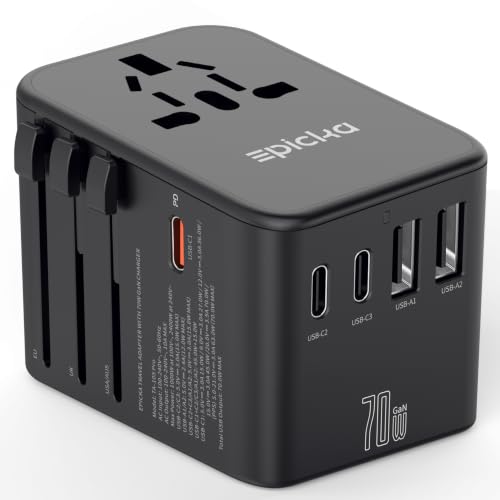

As an Amazon Associate we earn from qualifying purchases at no extra cost to you. Ratings are shown as listed on Amazon.
Adapter vs Converter: The Voltage Question
Electricity is about 120V in North America and parts of Central and South America and Japan (100V), and 220-240V across most of Europe, Asia, Africa and Australia. A universal adapter only reshapes the plug. Whether your device survives depends on its input rating.
| Device | Typical input label | Adapter alone OK? | Notes |
|---|---|---|---|
| Phone, tablet, laptop chargers | 100-240V, 50/60Hz | Yes | Nearly all modern USB chargers are dual voltage |
| Camera and drone battery chargers | 100-240V | Yes, usually | Check the label on the charger |
| Electric toothbrush, shaver | Varies | Sometimes | Many are dual voltage; some are 120V only |
| Hair dryer, straightener, curling iron | 120V only (US models) | No | Needs a dual-voltage model or a heavy converter; most adapters are rated far below 1,500-1,875W |
| Kettle, travel iron, CPAP humidifier heater | Often single voltage | No | Check the label; high-watt heaters exceed adapter limits |
Most universal adapters carry a maximum load rating such as 10A or 6A. At 230V, 10A is 2,300W in theory, but many are labeled lower for safety; at 120V, 6A is only 720W. Heating appliances can exceed those limits, so keep them off cheap adapters.
Plug Types by Destination
| Plug type | Shape | Common destinations |
|---|---|---|
| A / B | Two flat pins (B adds round ground) | US, Canada, Mexico, Japan, parts of Central America |
| C / E / F | Two round pins (Europlug and Schuko) | Most of continental Europe, much of South America, Korea, Indonesia |
| G | Three rectangular pins | UK, Ireland, Hong Kong, Singapore, Malaysia, UAE |
| I | Two angled flat pins plus ground | Australia, New Zealand, China (alongside A) |
| J / L / N | Country-specific three-pin designs | Switzerland (J), Italy (L), Brazil (N) |
A standard four-in-one universal adapter (US/UK/EU/AU) covers A, C, G and I directly. Type C Europlug pins fit most J, L and N sockets for ungrounded two-pin devices, but grounded three-pin plugs may not fit recessed Swiss, Italian or Brazilian outlets. Frequent visitors to those countries should carry a cheap country-specific adapter as well.
What Separates a Good Universal Adapter
USB output that is actually useful
Older adapters had 2.4A USB-A ports (12W), which charge a modern phone slowly. In 2026, look for at least one USB-C Power Delivery port at 20W for phones, 30-45W for tablets and MacBook Air, or 65W for most 14-inch laptops. Remember that USB output is shared: a 65W adapter with four USB ports usually drops to 45W + 20W when two are in use.
Grounding and fuse
Some compact adapters are ungrounded and accept only two-pin plugs. If you travel with a laptop power cord that has a ground pin, choose an adapter with a grounded socket. A replaceable fuse protects against overload; carrying one spare costs almost nothing.
Fit in the socket
A universal adapter is a stack of moving parts, and the extended plug can wobble in worn hotel sockets. Heavier adapters with a laptop charger plugged in front have more leverage. The Zendure Passport line and similar designs are known for a sturdy slide mechanism; budget no-name adapters are where loose pins and wobble are most common.
Safety shutters and certification
Child-safety shutters, flame-retardant housings and a recognized safety mark (such as CE in Europe or a UL/ETL listing) are worth having, especially in rentals and dorms.
Picks by Trip Type
| Traveler | Choose | Why |
|---|---|---|
| Phone-only weekend trip | Compact 4-in-1 adapter with one 20W USB-C | Replaces the phone charger entirely; lightest option |
| Family with several phones and tablets | 4-in-1 with AC socket plus 3-5 USB ports (30-45W total) | Charges everyone from one hotel outlet |
| Business trip with laptop | 4-in-1 GaN adapter with 65W USB-C | Leaves the laptop brick at home |
| Already own a good GaN charger | Basic adapter without USB, or slide-on country plug heads | Smallest and cheapest; your charger does the work |
| Frequent Switzerland, Italy, Brazil, South Africa | Universal adapter plus a country-specific plug | Universal designs often miss these sockets |
Expect broad price bands: basic plug-only adapters sit at the budget end, USB-equipped universal models in the low-midrange, and high-watt GaN universal adapters in the midrange, close to the cost of a quality laptop charger.
Common Mistakes
- Plugging a US hair dryer into an adapter in Europe. It receives 230V and can burn out within seconds. Use the hotel’s dryer or a dual-voltage model switched to 230V.
- Stacking adapters. Plugging one adapter into another, or a power strip into an adapter, overloads small contacts and causes heat.
- Running everything from USB. Five devices on a 30W shared USB budget each get only a few watts. Charge the laptop from the AC socket with its own charger instead.
- Forgetting it in the wall. Adapters are the item most often left behind in hotels. A bright color helps.
Bottom Line
For one-adapter-for-everywhere convenience, buy a four-in-one universal adapter with a grounded AC socket and a USB-C port sized to your largest device: 20W for phones, 65W if you want to leave the laptop charger at home. Check every appliance label for 100-240V before you plug in, and carry a country-specific plug for Switzerland, Italy, Brazil or South Africa.