Key takeaways
-
Best balance for an iPad: Logitech Combo Touch. It combines a removable keyboard, adjustable kickstand, protective case, and a large trackpad.
-
Best for a lightweight iPad workstation: Apple Magic Keyboard. Its rigid floating hinge and excellent trackpad feel are ideal at a desk, although it offers less protection and costs more.
-
Best for Surface Pro: Microsoft Surface Pro Flex Keyboard. It can be used attached to the tablet or separated over Bluetooth, which is useful when the screen needs to sit farther away.
-
Best ultralight keyboard: Logitech Keys-To-Go 2. It fits in a small bag and works with multiple devices, but it has no trackpad or integrated screen protection.
-
Best for a Galaxy Tab: Samsung Book Cover Keyboard, particularly the versions designed for Galaxy Tab S-series tablets. It provides a laptop-like layout, but fit and features vary substantially by tablet size and model.
The best tablet keyboards for typing on the go are the Logitech Combo Touch for flexible iPad travel, Apple’s Magic Keyboard for the slimmest premium desk setup, Microsoft’s Surface Pro Flex Keyboard for Windows work, and Logitech Keys-To-Go 2 when low weight matters more than a built-in trackpad.
Our top picks
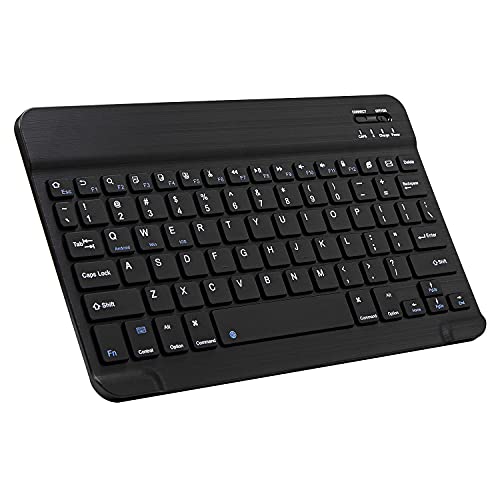


As an Amazon Associate we earn from qualifying purchases at no extra cost to you. Ratings are shown as listed on Amazon.
Quick picks by situation
-
Best balance for an iPad: Logitech Combo Touch. It combines a removable keyboard, adjustable kickstand, protective case, and a large trackpad.
-
Best for a lightweight iPad workstation: Apple Magic Keyboard. Its rigid floating hinge and excellent trackpad feel are ideal at a desk, although it offers less protection and costs more.
-
Best for Surface Pro: Microsoft Surface Pro Flex Keyboard. It can be used attached to the tablet or separated over Bluetooth, which is useful when the screen needs to sit farther away.
-
Best ultralight keyboard: Logitech Keys-To-Go 2. It fits in a small bag and works with multiple devices, but it has no trackpad or integrated screen protection.
-
Best for a Galaxy Tab: Samsung Book Cover Keyboard, particularly the versions designed for Galaxy Tab S-series tablets. It provides a laptop-like layout, but fit and features vary substantially by tablet size and model.
Comparison: the keyboards that make the most sense for travel
| Keyboard | Typical compatible device | Approximate weight | Trackpad | Connection | Protection and support |
|---|---|---|---|---|---|
| Logitech Combo Touch | Selected iPad, iPad Air, and iPad Pro models | About 600–780 g, depending on version | Yes | Smart Connector; no separate charging | Full case, detachable keyboard, adjustable kickstand |
| Apple Magic Keyboard | Selected iPad Pro and iPad Air models | About 580–670 g for current 11- and 13-inch versions | Yes | Smart Connector; no separate charging | Front and rear coverage, floating hinge, limited edge protection |
| Microsoft Surface Pro Flex Keyboard | Compatible Surface Pro models | About 340–350 g | Yes | Surface connection and Bluetooth | Keyboard cover, pen storage on supported versions, detachable use |
| Logitech Keys-To-Go 2 | iPad, Android tablets, Windows, and other Bluetooth devices | About 222 g | No | Bluetooth | Thin spill-resistant keyboard cover; no tablet protection |
| Samsung Book Cover Keyboard | Selected Galaxy Tab S-series models | Roughly 400–700 g, depending on tablet size and version | Some versions | Tablet connector; no routine charging on compatible models | Book-style cover and rear support; model-specific fit |
Weights in this table are approximate because manufacturers produce separate versions for different screen sizes. Check the exact model number before ordering: a keyboard made for an 11-inch tablet will not necessarily fit a newer 11-inch tablet, even when the screen diagonal is unchanged.
Logitech Combo Touch: the practical iPad choice
Combo Touch is the strongest all-rounder for people who carry an iPad between a kitchen table, classroom, train, and office. Its keyboard detaches, so the tablet can be used without the keys in the way. The kickstand usually offers a wide adjustment range, making it better than a fixed laptop-style hinge for reading, drawing, or watching video.
Its main advantage is protection. The case surrounds more of the tablet than Apple’s keyboard, and the raised edges are reassuring in a crowded bag. The trade-off is bulk: the case and keyboard can make an iPad feel closer to a small laptop than a tablet. The trackpad is roomy enough for document work, but its click and surface feel are generally less refined than Apple’s.
Choose Combo Touch if you frequently remove the tablet, want a stable kickstand, or do not want to carry a separate protective case. Avoid it if every gram matters or if you mainly type at a desk.
Apple Magic Keyboard: the best desk experience
Apple’s Magic Keyboard is the closest iPad accessory to a compact laptop dock. The keys have a relatively crisp, low-travel feel, the backlighting is useful in dim rooms, and the glass trackpad supports precise cursor movement and gestures. The floating hinge also keeps the tablet elevated, which can be more comfortable than typing with the screen flat behind the keyboard.
The design is rigid and compact, but that does not make it a complete protective shell. The corners and sides remain more exposed than they are with Combo Touch, and the hinge adds weight to the tablet when packed. The keyboard also has no function-row shortcuts on many versions, something to consider if you regularly adjust brightness, volume, or media controls.
It is a good purchase for a frequent typist who leaves the keyboard attached and values a clean desk setup. It is less compelling for occasional email, where a lighter Bluetooth keyboard or the tablet’s on-screen keyboard may be more convenient.
Microsoft Surface Pro Flex Keyboard: best for flexible Windows work
The Surface Pro Flex Keyboard addresses a limitation shared by many tablet keyboards: the screen and keys do not have to occupy the same surface. It can operate attached to the Surface or detached over Bluetooth, allowing the tablet to stand on a desk while the keyboard moves closer to the user.
The key layout feels more like a conventional laptop than a travel keyboard, and the integrated trackpad is important for Windows applications that are awkward to control by touch. Its cover design is slim, but it is not a rugged case. The detachable feature also means the keyboard must be charged when used wirelessly, creating one more battery to manage.
Pick it for office work, spreadsheets, and frequent switching between desk and lap. If you only need a keyboard for short notes, its price and extra complexity are difficult to justify.
Logitech Keys-To-Go 2: the weight-saving option
Keys-To-Go 2 is a useful answer when the keyboard must disappear into a small day bag. At about 222 grams, it weighs less than most tablet keyboard cases and can pair with several operating systems. Its built-in cover helps protect the keys from crumbs and light spills, while replaceable coin-cell batteries avoid regular USB charging.
There is no trackpad, kickstand, or tablet protection. You need a separate stand, and the keyboard works best on a firm table rather than a lap. The shallow keys are suitable for messages, notes, and moderate writing, but people who type for hours may prefer the deeper feel of a keyboard case.
Calculate the complete travel setup rather than the keyboard alone. For example, a 222 g keyboard plus a 250 g folding stand is about 472 g before adding the tablet. That can still be lighter than a 650 g integrated keyboard case, but only if you already own a suitable stand.
Samsung Book Cover Keyboard: check the exact Galaxy Tab version
Samsung’s Book Cover Keyboard range gives Galaxy Tab owners a coherent, connector-based option with a laptop-like layout. Higher-end versions may include a trackpad, while simpler versions omit it. The cover can be convenient for DeX desktop mode, where a pointer and keyboard make Android feel more like a conventional computer.
Fit is the key issue. Galaxy Tab models vary in camera position, magnetic attachment, thickness, and connector placement. A keyboard for a large Ultra tablet can also become surprisingly heavy once the tablet is included. Confirm the exact tablet name and generation, not merely “Galaxy Tab S,” before buying.
Decision matrix: choose by your real use
| Your situation | Best direction | Why |
|---|---|---|
| Daily typing at a desk | Apple Magic Keyboard or Surface Pro Flex Keyboard | Better trackpads, rigid support, and laptop-like key layouts |
| Frequent travel with protection needed | Logitech Combo Touch | Case coverage, detachable keys, and a broad kickstand range |
| Very limited bag space | Logitech Keys-To-Go 2 plus a folding stand | Low keyboard weight and multi-device Bluetooth pairing |
| Android tablet and DeX use | Compatible Samsung Book Cover Keyboard | Direct attachment and a layout suited to desktop-style use |
| Occasional notes and short emails | Light Bluetooth keyboard or no keyboard | An expensive case adds weight that may not repay its convenience |
Key feel, stability, and protection: what specifications do not tell you
Key travel matters more than the number of keys. Low-profile keyboards pack small but can feel cramped during long sessions. Look for full-size letter keys, a standard bottom row, and dedicated arrow keys if you edit documents or navigate spreadsheets.
Kickstand stability depends on the base as well as the hinge. A narrow stand may hold a tablet on a desk but wobble when tapped. On a lap, almost every tablet keyboard is less stable than a conventional laptop because the screen’s weight sits farther behind the hinge.
Trackpads are particularly valuable on iPadOS, Windows, and DeX when selecting text or dragging files. They are less important if you mostly write in a single app. A keyboard without a trackpad can be the better travel choice if it saves several hundred grams.
Ownership tips before and after buying
-
Measure the tablet’s height, width, thickness, camera position, and connector location. Screen size alone does not confirm compatibility.
-
Clean crumbs from the key gaps with a soft, dry brush. Avoid spraying liquid directly onto keys or connectors.
-
Expect key legends, hinge fabric, and trackpad coatings to show wear first. Heavy daily use makes these areas more important than a short-term discount.
-
Keep detachable keyboards separate from rough items such as chargers and metal pens, which can scratch the key surface or trigger magnets.
-
For Bluetooth models, charge or replace the battery before a trip and remove unused pairings if reconnection becomes unreliable.
For most travelers, the decision is simple: choose Combo Touch when protection and flexibility matter, Magic Keyboard or Surface Pro Flex when desk typing matters most, and Keys-To-Go 2 when carrying less is the overriding priority. The best tablet keyboards are not the ones with the longest feature list; they are the ones whose weight, fit, and support match how you actually use the tablet.