Key takeaways
- The mask should cover the nose and mouth without pressing hard against the eyes or leaving large gaps at the cheeks.
- Hold an infant or child upright rather than lying flat, unless a healthcare professional has advised otherwise.
- Do not strap a mask tightly enough to cause distress; crying changes breathing and can make treatment less effective or more difficult.
- Check whether the package includes both adult and child masks. Some inexpensive units include only one size.
- Replace a mask when it becomes stiff, cracked, cloudy, stretched, or difficult to clean.
The best nebulizers for home respiratory care are the Omron NE-C801 for quiet everyday use, the Omron MicroAIR U100 for portable battery-powered treatment, and a PARI compressor system with an LC Sprint nebulizer when treatment speed and durable output matter more than noise.
A nebulizer turns liquid medication into an inhalable aerosol. The right choice depends less on the longest feature list than on whether the device can deliver treatment at a convenient speed, fit the intended user’s face, and be cleaned correctly after every session. Prescribed medication, age, breathing ability, and local availability should guide the final choice with a clinician or pharmacist.
Our top picks

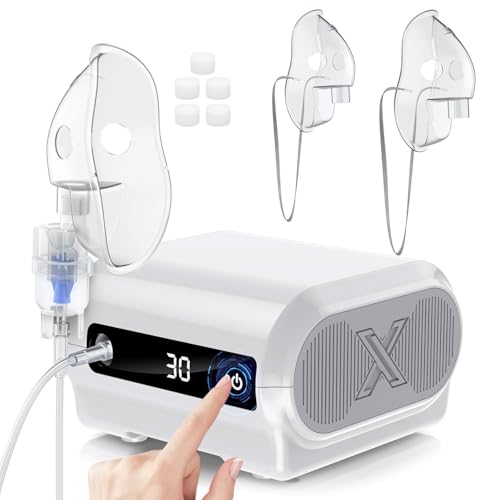

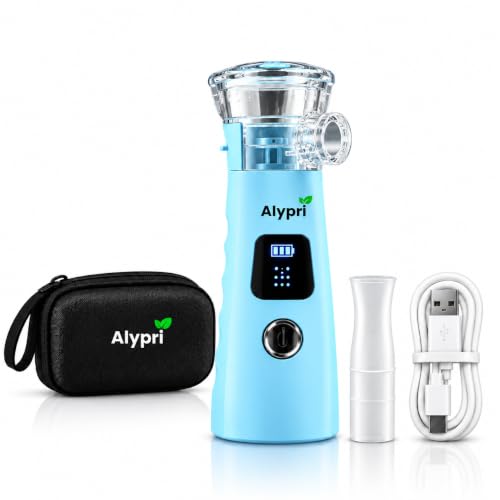
As an Amazon Associate we earn from qualifying purchases at no extra cost to you. Ratings are shown as listed on Amazon.
Best nebulizers by situation
| Situation | Best fit | Why it makes sense | Main compromise |
|---|---|---|---|
| Quiet treatment around a sleeping child | Omron NE-C801 | About 46 dB, compact compressor, child and adult masks commonly supplied | Slower than larger compressors for some medications |
| Travel, commuting, or treatment away from an outlet | Omron MicroAIR U100 | Handheld vibrating-mesh design, approximately 118 g, two AA batteries | Mesh cleaning and medication compatibility require more care |
| Frequent home use where output speed matters | PARI compressor with LC Sprint | High-output compressor system with a durable reusable nebulizer cup | Larger, louder, and dependent on mains power |
| Occasional, budget-conscious family use | Basic compressor nebulizer | Usually the lowest purchase cost and simple replacement parts | Typically 55–65 dB and less convenient to carry |
| Small bag or bedside drawer | Rechargeable mesh nebulizer | Often around 100–250 g and USB rechargeable | Battery and mesh reliability vary widely by model |
The table uses representative published specifications and common product configurations; accessories and exact measurements can vary by country and package. Do not substitute one nebulizer cup for another unless the manufacturer says it is compatible.
Head-to-head: compressor versus mesh nebulizers
Compressor models: dependable, but louder
A compressor pushes air through a medication cup and produces aerosol continuously or in response to breathing, depending on the design. The technology is familiar to clinics and generally forgiving of occasional handling mistakes. Replacement tubing, mouthpieces, masks, filters, and nebulizer cups are usually easier to identify and buy.
The disadvantages are practical. A compressor requires a mains outlet unless it is specifically designed for another power source. Typical home units weigh roughly 1–2 kg, occupy more space, and produce a noticeable hum. A treatment that takes 6–10 minutes on a high-output system may take longer on a compact quiet compressor.
The PARI LC Sprint is a useful example of the compressor approach: it is designed for efficient aerosol delivery and can be paired with several PARI compressor systems. It is not the smallest option, but it suits households that value a robust reusable cup and regular availability of replacement components.
Vibrating-mesh models: portable and quiet
Mesh nebulizers use a perforated vibrating membrane to create aerosol. They are usually much quieter than compressors and can run from batteries or an internal rechargeable battery. That makes them easier to use during travel, in a shared room, or with a child who dislikes loud equipment.
The trade-off is ownership discipline. Medication residue can block the mesh, and minerals from tap water may leave deposits. A mesh unit should be rinsed and dried exactly as its manual specifies; poking the membrane with a cotton bud, needle, or tissue can permanently damage it. Some suspensions, viscous liquids, or medications not intended for mesh delivery may perform poorly or be unsuitable. Confirm compatibility with a pharmacist or the device manufacturer before switching technology.
What the numbers mean in real use
| Characteristic | Compact compressor | Handheld mesh unit | Larger compressor system |
|---|---|---|---|
| Typical device weight | 0.8–1.3 kg | 0.10–0.25 kg | 1.2–2.0 kg |
| Typical noise | 45–55 dB | Less than 35 dB | 55–65 dB |
| Common medication-cup capacity | 6–10 mL | 6–10 mL | 8–10 mL |
| Typical treatment time for a 2.5 mL fill | 6–12 minutes | 4–8 minutes | 5–9 minutes |
| Power options | AC adapter | AA batteries or internal rechargeable battery | AC adapter |
| Cleaning burden | Medium: cup, mask, mouthpiece, tubing exterior | High: cup, mesh, electrodes or contacts, mask or mouthpiece | Medium: cup, mask, mouthpiece, tubing exterior |
These are useful planning ranges rather than universal performance claims. Particle size, breathing pattern, fill volume, medication viscosity, ambient temperature, and the condition of the cup all affect treatment time. A smaller particle specification alone does not prove that one device is clinically better for a particular medication.
Mask fit matters more than a small speed difference
For adults and cooperative older children, a mouthpiece usually reduces medication loss because the aerosol travels directly into the mouth. A mask is more practical for toddlers, children who cannot seal around a mouthpiece, and anyone who is too tired or unwell to coordinate breathing.
- The mask should cover the nose and mouth without pressing hard against the eyes or leaving large gaps at the cheeks.
- Hold an infant or child upright rather than lying flat, unless a healthcare professional has advised otherwise.
- Do not strap a mask tightly enough to cause distress; crying changes breathing and can make treatment less effective or more difficult.
- Check whether the package includes both adult and child masks. Some inexpensive units include only one size.
- Replace a mask when it becomes stiff, cracked, cloudy, stretched, or difficult to clean.
A practical fit check is to watch for aerosol escaping continuously around the cheeks while the user breathes normally. A small visible gap can waste more medication than a modest difference in advertised output rate.
Power, portability, and treatment-time calculation
For occasional use beside a bed, AC power is usually simplest. For travel, a mesh nebulizer avoids carrying a compressor and tubing, but battery planning is essential. If a device uses two AA batteries and your household completes two 7-minute sessions daily, a pair rated for roughly 1,000 minutes of intermittent use would theoretically cover about 71 sessions:
1,000 minutes ÷ (2 sessions × 7 minutes) = approximately 71 days.
Real-world life may be shorter because output declines as batteries discharge, and the motor or mesh may draw power differently with each medication. Rechargeable models remove the need to carry spare cells but introduce charging time and eventual battery wear. Avoid leaving a rechargeable unit unused for months at zero charge.
When comparing advertised treatment time, compare like with like. A 3 mL fill finished in 5 minutes is not automatically faster than a 2 mL fill finished in 4 minutes. Also allow time for setup, cleaning, and drying. A device saving two minutes of aerosol time but requiring delicate mesh maintenance may be less convenient for frequent family use.
Cleaning and ownership realities
Cleaning is not optional. Residue can obstruct the aerosol path, alter output, or allow contamination. Follow the manual and medication instructions, because some parts are dishwasher-safe while others are not.
- Wash your hands and disconnect the device from power.
- Discard leftover medication; do not store it in the cup for the next session.
- Separate the medication cup, mouthpiece, and mask. Keep compressor tubing dry unless the manual specifically permits washing it.
- Rinse washable parts with the recommended water, then air-dry them on a clean towel.
- Disinfect at the interval specified by the manufacturer, particularly when several people share the device.
- Inspect the cup, valve, mask, tubing, and filter before the next use.
The parts that usually wear first are the nebulizer cup, one-way valves, tubing, masks, mouthpieces, mesh membrane, and compressor air filter. Keep a spare cup and mask if treatment is important, but use only approved replacements. A cracked cup or flattened valve can make a normally capable compressor appear weak.
Common buying mistakes
- Choosing by decibel rating alone without checking medication compatibility.
- Buying a child-sized mask for an adult or assuming one mask fits every face.
- Ignoring replacement-part availability and the cost of cups, filters, and batteries.
- Using tap water, essential oils, or unprescribed liquids in the medication cup.
- Cleaning a mesh membrane with sharp objects.
- Expecting a nebulizer to replace an inhaler, spacer, oxygen equipment, or another prescribed treatment.
Bottom line
Choose the Omron NE-C801 when low noise and a compact home compressor are priorities. Choose the Omron MicroAIR U100 when portability, battery operation, and quiet use outweigh the extra cleaning care. Choose a PARI compressor paired with an LC Sprint when frequent users prioritize established replacement parts and efficient compressor delivery. For any option, confirm the prescribed medication, particle/output requirements, mask size, and cleaning instructions with a healthcare professional before purchase.