Key takeaways
- 14-gauge (1.9mm): Minimum for a true security safe. Common in quick-access handgun safes and entry-level long-gun safes from brands like Vaultek, SentrySafe, and Stack-On. Resists hand tools but can be defeated with pry bars if not bolted down.
- 12-gauge (2.6mm): Noticeably more pry-resistant. Found in mid-range home safes from Liberty Safe (Centurion series), Hornady Rapid Safe, and Fort Knox. Best balance of weight and security for most homes.
- 10-gauge (3.4mm) and 7-gauge (4.5mm): Heavy-duty residential safes. Found in Liberty Safe Colonial/Franklin series and Fort Knox Maverick series. Significantly heavier and harder to move, often requires professional delivery.
- Door vs. body: Many manufacturers use thicker steel on the door (e.g., 10-gauge door with 12-gauge body). Check both specs. A 12-gauge body with a 10-gauge door is stronger than a uniform 14-gauge build.
The best gun safes for home security for quick access are 14- to 12-gauge steel models with electronic keypad or biometric entry under 2 seconds, a 30 to 75-minute fire rating at 1200°F, and included bolt-down hardware — with the right pick depending on whether you need bedside access for one handgun, closet storage for 3-5 long guns, or full-capacity storage for 8+ firearms.
Our top picks
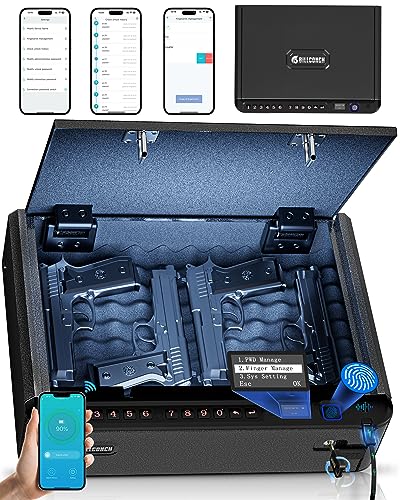


As an Amazon Associate we earn from qualifying purchases at no extra cost to you. Ratings are shown as listed on Amazon.
What Actually Makes a Gun Safe Quick and Secure
Quick-access home security safes balance three competing factors: steel thickness to resist prying, lock speed to get you in fast, and fire protection to survive house fires. Most buyers overestimate fire rating and gun count while underestimating steel gauge and anchoring. Here is how to evaluate each spec before you choose.
1. Steel Gauge: Thinner Number Means Thicker Steel
Steel gauge is the single best indicator of pry resistance. For home security, avoid 16-gauge and thinner cabinets often marketed as “gun safes” — they are gun cabinets. Look for:
- 14-gauge (1.9mm): Minimum for a true security safe. Common in quick-access handgun safes and entry-level long-gun safes from brands like Vaultek, SentrySafe, and Stack-On. Resists hand tools but can be defeated with pry bars if not bolted down.
- 12-gauge (2.6mm): Noticeably more pry-resistant. Found in mid-range home safes from Liberty Safe (Centurion series), Hornady Rapid Safe, and Fort Knox. Best balance of weight and security for most homes.
- 10-gauge (3.4mm) and 7-gauge (4.5mm): Heavy-duty residential safes. Found in Liberty Safe Colonial/Franklin series and Fort Knox Maverick series. Significantly heavier and harder to move, often requires professional delivery.
- Door vs. body: Many manufacturers use thicker steel on the door (e.g., 10-gauge door with 12-gauge body). Check both specs. A 12-gauge body with a 10-gauge door is stronger than a uniform 14-gauge build.
2. Fire Rating: Minutes Matter More Than Marketing
Fire rating is tested at a sustained external temperature, typically 1200°F or 1400°F. For home use, 30 minutes is the minimum to survive an average room-and-contents fire until firefighters arrive. 60 to 75 minutes provides more margin if you live rurally or store documents and ammunition inside. Above 90 minutes is usually overkill for quick-access safes and adds significant weight and cost due to fireboard layers.
Check whether the rating is from an ETL or UL verified test versus an internal factory test. Verified tests maintain an internal temperature below 350°F, protecting paper and preventing ammo cook-off. Seals matter too — intumescent door seals expand when heated to block smoke and heat.
3. Biometric vs. Keypad vs. Mechanical: Entry Speed and Reliability
For home security, entry speed under stress is critical. There is a trade-off between speed and failure points:
- Biometric (fingerprint): Fastest at 0.5 to 1.5 seconds when your finger is clean and positioned correctly. Modern capacitive sensors from Vaultek and Hornady are far more reliable than older optical sensors, but they still fail more often with wet, dirty, or injured hands and require battery power. Always choose a model with a backup keypad or key.
- Electronic keypad (4-8 digit PIN): 1.5 to 2.5 seconds with muscle memory. More reliable in adverse conditions, fewer false rejections, and easier to share access via code. Battery life is typically 6-12 months on 4x AA batteries. Look for backlit keys and wrong-try lockout.
- Mechanical Simplex / dial: No batteries, decades-long reliability, but 3 to 5 seconds and requires precise finger placement. Found on Fort Knox and V-Line quick-access safes. Preferred for those who want zero electronics.
If your primary use is middle-of-the-night bedside access, a biometric + keypad combo gives you both speed and a fallback. For a closet long-gun safe opened a few times a month, a keypad alone is often more dependable.
Comparison Table: Quick-Access Home Security Safes by Type
This table shows realistic specs for current product categories in 2026. Weight, interior dimensions, and battery life are where listings often hide compromises.
| Category / Example Type | Steel Gauge (Body/Door) | Fire Rating | Lock Type & Avg. Entry Time | Labeled vs. Realistic Long Gun Capacity | Weight | Battery Life |
|---|---|---|---|---|---|---|
| Bedside Handgun Safe (Vaultek RS / Hornady Rapid Safe style) | 14-gauge / 14-gauge | None or 30 min* | Biometric + Keypad, 1.0 – 2.0 sec | 1-2 handguns (no long guns) | 13 – 28 lbs | 4-6 months (rechargeable Li-ion) |
| Compact Long-Gun Safe 10-18 Gun (Stack-On Total Defense / SentrySafe QAP2BE style) | 14-gauge / 14-gauge | 30 min at 1200°F | Keypad, 2.0 sec | Labeled 10 / Realistic 5-6 with scopes | 120 – 250 lbs | 8-12 months (4x AA) |
| Mid-Range Home Safe 24-30 Gun (Liberty Safe Centurion 24) | 12-gauge / 12-gauge body, 10-gauge door | 40-60 min at 1200°F | Keypad (SecuRam), 2.0 sec | Labeled 24 / Realistic 12-14 | 380 – 550 lbs | 12 months (9V / AA) |
| Heavy-Duty Home Safe 30-50 Gun (Liberty Safe Colonial / Fort Knox Maverick) | 11-gauge / 10-gauge to 7-gauge door | 75-110 min at 1200°F-1400°F | Keypad or Dial, 2.0 – 4.0 sec | Labeled 48 / Realistic 24-30 | 700 – 1100 lbs | 12+ months or mechanical no battery |
| Heavy All-Steel Handgun Vault (Fort Knox PB1 / V-Line Brute) | 10-gauge / 10-gauge | None (security-focused) | Mechanical Simplex, 3.0 sec | 1-2 handguns | 22 – 35 lbs | No battery (mechanical) |
* Many bedside vaults prioritize 16-gauge steel and quick access over fire protection. If fire protection is required for handguns and documents, choose a model explicitly rated for 30+ minutes.
Best Picks by Situation: Decision Matrix
Use your primary constraint — space, access speed, and firearm count — to narrow the field.
| Your Situation | Best Safe Type | Why It Fits | What to Check Before Buying |
|---|---|---|---|
| Apartment or bedroom, 1-2 handguns, need sub-2-second access | Biometric + keypad bedside vault, 14-gauge, bolt-down ready | Light enough for nightstand or under-bed, opens one-handed in the dark | Interior height must fit your pistol with optic; confirm CA DOJ approval if required in your state |
| Single-family home, 3-6 long guns with optics, closet install | 12-gauge mid-range safe, 40-60 min fire rating, keypad | Realistic capacity for scoped rifles, fire protection for residential response time | Measure closet door: most 24-gun safes are 60.5″ H x 26″ W x 22″ D; check swing clearance |
| Family home, 8+ long guns, documents and valuables | Heavy-duty 30+ gun safe, 75+ min fire rating | Thicker steel and fireboard protects contents longer; holds guns without cramming | Floor load: 900+ lbs on 4 sq ft = 225 lbs/sq ft — confirm floor joist capacity and hire installers |
| No-battery, maximum reliability priority | 10-gauge mechanical vault (handgun) or dial-lock long-gun safe | No electronics to fail; works after years without maintenance | Practice the combo until it is muscle memory; mechanical locks are slower under stress |
| Rental or frequent moves | 14-gauge compact safe under 300 lbs with pre-drilled bolt holes + steel anchor kit | Can be moved without equipment and still anchored securely | Get landlord permission for floor anchors; use concrete sleeve anchors or lag bolts into studs/joists |
Interior Capacity vs. Labeled Gun Count: Do the Math
Manufacturers count capacity using unscoped .22 or slender shotguns stored without shelves. With scoped AR-15s, bolt rifles, and pistol grips, realistic capacity is 45% to 60% of the label.
Worked calculation: A safe labeled “24-gun” typically has an interior width of about 24 inches on the gun side. A scoped AR-15 needs about 3.5 to 4 inches of width on the rack, a scoped bolt rifle about 4 inches.
24-inch rack / 4 inches per scoped rifle = 6 scoped rifles per row. With a standard two-row gun rack, that is 12 scoped rifles. Add a side shelf for handguns/ammo and you lose another 2 slots. Realistic total: 10-12 long guns, not 24. If you store 6 long guns, buy a 12 to 18-gun labeled safe. If you store 12, buy a 24 to 30-gun labeled safe.
Also check interior depth. Safes with 12 inches of usable depth cannot close on a 42-inch rifle with a muzzle brake. Look for at least 14 inches interior depth for modern sporting rifles.
Bolt-Down Hardware: Why Anchoring Matters More Than Weight Alone
An unanchored 400-lb safe can be tipped and pried open with leverage in minutes or carried out by two people with a dolly. Anchoring is what turns a safe into security.
- What should be included: At least 4 pre-drilled anchor holes in the floor (not just the back wall), 3/8″ x 3″ concrete wedge anchors or 1/2″ x 2.5″ lag bolts with washers for wood subfloor. Look for anchor hole caps that hide the bolts from inside.
- Where to anchor: Concrete slab in a garage or basement is ideal. For wood floors, span at least two floor joists and use lag bolts into the joists, not just plywood. Use a stud finder and pilot drill.
- Common mistake: Anchoring only to drywall or to the wall studs behind the safe. Wall anchors prevent tipping but do not prevent removal; floor anchoring does both.
- Rental alternative: If you cannot drill, choose the heaviest safe your floor can support and add a steel anchoring plate or security cable to a structural point, but understand this is less secure than floor bolts.
Installation tip: Level the safe with shims before anchoring, then torque anchors evenly. An unlevel door will sag and wear the bolt work prematurely.
Durability and Ownership Realities
What wears first is not the steel — it is the electronics and seals.
- Batteries and electronics: Keypad batteries die every 6-12 months even without use. Set a calendar reminder. Biometric scanners degrade if you never clean them — wipe the sensor monthly with a dry microfiber cloth, not solvents. Keep the backup keys outside the safe, not inside it.
- Lock solenoids and bolt work: Cheap solenoids stick after 3-5 years in humid environments. Lubricate the bolt work annually with a light silicone-based lubricant, never oil or grease that attracts dust.
- Fire seals and humidity: Intumescent seals crack after 7-10 years or in very dry climates. Replace if they become brittle. All gun safes trap moisture — use a rechargeable dehumidifier rod or desiccant canister and check it quarterly to prevent rust, especially on 14-gauge interiors without carpet lining.
- Common mistakes: Stacking ammo on the top shelf directly under the top seam (heat enters fastest there), overloading door organizers so the door will not fully latch, and forgetting to reprogram the factory default code. Change the default code during setup and test the new code three times with the door open.
Maintenance takes about 15 minutes twice a year: replace batteries, vacuum interior, wipe the door seal, function-test the lock with the door open, and confirm anchor bolts are still tight.
How to Set Up a Quick-Access Safe Correctly
A safe that is fast on day one can be slow on day 90 if set up poorly. Follow this sequence:
- Unbox and leave the door open. Install batteries and program your primary code and a second fingerprint at two different angles.
- Test entry 10 times with the door open, then 5 times with eyes closed to build muscle memory in the dark.
- Position the safe where you can reach it without standing or crossing the room — bedside vaults work best at mattress height, not on the floor.
- Bolt it down before loading firearms. Use a level and torque anchors as specified.
- Load firearms with muzzles up, bolts open if possible, and no round chambered for storage. Store magazines loaded but separate to speed access while meeting safe storage laws in many states.
- Add interior lighting. Battery LED strips prevent fumbling and do not affect fire rating.
Frequently Asked Questions
Do I need a fire-rated safe for quick access?
If the safe holds your only defensive firearm, prioritize access speed and steel over fire rating — a bedside vault without a fire rating but with quick biometric entry is appropriate. For primary long-gun storage, choose at least 40 minutes at 1200°F to protect contents during an average house fire.
Are biometric safes reliable enough for home defense?
Yes when they are capacitive sensors from reputable brands and paired with a keypad backup. Register the same finger twice and keep the keypad code memorized. Replace batteries proactively, not when the low-battery warning appears.
Can I put a gun safe upstairs?
Yes if the floor can support the load. Many second floors are rated for 40 lbs per square foot. A 500-lb safe on a 6 sq ft footprint is 83 lbs/sq ft — over the limit. Spread the load with a steel plate or place it against a load-bearing wall over joists, or choose a lighter 14-gauge model under 300 lbs.
How often should I change the batteries and codes?
Change batteries every 6 months for lithium rechargeable models or annually for AA models, even if the indicator shows life remaining. Change codes only when access needs change or if you suspect compromise — frequent code changes increase the chance of forgetting under stress.