Key takeaways
- Open-weave gauze: airy appearance, high daylight, weak nighttime privacy.
- Standard voile: balanced light diffusion and daytime privacy for living areas.
- Privacy sheer: denser weave, better silhouette reduction, slightly dimmer rooms.
- Polyester-linen blend: textured appearance, but often more prone to wrinkles and shrinkage than polyester.
- Polyester: usually the easiest material to wash, dry, and replace consistently.
The best sheer curtains combine the right opacity, panel width, heading style, and length for your window—not simply the thinnest fabric available.
For most homes, choose a tightly woven polyester or polyester-linen sheer with approximately 40–60% light transmission, two panels that together measure 1.5–2 times the curtain-rod width, and a heading compatible with how often you open the curtains. Use a denser voile or privacy sheer for street-facing rooms, a lighter gauze for decorative layering, and extra-wide panels for large windows or sliding doors.
Our top picks


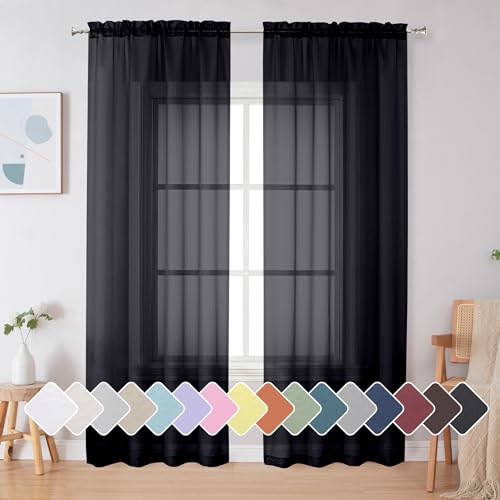
As an Amazon Associate we earn from qualifying purchases at no extra cost to you. Ratings are shown as listed on Amazon.
Best sheer curtains by room and window type
| Situation | Recommended fabric | Target light transmission | Panel and length guidance | Best heading |
|---|---|---|---|---|
| Bedroom facing a street | Dense voile or privacy sheer | 35–50% | Two panels, 1.75–2× rod width; just to the floor | Back tab or pinch pleat |
| Small living-room window | Medium-weight polyester sheer | 45–60% | Two panels, 1.5–1.75× rod width; 1–2 cm above floor | Rod pocket or back tab |
| Large picture window | Polyester-linen blend or tightly woven voile | 40–55% | Four standard panels or two extra-wide panels; 1.75–2× rod width | Grommet or pinch pleat |
| Sliding glass door | Durable polyester sheer | 40–55% | Two or three panels reaching the floor; 10–20 cm above the door frame | Grommet or back tab |
| Kitchen or frequently opened window | Machine-washable polyester voile | 50–70% | Sill or apron length; avoid excess fabric near worktops | Rod pocket or back tab |
How sheer fabric affects privacy and soft light
Opacity and privacy are related, but they are not the same specification. A curtain can look visually dense while still allowing silhouettes to appear at night when indoor lights are on. During daylight, sheer fabric generally provides useful privacy because the brighter exterior makes it difficult to see inside. After dark, the balance reverses.
For a room that needs reliable evening privacy, pair sheer curtains with roller shades, blinds, lined drapes, or privacy film. If you want one fabric to do more of the work, choose a tightly woven privacy sheer rather than an open-weave gauze. It will soften daylight less dramatically, but it usually obscures outlines more effectively.
- Open-weave gauze: airy appearance, high daylight, weak nighttime privacy.
- Standard voile: balanced light diffusion and daytime privacy for living areas.
- Privacy sheer: denser weave, better silhouette reduction, slightly dimmer rooms.
- Polyester-linen blend: textured appearance, but often more prone to wrinkles and shrinkage than polyester.
- Polyester: usually the easiest material to wash, dry, and replace consistently.
Choose the correct curtain width
Measure the curtain rod, not just the glass. Include the full rod span between finials, then multiply it by the fullness factor. A 1.5× factor creates a relatively restrained look; 2× produces fuller folds and better visual coverage when the curtains are closed.
For example, a 240 cm rod needs approximately 360–480 cm of total flat curtain width:
240 cm × 1.5 = 360 cm
240 cm × 2 = 480 cm
If each panel is 140 cm wide, two panels provide 280 cm, which is too narrow for a full appearance on that rod. You would need either four 140 cm panels, two panels around 200–240 cm wide each, or a deliberately flatter installation.
Extra fullness is especially useful for sheer curtains because thin fabric can look sparse when stretched. However, avoid excessive fullness on a narrow window: it consumes stack-back space and may block part of the glass when open.
Get the length right for each installation
For a rod mounted above a window, measure from the top of the rod or the bottom of the rings to the desired endpoint. For floor-length curtains, allow either a 1–2 cm clearance for a clean finish or an extra 2–5 cm for a relaxed break. Avoid a long puddle in high-traffic areas, where hems collect dust and catch on vacuum cleaners.
- Sill length: finish 1–2 cm above the sill; practical for kitchens and radiators.
- Apron length: finish about 10–15 cm below the sill; useful for casual rooms.
- Floor length: finish 1–2 cm above the floor; the easiest option to maintain.
- Door length: reach the floor and extend the rod beyond the frame so the panels clear the opening.
For a 210 cm floor-to-rod measurement, buy a curtain close to 210 cm after accounting for the heading. Do not assume the stated product length equals the hanging length: rod-pocket, tab-top, grommet, and pinch-pleat curtains each position the fabric differently.
Heading styles compared
| Heading | Best for | Opening effort | Stack-back and appearance | Potential drawback |
|---|---|---|---|---|
| Rod pocket | Infrequently moved decorative panels | High friction | Soft gathered top; compact hardware | Awkward on wide or frequently used windows |
| Back tab | Low-cost, cleaner-looking installations | Moderate | Concealed rod with relaxed folds | Tabs can wear if pulled roughly |
| Grommet | Sliding doors and regular opening | Low | Even, broad folds; modern appearance | Requires a compatible rod and creates visible hardware |
| Pinch pleat | Formal rooms and curtain tracks | Low with rings or gliders | Structured folds and controlled stack-back | Usually costs more and needs accurate spacing |
A practical decision matrix
| Priority | Choose | Avoid |
|---|---|---|
| Lowest initial cost | Standard polyester, rod pocket, ready-made panels | Custom linen blends and complex pleats |
| Frequent daily use | Grommets, rings, or gliders with reinforced top seams | Rod pockets on wide windows |
| Small room | Light-colored medium-density sheers, mounted high and wide | Very heavy texture or excessive pooling |
| Maximum daytime privacy | Dense privacy sheer with 1.75–2× fullness | Loose gauze or widely spaced open weave |
| Rental or temporary setup | Ready-made panels with a tension or removable rod | Heavy hardware that requires permanent drilling |
Ownership details that affect value
Sheer curtains often fail first at the top edge, hems, and areas exposed to direct sunlight. Repeated pulling can stretch rod pockets and back tabs, while ultraviolet exposure can yellow or weaken inexpensive fibers over time. On a sliding door, choose a reinforced header and a track or rod that lets the panel glide without dragging.
Wash according to the care label, but a useful general routine is a cool, gentle cycle, mild detergent, and low or no heat. Remove the curtains promptly to reduce wrinkles, then hang them slightly damp. Avoid bleach unless the manufacturer specifically permits it; it can weaken fine fibers and create uneven color. Dust or vacuum the panels before washing, particularly in rooms with open windows.
Do not iron sheer fabric at high heat. If pressing is necessary, use the lowest suitable setting and a pressing cloth. For linen blends, expect some natural creasing rather than treating every wrinkle as a defect.
What to check before buying
- Confirm whether the listed width is for one panel or the pair.
- Check the actual hanging length from the heading to the hem.
- Look for fabric composition, care instructions, and shrinkage guidance.
- Measure the rod and calculate total width before choosing a pack size.
- Check the return policy if the color or opacity is difficult to judge online.
- Order a swatch when matching walls, upholstery, or layered blackout curtains.
Bottom line
The best sheer curtains for a small, bright room are usually medium-density polyester panels with moderate fullness and a simple back-tab or rod-pocket heading. For a street-facing bedroom, step up to a denser privacy sheer and plan a second privacy layer for nighttime. For a wide window or sliding door, prioritize extra-wide panels, reinforced construction, and a low-friction grommet or track system. Measure first, treat the stated opacity as daytime guidance rather than a nighttime guarantee, and match the heading to how often the curtains will actually move.