Key takeaways
- Compare top 360 cameras for travel, action and virtual tours. We cover resolution, sensors, stabilization, battery life and storage to help you choose.
- Top Pick: Insta360 X5
- Runner-up: DJI Osmo 360
- Also consider: Insta360 X4
The best 360 cameras for most buyers are the Insta360 X5, the DJI Osmo 360, the Insta360 X4, the Insta360 One RS 1-Inch 360 Edition and the Ricoh Theta Z1 51GB. Together they cover travel video, action sports, creative reframing, low-light stills and virtual tours. If you want the sharpest all-round 360 video, start with the X5 or the Osmo 360. If you want a lower-cost route, the X4 is the proven mid-range choice, and if still photography matters more, the Theta Z1 51GB is the specialist pick.
A 360 camera records everything around it at once, using two lenses that face in opposite directions. The footage is stitched into a single spherical video or photo, and you choose the viewing angle later in an app or on a computer. That freedom is the main advantage over a conventional camera, because reframing lets you follow the action without aiming the camera while you shoot.
As an Amazon Associate, we earn from qualifying purchases.
Quick Answer
For most buyers, the Insta360 X5 is the best 360 camera, thanks to its 8K 360 video, 72-megapixel photos, larger sensors and long battery life. The DJI Osmo 360 is the closest rival, with 120-megapixel photos and generous built-in storage. Choose the X4 for a proven mid-range option, the One RS 1-Inch 360 Edition for large-sensor image quality, or the Theta Z1 51GB for virtual tours and still photography.
Insta360 X5

The Insta360 X5 is the premium all-round pick in this guide, and the best 360 camera for most buyers. It records 8K 360 video at 30 frames per second and captures 72-megapixel 360 photos, using two 1/1.28-inch sensors that are larger than the sensors in the X4, which helps in low light and in high-contrast scenes. The X5 is waterproof to 15 metres without a separate case, has a 2.5-inch touchscreen and uses a removable 2400 milliamp-hour battery. Its published specifications list FlowState stabilization and horizon lock, and the companion app supports reframing and quick edits.
Specs
| Feature | Detail |
|---|---|
| Video resolution | 8K 360 video at 30 frames per second |
| Photo resolution | 72-megapixel 360 photos |
| Sensors | Two 1/1.28-inch sensors |
| Stabilization | FlowState stabilization with horizon lock |
| Water resistance | Waterproof to 15 metres |
| Battery | Removable 2400 milliamp-hour battery |
| Storage | Memory card slot |
| Weight | 200 grams |
DJI Osmo 360
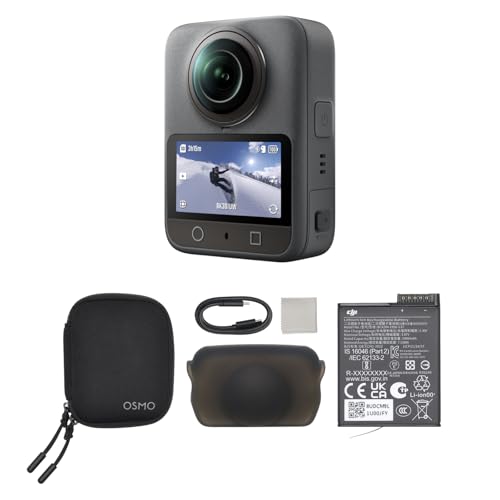
The DJI Osmo 360 is the premium rival to the Insta360 X5, and it stands out for its large sensors, its very high still resolution and its built-in storage. It records native 8K 360 video at up to 50 frames per second and captures 120-megapixel 360 photos, the highest still resolution in this guide. Its square 1-inch sensors help in low light and in high-contrast scenes, and the camera also offers a 4K single-lens mode. It is waterproof to 10 metres without a case, has a 2-inch touchscreen and uses a 1950 milliamp-hour battery. Its published specifications list 128 gigabytes of built-in storage in addition to a memory card slot, and magnetic quick-release mounting makes it easy to move between mounts.
Specs
| Feature | Detail |
|---|---|
| Video resolution | 8K 360 video at up to 50 frames per second |
| Photo resolution | 120-megapixel 360 photos |
| Sensors | Two square 1-inch sensors |
| Stabilization | Electronic stabilization with horizon balancing |
| Water resistance | Waterproof to 10 metres |
| Battery | 1950 milliamp-hour battery |
| Storage | 128 gigabytes built-in storage plus memory card slot |
| Weight | 183 grams |
Insta360 X4

The Insta360 X4 is the mid-range pick in this guide, and a good choice if you want proven 8K 360 performance at a lower tier than the X5. It records 8K 360 video at 30 frames per second, captures 72-megapixel 360 photos and uses two half-inch 48-megapixel sensors. The photo resolution matches the X5. The X4 is waterproof to 10 metres, has a 2.5-inch touchscreen and uses a removable 2290 milliamp-hour battery. Its published specifications list FlowState stabilization and horizon lock, and the companion app offers reframing and artificial intelligence editing tools.
Specs
| Feature | Detail |
|---|---|
| Video resolution | 8K 360 video at 30 frames per second |
| Photo resolution | 72-megapixel 360 photos |
| Sensors | Two half-inch 48-megapixel sensors |
| Stabilization | FlowState stabilization with horizon lock |
| Water resistance | Waterproof to 10 metres |
| Battery | Removable 2290 milliamp-hour battery |
| Storage | Memory card slot |
| Weight | 203 grams |
Insta360 One RS 1-Inch 360 Edition
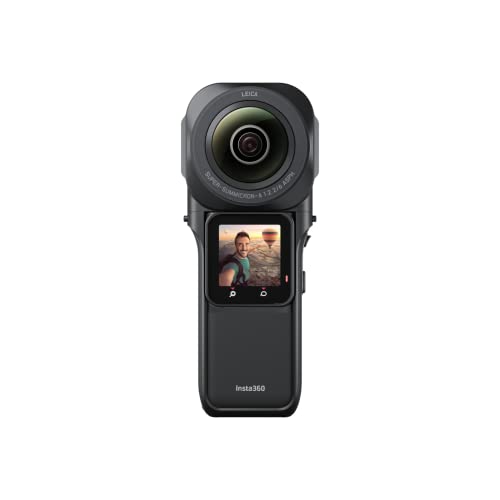
The Insta360 One RS 1-Inch 360 Edition is the large-sensor specialist in this guide, and the best choice here for buyers who put image quality ahead of waterproofing. It was co-engineered with Leica, and it uses dual 1-inch sensors to capture 6K 360 video and 21-megapixel 360 photos. The larger sensors capture more light per pixel, which helps dynamic range and low-light performance, and the published specifications list PureShot high dynamic range photo mode. The modular design sets this camera apart: the lens module, the core and the battery base separate, so the system can be reconfigured, although that makes it bulkier than a single-body camera. It is rated IPX3, so it handles light rain and snow but is not a camera for swimming or diving without a separate dive case, and its published run time is about 62 minutes at 6K and 30 frames per second.
Specs
| Feature | Detail |
|---|---|
| Video resolution | 6K 360 video at 30 frames per second |
| Photo resolution | 21-megapixel 360 photos |
| Sensors | Two 1-inch sensors |
| Lens | Co-engineered with Leica, f/2.2 aperture |
| Stabilization | FlowState stabilization with horizon lock |
| Water resistance | IPX3, protection against light rain and snow |
| Battery | 1350 milliamp-hour battery |
| Run time | About 62 minutes at 6K and 30 frames per second |
| Storage | Memory card slot |
| Weight | 239 grams |
Ricoh Theta Z1 51GB
The Ricoh Theta Z1 51GB is the still-photography specialist in this guide, and the best 360 camera here for virtual tours, real estate and business use. It captures about 23-megapixel spherical still images and records 4K 360 video at 30 frames per second, using two 1-inch back-illuminated sensors. Its variable aperture, with settings of f/2.1, f/3.5 and f/5.6, gives more control over exposure than most pocket 360 cameras, and it supports raw photo capture. The camera has 51 gigabytes of internal memory, with room for about 6350 JPEG still images or about 110 minutes of 4K video, and it has no memory card slot. A small 0.93-inch display shows shooting information, and its published battery life is about 300 still images or about 60 minutes of video.
Specs
| Feature | Detail |
|---|---|
| Video resolution | 4K 360 video at 30 frames per second |
| Photo resolution | About 23-megapixel spherical stills |
| Sensors | Two 1-inch back-illuminated sensors |
| Aperture | f/2.1, f/3.5 and f/5.6 |
| Stabilization | 3-axis rotational stabilization |
| Display | 0.93-inch organic light-emitting diode display |
| Battery life | About 300 still images or about 60 minutes of video |
| Storage | 51 gigabytes internal memory, no memory card slot |
| Weight | About 182 grams |
How to Choose
Start with your main use, because no single 360 camera is best for every job. Travel creators need long battery life, simple app editing and a camera that survives rain and dust. Action sports riders need strong stabilization, a rugged body and a secure mount. Real estate and virtual tour creators need high-resolution still images and a camera that works well on a tripod.
Resolution needs context in 360 capture. A 360 video spreads its pixels across a full sphere, so only part of the frame is visible at any moment. That is why 8K 360 video looks noticeably sharper than 5.7K or 6K 360 video when you crop into a normal wide view. Sensor size matters too: larger sensors generally capture more light, which helps in low light. The Osmo 360, the One RS 1-Inch 360 Edition and the Theta Z1 51GB all use 1-inch sensors, while the X5 uses 1/1.28-inch sensors and the X4 uses half-inch sensors. Finally, weigh battery life, storage and water resistance.
Who Should Skip
Skip a 360 camera altogether if you only ever want a normal flat video and never plan to reframe a shot after shooting. A conventional action camera or a phone is simpler and easier to edit in that case. Buyers who dislike app-based editing should also think carefully, because reframing is where most of the creative value comes from.
Skip the action-style models if your work is mainly indoor still photography, because the Theta Z1 51GB is built for that job. Skip the One RS 1-Inch 360 Edition if you need a camera for swimming, diving or heavy rain, because its light rain rating is far below the waterproof ratings of the X5, the Osmo 360 and the X4. Skip the Theta Z1 51GB if you need long continuous video, because its video clips are limited in length and its battery life is short.
Frequently Asked Questions
What is a 360 camera?
A 360 camera uses two lenses that face in opposite directions to record everything around it at once. The two views are stitched into a single spherical video or photo, and you choose the viewing angle later in an app or on a computer.
Do I need 8K video in a 360 camera?
You need 8K video if you plan to crop into a normal wide view and publish reframed clips, because 360 video spreads its pixels across a full sphere. In that case, 8K gives you noticeably more detail than 5.7K or 6K. If you mainly share full spherical video, a lower resolution can still look good.
Can 360 cameras replace a normal action camera?
A 360 camera can replace a normal action camera for many uses, because most models offer a single-lens mode that records standard wide-angle video. They are especially useful for creators who work alone, because reframing lets you follow the action without aiming the camera.
Are 360 cameras waterproof?
Many action-style 360 cameras are waterproof without a separate case, according to their published specifications. The Insta360 X5 is rated to 15 metres, and the DJI Osmo 360 and the Insta360 X4 are rated to 10 metres. The One RS 1-Inch 360 Edition is only rated for light rain and snow, and the Ricoh Theta Z1 51GB is designed mainly for indoor and dry outdoor use.
Final Verdict
The Insta360 X5 is the best all-round choice for most buyers, with 8K video, 72-megapixel photos and larger sensors. The DJI Osmo 360 is the best premium alternative, with 120-megapixel photos and generous built-in storage. The Insta360 X4 is the best mid-range choice, the One RS 1-Inch 360 Edition is the best choice for large-sensor image quality on dry land, and the Ricoh Theta Z1 51GB is the best specialist choice for still photography and virtual tours. Start with your main use, then match it to the model that fits best.
More from Amazon
Programs that pair well with the guide above. Offers and eligibility are set by Amazon and may change.
Free shipping on eligible items, Prime Video and more. Eligible new members can start with a free trial.
Start a Prime free trialAudiobooks and podcasts to listen to on the go. Eligible new members can start with a free trial.
Try Audible freeAd-free music streaming. Eligible new subscribers can start with a free trial.
Try Music Unlimited freeA free business account with business pricing and bulk-buying tools for work, shop or home office.
Create a business accountAs an Amazon Associate we earn from qualifying purchases.