Key takeaways
- Weight and support: A heavy chandelier may need a fan-rated or otherwise suitably braced ceiling box. The existing box may not be adequate, even if it has held a lightweight fixture.
- Wiring and location: Center the fixture over the table, not necessarily the middle of the room. If the ceiling outlet is misplaced, a licensed electrician can assess whether to relocate it or use an approved alternative.
- Height adjustment: Confirm the fixture includes enough chain or downrod to achieve the intended hanging height. A fixed-length stem is less flexible if the ceiling or table changes.
- Two-fixture layouts: Two pendants can cover a long table well, but often require two correctly spaced power points. Do not assume an ordinary ceiling box can safely support a fixture at a different location.
- Assembly and upkeep: Multi-arm and crystal designs may require more assembly and dusting. Check whether shades or glass components can be removed safely for cleaning and whether replacement parts are available.
Best chandeliers for dining rooms: choose by table, ceiling, and installation
The best chandelier for a dining room is usually ½ to ⅔ the width of the table, hung so its bottom sits about 30–36 inches above the tabletop on a standard 8-foot ceiling. For longer tables, a linear fixture or two smaller pendants often distributes light more evenly than one compact central chandelier.
Those are starting points, not hard rules: ceiling height, room scale, the chandelier’s visual weight, and the amount of light it delivers all affect the result. Use the comparisons below to narrow your choice before shopping.
Our top picks


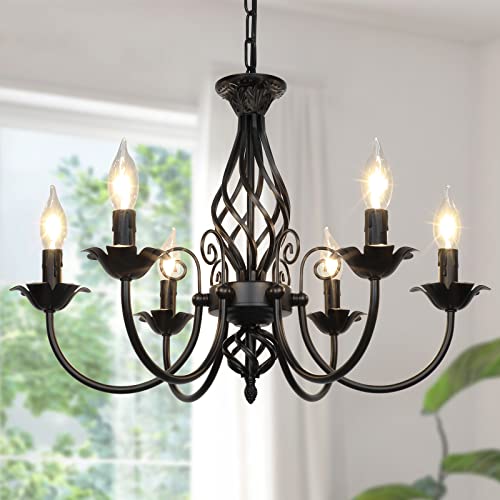
As an Amazon Associate we earn from qualifying purchases at no extra cost to you. Ratings are shown as listed on Amazon.
Choose the right shape and size for your setup
| Dining setup | Chandelier style | Useful fixture size | Installation and ownership notes |
|---|---|---|---|
| 36-inch-wide round table | Compact drum, globe, or small lantern | 18–24 inches wide | One ceiling junction box is usually sufficient. Check that the fixture does not obstruct sightlines across the table. |
| 42-inch-wide round table | Open-frame, lantern, or multi-arm chandelier | 21–28 inches wide | Choose a design with a contained footprint if people walk close to the table. |
| 36 × 72-inch rectangular table | Linear chandelier or elongated lantern | 36–48 inches long | A centered single junction box can work, but a long fixture may need careful alignment and a properly rated support. |
| 40 × 96-inch rectangular table | Long linear fixture or two pendants | 48–64 inches long, or two 18–24-inch fixtures | Two fixtures may require relocating or adding junction boxes; account for that before choosing the layout. |
| Low, 8-foot ceiling | Flush or semi-flush chandelier | Typically 16–24 inches wide; keep the bottom 30–36 inches above the table | Prioritize compact vertical height. A deep fixture can feel imposing even when its width is right. |
| 9-foot or taller ceiling | Tiered chandelier, larger lantern, or sculptural fixture | Size to the table first; allow a longer drop where appropriate | Confirm the canopy, stem, or chain can achieve the desired height, and plan for safe access during cleaning. |
Fixture dimensions are practical starting ranges, not universal standards. Measure the table and room, then compare the fixture’s full width and height—not just the shade or central body—with the space.
Best styles by situation
For a long rectangular table: linear chandelier
A linear chandelier spreads light along the table’s length and usually looks more balanced than a small round fixture centered over it. Aim for a length around half to two-thirds of the table length. For a 72-inch table, that suggests roughly 36–48 inches. Keep enough space at each end so the fixture does not visually overrun the table.
Choose a model with multiple replaceable bulbs or accessible integrated LED components. A long fixture can be awkward to clean, so simpler arms and shades are easier to maintain than tightly packed decorative details.
For a round or square table: globe, lantern, or multi-arm design
A centered, roughly symmetrical chandelier suits a round table and provides a clear visual focal point. Globe and drum designs give a softer, more contained look; open-frame lanterns feel lighter in a small room; multi-arm styles can spread light without a large opaque shade. Check the fixture’s diameter against the table, and avoid a body so wide that it crowds chairs or sightlines.
For a small room or low ceiling: semi-flush fixture
A semi-flush chandelier preserves headroom while adding more character than a basic ceiling light. In a room with an 8-foot ceiling, a tall, tiered fixture can dominate the space even if it technically clears the table. Prefer a shallower design, particularly if people pass beneath the fixture outside the table area.
For a large room or high ceiling: larger lantern or tiered chandelier
A small fixture can look lost in a spacious dining room. Scale up the diameter or choose a fixture with more vertical presence, but keep the table—not just the room—as the main sizing reference. In a room with ceilings above 9 feet, a longer drop can help the light feel connected to the dining area. If the dining room opens into another space, consider how the fixture looks from nearby seating and walkways.
Work out light output before choosing a dimmer
For comfortable dining, look for dimmable light and enough output for eating, serving, and cleanup. A useful starting estimate for ambient dining-room light is about 20–30 lumens per square foot. A 12 × 14-foot room is 168 square feet, so the initial target is approximately 3,360–5,040 lumens for the room. The chandelier need not provide all of that if other lights contribute, and a dimmer lets you reduce brightness for meals.
Check the fixture’s total lumen output or add together the bulb lumens it supports. Wattage indicates energy use, not brightness. For a warm dining atmosphere, many people prefer a color temperature around 2700–3000 K. Confirm that the bulbs, fixture, and dimmer are compatible; some LED lamps can flicker or buzz with incompatible dimmers.
Clear glass and exposed bulbs tend to create more direct glare than fabric or frosted shades. If diners can see the bulbs from their seats, choose lower-glare shades or suitable frosted lamps rather than relying on a dimmer to solve every comfort issue.
Installation difficulty: what to check before buying
- Weight and support: A heavy chandelier may need a fan-rated or otherwise suitably braced ceiling box. The existing box may not be adequate, even if it has held a lightweight fixture.
- Wiring and location: Center the fixture over the table, not necessarily the middle of the room. If the ceiling outlet is misplaced, a licensed electrician can assess whether to relocate it or use an approved alternative.
- Height adjustment: Confirm the fixture includes enough chain or downrod to achieve the intended hanging height. A fixed-length stem is less flexible if the ceiling or table changes.
- Two-fixture layouts: Two pendants can cover a long table well, but often require two correctly spaced power points. Do not assume an ordinary ceiling box can safely support a fixture at a different location.
- Assembly and upkeep: Multi-arm and crystal designs may require more assembly and dusting. Check whether shades or glass components can be removed safely for cleaning and whether replacement parts are available.
Turn off power at the breaker before any fixture work. If the wiring, ceiling support, or circuit is unfamiliar, have a qualified electrician handle the installation. Fixture weight, local code, and existing wiring all matter.
Quick decision matrix
| Your priority | Best fit | Trade-off to consider |
|---|---|---|
| Low budget and simple replacement | Lightweight semi-flush or compact lantern | Fewer decorative details and less adjustment range |
| Long table, even coverage | Linear chandelier sized to the table | Can be harder to clean and may need more careful alignment |
| Low ceiling or frequent foot traffic | Shallow semi-flush fixture | Less dramatic vertical presence |
| Soft, adjustable light | Dimmable fixture with compatible LED bulbs | Requires checking bulb, fixture, and dimmer compatibility |
| High ceiling and spacious room | Larger lantern or tiered chandelier with an adjustable drop | More difficult to install and reach for cleaning |
Before you buy
Measure the table width and length, ceiling height, and distance to nearby walkways. Use the table above to choose a fixture footprint, then check the actual hanging height, total lumen output, dimming compatibility, weight, and installation requirements. A well-sized chandelier should illuminate the dining surface, leave comfortable headroom, and feel proportionate to both the table and the room.