Key takeaways
- Pro: Enclosed chamber handles engineering filaments that open-frame machines cannot
- Pro: AMS color system is among the most reliable and waste-conscious on the market
- Con: At $549, it sits above single-color rivals, and AMS replenishment filament costs add up over months
Shopping for a new machine this year means navigating a crowded field where 3d printer prices range from under $300 to well over $800, and the gap between cheap and expensive is not always obvious on a spec sheet. The real question every buyer faces is the same: will this printer actually deliver reliable, repeatable results week after week without me spending my evenings troubleshooting? That single factor separates a worthwhile purchase from an expensive paperweight.
The 2026 market has matured considerably, with auto-leveling now nearly universal and multi-color systems competing fiercely on price. What still differentiates machines is how gracefully the software, firmware, and hardware interact when you push them daily. Owner feedback tells us which brands ship solid out-of-the-box experiences and which ones leave you patching things together through community forums. Below, we ranked the eight most discussed options on published specifications, current 3d printer prices, and recurring themes from long-term owners to help you cut through the noise.
Our top picks


As an Amazon Associate we earn from qualifying purchases at no extra cost to you. Ratings are shown as listed on Amazon.
Quick Picks
| Product | Best for | Price |
|---|---|---|
| Bambu Lab P1S Combo | Multicolor without compromise | $549 |
| FLASHFORGE Adventurer 5M | Entry-level speed and simplicity | $249 |
| FLASHFORGE AD5X | Precision and efficiency in one package | $349 |
| Bambu Lab P1S | Reliable single-color FDM | $399 |
| Bambu Lab A1 | Beginners and kids | $299.99 |
| Creality K2 Combo (A) | Large-build multicolor on a budget | $521 |
| Anycubic Kobra X | Easy setup, native four-color | $329.99 |
| Snapmaker U1 | High-end multicolor with fast tool swapping | $849 |
How We Picked
We weighed four factors across every machine. First, speed reliability: a printer claiming 600 mm/s means little if it introduces ghosting or layer inconsistency at that pace, so we looked at owner reports about quality at high speeds. Second, color-system robustness: how many colors does the system support natively, and does it jam, purge poorly, or waste filament in practice? Third, setup friction: how quickly can a new owner go from unboxing to a good first print, judging by auto-leveling quality, pre-assembly percentage, and firmware polish. Fourth, value at that price point: not just the sticker number but whether the machine delivers more capability than a cheaper option or less than a pricier one.
The 8 Best 3D Printer Prices in 2026
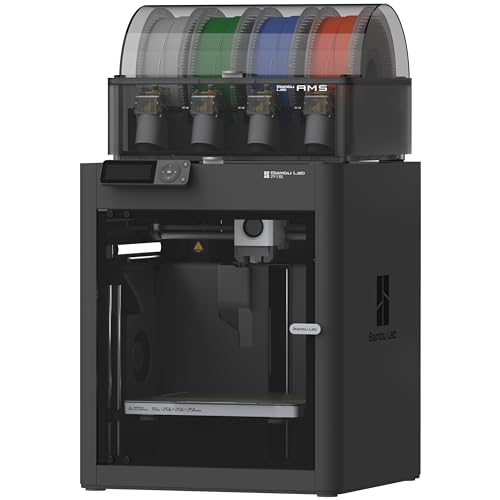
Bambu Lab P1S Combo
For makers who want multicolor printing without spending five figures, the P1S Combo bundles the enclosed P1S with the AMS unit, making 3d printer prices for multicolor feel accessible. Owners consistently praise the enclosed chamber for warping-prone materials like ABS and ASA, and the AMS integration delivers clean color changes with minimal purging waste. The touchscreen workflow and Bambu Studio slicer earn praise for reliability out of the box.
- Pro: Enclosed chamber handles engineering filaments that open-frame machines cannot
- Pro: AMS color system is among the most reliable and waste-conscious on the market
- Con: At $549, it sits above single-color rivals, and AMS replenishment filament costs add up over months
Skip it if you only print single-color PLA and want the lowest entry cost.
FLASHFORGE Adventurer 5M
At $249, the Adventurer 5M is one of the most aggressive 3d printer prices for a CoreXY machine with fully auto-leveling and 600 mm/s rated speed. Beginners and budget-conscious hobbyists appreciate the direct extruder with a 280°C nozzle, which covers PLA, PETG, and TPU without a hotend swap. The all-metal structure and detachable nozzle simplify maintenance.
- Pro: Fastest CoreXY under $300 with genuinely usable auto-leveling
- Pro: 3S detachable nozzle makes swaps quick without heating the whole block
- Con: Open frame limits material choices compared to enclosed rivals at higher prices
Skip it if you need multicolor capability or plan to print ABS regularly.
FLASHFORGE AD5X Multi-Color
The AD5X targets users who want color without the Bambu price tag. At $349, 3d printer prices for CoreXY speed, a 300°C direct-drive extruder, and 1-click auto-leveling make this a compelling single-machine solution. Owners highlight the higher nozzle temperature ceiling for flexible material choices, and the 220 mm build volume is practical for most hobbyist projects.
- Pro: 300°C hotend covers a wider filament library than many competitors at this price
- Pro: Speed and leveling combination suits both learning and production workloads
- Con: Multicolor ecosystem is newer, with less community troubleshooting material than established systems
Skip it if you need a large-volume build or absolute maximum color reliability today.
Bambu Lab P1S
The standalone P1S at $399 is the enclosure-only version of the Combo, ideal for users who prioritize chamber stability and single-color quality. Owner feedback emphasizes the enclosed design eliminating warping on PETG and ABS, and the CoreXY frame delivering consistent surfaces at high speeds. Bambu Studio remains one of the most polished slicers available.
- Pro: Enclosed build chamber expands usable material range significantly over open-frame rivals
- Pro: Ready-to-use out of the box with minimal calibration required
- Con: Without the AMS, you are limited to single-color prints unless you upgrade later
Skip it if you want multicolor now; the Combo saves you an upgrade path and some cost.
Bambu Lab A1
At $299.99, the A1 is Bambu Lab’s answer to entry-level buyers, including families and kids printing as a hobby. It is open-frame, bed-slinger style, but the auto-leveling and software polish keep setup anxiety low. Owners report reliable first-layer results and a quiet operating profile that makes it suitable for a shared workspace.
- Pro: Lowest 3d printer prices among Bambu machines with the same software experience
- Pro: Genuinely ready-to-use, with minimal troubleshooting for new owners
- Con: Open frame means warping risk on ABS and larger prints compared to enclosed siblings
Skip it if your projects require engineering-grade materials or large, flat surfaces that demand chamber heat.
Creality K2 Combo (A)
The K2 Combo enters at $521, undercutting the Bambu Combo while offering a 260 mm build volume, CFS multicolor, and a smart AI camera. Owner feedback praises the 95% pre-assembly for cutting setup time and the camera for first-layer monitoring. The next-gen direct-drive extruder and 600 mm/s rated speed keep print times competitive.
- Pro: Larger build volume than most rivals at comparable 3d printer prices in this bracket
- Pro: AI camera adds a layer of confidence for unattended long prints
- Con: CFS color system has fewer long-term owner reports than Bambu’s AMS, so reliability data is thinner
Skip it if you want the most proven multicolor ecosystem with the deepest troubleshooting community.
Anycubic Kobra X
At $329.99, the Kobra X targets anyone who wants native four-color printing without spending above $350. Setup simplicity is a recurring owner theme, with the system detecting and configuring color stations on first boot. For hobbyists juggling several filament spools, the native four-color approach reduces workflow friction considerably.
- Pro: Native four-color capability at one of the lowest 3d printer prices in the segment
- Pro: Easy setup suits users who dislike multi-step calibration routines
- Con: Speed is modest compared to 600 mm/s CoreXY competitors at this tier
Skip it if you print large, tall models where speed and build height matter more than color count.
Snapmaker U1
The Snapmaker U1 leads this roundup at $849, justified by its 4-toolhead design and five-second toolchanger for multicolor work. Owners who demand clean, multi-material outputs without shared-nozzle purge waste see the U1 as worth the premium. The build quality and modular approach extend its usefulness beyond pure printing into laser and CNC add-ons within the Snapmaker ecosystem.
- Pro: Physical tool-swapping eliminates color mixing and purge waste entirely
- Pro: Platform supports modular manufacturing beyond FDM printing
- Con: $849 is nearly triple the cost of capable single-color machines
Skip it if you are a casual hobbyist; the cost only pencils out for frequent multicolor or multi-material output.
Buying Guide
Frame Type and Speed Stability
CoreXY frames dominate current 3d printer prices across all tiers because they decouple the print head from heavy bed movement, enabling higher accelerations without ringing. If speed matters for throughput, look for published claims above 300 mm/s and check whether owners report quality retention at those rates. Bed-slingers like the Bambu A1 remain excellent for small prints but hit practical speed ceilings earlier than CoreXY designs.
Color Systems: Enclosed Chamber vs. Tool-Swap
Multicolor printing arrives through two philosophies: shared-nozzle systems (AMS, CFS, Kobra X native) that purge between colors, and tool-head swaps (Snapmaker U1) that simply lift a loaded nozzle out of the way. Shared-nozzle systems are cheaper and more common, but they consume filament during purging and risk slight color bleed on small features. Tool-swap machines cost more but deliver cleaner transitions with zero purge. Decide which trade-off fits your workflow before comparing sticker prices.
Enclosure and Material Compatibility
An enclosed chamber raises effective material range because it prevents ABS and ASA from warping on cold drafts. If you plan beyond PLA and PETG, prioritize machines with sealed or semi-sealed chambers when comparing 3d printer prices. Hotend temperature ceiling matters too: 240°C limits you to common filaments, while 300°C opens the door to nylon, polycarbonate, and reinforced composites without a hardware upgrade later.
Our Verdict
Top pick: the Bambu Lab P1S Combo at $549 remains the most complete multicolor package under $600, combining a proven enclosure, a deeply tested AMS ecosystem, and a polished slicer workflow that keeps frustration low. Budget pick: the FLASHFORGE Adventurer 5M at $249 delivers the fastest usable CoreXY experience for single-color printing at the lowest 3d printer prices in this roundup. Condition favoring another: if you print large, flat, multi-material parts frequently, the Snapmaker U1’s tool-swap design justifies its premium because it eliminates purge waste that shared-nozzle systems accumulate over hundreds of prints.
FAQ
What is the average 3d printer prices range in 2026?
Reliable home FDM machines now span from about $250 to $850 depending on enclosure, speed, and color capability. You can get a solid single-color CoreXY around $250-$300, and multicolor systems start near $330 and climb from there.
Do I need an enclosed chamber for 3D printing?
If you only print PLA, PETG, and TPU, an open frame works fine. For ABS, ASA, nylon, or polycarbonate, an enclosure is strongly recommended to prevent warping and layer cracking from drafts and temperature swings.
Is multicolor printing worth the extra cost?
It depends on your projects. Multicolor adds significant waste and setup complexity, so if you rarely need more than one color per object, the premium is hard to justify. For makers producing figurines, educational tools, or multi-part enclosures, color capability transforms the workflow.
How important is auto-leveling on a budget printer?
It is arguably the single most important feature for new owners. Manual leveling is the top cause of failed prints among beginners, so a fully automatic system at any price tier saves hours of frustration and wasted filament in the first month.