Key takeaways
- Pro: CoreXY all-metal frame at this price point
- Pro: 600mm/s speed with usable print quality
- Con: Slicer and app software less refined than competitors
A 3 d printer in 2026 is no longer a hobbyist’s patience exercise, but the gap between machines has widened in ways that matter for your wallet and your free time. The best budget FDM printers now auto-level, print at speeds that would have seemed absurd a few years ago, and ship with software that handles the hard calibration work for you. The worst still require you to become a mechanical engineer before you can pull a decent figurine off the bed. The difference often comes down to how much the manufacturer has invested in eliminating failure modes you never asked to manage.
What separates a good purchase from a frustrating one: whether the printer holds tolerances at high speed, whether it handles multi-material work without a tangle of tubes and frustration, and whether the ecosystem of spare parts and community support will still exist when you need a nozzle replacement at two in the morning. We compared published specs, listed prices, and aggregated owner feedback across these eight machines to identify which ones deliver on their claims and which ones leave buyers troubleshooting instead of printing.
Our top picks



As an Amazon Associate we earn from qualifying purchases at no extra cost to you. Ratings are shown as listed on Amazon.
Quick Picks
| Product | Best for | Price |
|---|---|---|
| FLASHFORGE Adventurer 5M | Speed on a budget | $249 |
| Bambu Lab P1S Combo | Multi-color printing | $549 |
| Bambu Lab P2S Combo | Premium multi-color | $769 |
| Bambu Lab A1 | Beginners and kids | $299.99 |
| FLASHFORGE AD5X | Multi-color on a budget | $349 |
| Bambu Lab P1S | Solo FDM without extras | $399 |
| Entina Tina2C | STEM and first-time users | $199.99 |
| FLASHFORGE AD5M | Lowest-cost CoreXY speed | $248.99 |
How We Picked
We evaluated each 3 d printer on four criteria: out-of-box reliability (how quickly and consistently the machine produces good prints without user intervention), throughput ceiling (whether rated speed translates to usable quality at that speed), ecosystem completeness (multi-material support, software maturity, and parts availability), and price-to-capability ratio within its tier. Owner feedback weighted toward reports of sustained performance after three or more months of regular use, since first-week impressions on any printer tend to run optimistic.
The 8 Best 3 D Printer in 2026
FLASHFORGE Adventurer 5M
This is the machine for someone who wants CoreXY speed without the Bambu price tag. The fully auto leveling and 280°C direct extruder mean it handles common and engineering filaments alike, and the 3S detachable nozzle cuts swap time to seconds. At 600mm/s rated speed with a 220x220x220mm build volume, it matches or beats printers costing significantly more on raw throughput. Owners consistently praise the print quality at speed, noting the all-metal structure keeps vibration manageable. The main con is that FLASHFORGE’s software ecosystem is less polished than Bambu’s slicer stack, and community troubleshooting resources are thinner.
- Pro: CoreXY all-metal frame at this price point
- Pro: 600mm/s speed with usable print quality
- Con: Slicer and app software less refined than competitors
Skip it if multi-color printing is a priority or if you want the most turnkey software experience available.
Bambu Lab P1S Combo
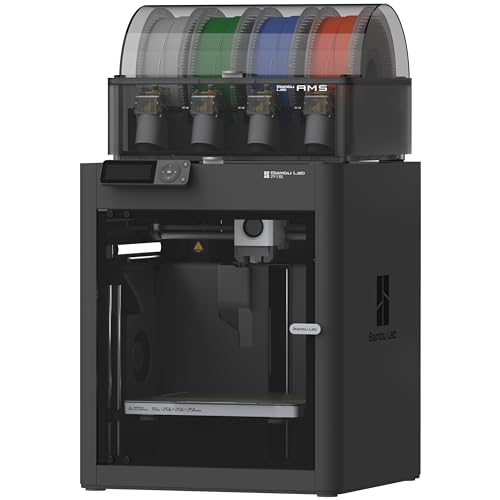
The P1S Combo bundles the enclosed P1S printer with Bambu’s AMS system, giving you multi-color and multi-material printing out of the box. For anyone who wants to print labeled parts, aesthetic prototypes, or functional items requiring two materials, this is the most practical path under $600. The enclosed chamber handles ABS and PETG without warping drama, and Bambu’s software pipeline from model selection to finished print remains the smoothest in the category. Owners report excellent reliability and a deep parts marketplace. The con is build volume: at 256mm cube, it will not accommodate large single pieces without splitting, and the AMS tubes add a layer of filament-loading complexity that a single-spool printer avoids.
- Pro: Mature multi-material ecosystem with minimal setup
- Pro: Enclosed chamber for temperature-sensitive filaments
- Con: AMS tube management adds maintenance overhead
Skip it if you primarily print large-format single-color parts or want the absolute simplest workflow.
Bambu Lab P2S Combo
The P2S Combo is Bambu’s current flagship bundle, pairing the P2S printer with the AMS 2 Pro. The incremental improvements over the P1S Combo are real but narrow: faster nozzle heating, refined airflow control, and the AMS 2 Pro’s updated handling logic reduce filament swap time and waste. If you already own a P1S, the upgrade path offers modest gains. If you are entering the ecosystem fresh and budget allows, the P2S Combo eliminates several small compromises that P1S owners tolerate. Owner feedback at this price tier is overwhelmingly positive, with most complaints directed at cost rather than capability. The con is straightforward: at $769 you are paying for marginal refinements that a $549 P1S Combo already covers for most workflows.
- Pro: Best-in-class software and hardware integration
- Pro: AMS 2 Pro reduces filament change downtime
- Con: Price premium over P1S Combo is hard to justify
Skip it if the P1S Combo fits your budget; the difference rarely impacts print quality.
Bambu Lab A1
The A1 targets the entry point Bambu never previously offered, and it works. Ready-to-use out of the box means a teenager or a curious adult can unpack, level, and pull a first print without opening a manual. The open-frame design keeps weight and cost down, and Bambu’s software ecosystem still applies, so calibration profiles and model libraries are available. Owner feedback from parents and first-time users is strongly positive on simplicity. The tradeoff is material range: the open frame means no heated chamber, so ABS and polycarbonate are impractical. Multi-color requires adding an AMS unit separately, pushing total cost past what the A1 alone promises. The build volume is also smaller than the P-series machines.
- Pro: Genuinely zero-friction setup for novices
- Pro: Access to Bambu’s full software ecosystem
- Con: No chamber means limited filament compatibility
Skip it if you need to print engineering materials or large-format parts.
FLASHFORGE AD5X
The AD5X is FLASHFORGE’s answer to the multi-color question at a price that undercuts Bambu’s combo bundles. CoreXY structure at 600mm/s, a 300°C direct drive extruder, 1-click auto leveling, and a 220x220x220mm build volume give it a spec sheet that competes with machines costing more. It is positioned for precision and efficiency, and owners confirm clean geometry and consistent first layers across materials. The con is ecosystem maturity: FLASHFORGE’s multi-color support and slicer integration trail Bambu’s in terms of automation and failure recovery, meaning more manual intervention when filament runs low or a swap goes wrong. Parts availability is also thinner outside major markets.
- Pro: Multi-color at a price well below Bambu bundles
- Pro: 300°C extruder covers a wide material range
- Con: Software and automation less seamless than Bambu
Skip it if turnkey reliability with zero babysitting during long multi-color jobs is non-negotiable.
Bambu Lab P1S
The standalone P1S is the same enclosed CoreXY printer from the combo, minus the AMS. At $399 it occupies an interesting middle ground: you get Bambu’s software pipeline, enclosed chamber, and speed without paying for multi-material hardware you may not use. Owners praise its consistency for single-color functional prints, and the enclosure makes engineering filaments practical. The con is obvious: if you ever want multi-color, you need to purchase the AMS separately and integrate it. The P1S also shares the same build volume limitation as the combo, so large-format projects remain constrained regardless of how you configure it.
- Pro: Enclosed chamber and Bambu software at a lower entry point than combo
- Pro: Excellent single-color reliability for functional parts
- Con: Multi-color upgrade path adds cost and complexity later
Skip it if you know from the start you will want multi-color; the combo is better value.
Entina Tina2C
The Tina2C is not a performance machine, and it does not pretend to be. It is a 3 d printer designed to get a child or complete beginner to a finished print in eight minutes with no calibration step. Fully assembled, app-controlled, WiFi-enabled, with auto leveling and a 3000+ model library, it removes every barrier between curiosity and result. The 20+ creative DIY modules are explicitly built for STEM contexts, making it a better education tool than a hobbyist printer. Owner feedback from parents confirms kids stay engaged because the friction is near zero. The con is ceiling: print size is mini-class, speed is modest, and the material range is limited to basic PLA-friendly filaments.
- Pro: True 8-minute time from unboxing to first print
- Pro: Curriculum-aligned STEM modules for home and classroom
- Con: Mini build volume and basic filament range cap its usefulness
Skip it if you are an adult hobbyist who wants a capable general-purpose printer.
FLASHFORGE AD5M
The AD5M sits in an awkward spot: it is $0.01 cheaper than the Adventurer 5M while offering slightly different software features like fully auto calibration and a quick-swap nozzle marketed under a different name. CoreXY, 600mm/s, 220x220x220mm — the hardware story is essentially identical to its sibling. For buyers who do not want the 5M’s specific nozzle system or prefer AD5M’s calibration workflow, the price and performance parity make it a valid alternative. Owners report print quality matching the 5M. The con is differentiation: choosing between these two FLASHFORGE models often comes down to minor software preferences rather than meaningful hardware advantages, which creates decision fatigue at purchase.
- Pro: Identical CoreXY performance at the lowest price in this list’s upper tier
- Pro: Quick-swap nozzle reduces downtime between filament changes
- Con: Nearly indistinguishable from the 5M, making comparison shopping confusing
Skip it if you already found the Adventurer 5M; there is no clear reason to pay attention to both.
Buying Guide
Speed Rating vs. Real-World Throughput
A 600mm/s rated speed means almost nothing without context. What matters is whether the printer maintains layer accuracy, wall thickness, and surface finish at that rate. CoreXY kinematics reduce moving mass compared to bed-slingers, which is why both FLASHFORGE and Bambu lean heavily on that architecture for speed. Look for owner reports that confirm quality holds at high acceleration rather than just maximum travel speed, since many printers hit 600mm/s on retraction but crawl during infill.
Enclosure and Material Compatibility
Open-frame printers like the Bambu A1 are fine for PLA and PETG, but if you plan to print ABS, ASA, polycarbonate, or nylon, a heated enclosure is not optional. The P1S and P2S chambers manage ambient temperature; the FLASHFORGE CoreXY machines in this list offer all-metal structures but vary in enclosure completeness. Decide your material needs before choosing a machine, not after.
Software and Ecosystem Lock-In
Bambu Lab’s slicer, model marketplace, and firmware update pipeline create a tightly integrated experience that reduces user error but also reduces flexibility. FLASHFORGE’s software stack is functional but less mature. If you want to swap filaments freely, modify profiles deeply, or avoid vendor firmware constraints, the open-er architectures demand more skill but grant more control. Weigh convenience against long-term adaptability.
Our Verdict
Top pick: the Bambu Lab P1S Combo at $549 delivers the best balance of speed, enclosure quality, multi-material capability, and software polish for anyone who can stretch past the entry tier. Budget pick: the FLASHFORGE Adventurer 5M at $249 gives you CoreXY speed and solid print quality at the lowest functional price point in this list. Condition where another wins: if the buyer is a child under twelve or a STEM educator running a first introduction, the Entina Tina2C’s eight-minute setup and model library make every other option feel like overkill.
FAQ
Is a 3 d printer still difficult to set up in 2026?
Far less so than prior generations. Auto leveling, pre-calibrated profiles, and guided first-print workflows mean most modern machines produce acceptable results without user intervention. The remaining difficulty depends on material choice and whether you are managing multi-spool systems.
Do I need an enclosure for functional prints?
Only for temperature-sensitive materials like ABS, ASA, or nylon. PLA and PETG print reliably on open-frame machines. If your functional parts use engineering filaments, an enclosed printer prevents warping and improves layer adhesion through stable ambient temperature.
Is multi-color printing worth the added complexity?
For aesthetic or labeled prints, yes. For single-color functional parts, the AMS tube system introduces maintenance points (clogs, filament tangles, purge waste) that slow you down. If you mostly print one color, a solo machine with an upgrade path gives you the option without the overhead.
What build volume do I actually need?
Most functional household repairs, brackets, and small parts fit comfortably in a 220mm cube. Large cosplay pieces, helmet shells, or decorative items often exceed that envelope. If you regularly need more than 250mm on any axis, verify the specific machine’s usable volume against your typical project dimensions before committing.