Key takeaways
- Compare the best VR headsets from Meta, Sony and HTC, including Quest 3, Quest 3S, PSVR2 and VIVE models, with resolution, refresh rate and platform specs.
- Top Pick: Meta Quest 3 (512GB)
- Runner-up: Meta Quest 3S (128GB)
- Also consider: PlayStation VR2
Buying a VR headset in 2026 is less about raw display numbers than it used to be. The five headsets below split into three camps that barely overlap: Meta’s standalone Quest line, Sony’s console-tethered PlayStation VR2, and HTC’s VIVE range, which straddles standalone play and PC VR. Each camp has its own game library and comfort trade-offs, so the right first question is not which headset is strongest, but which ecosystem you want to live in. This guide compares the leading model from each camp on resolution, refresh rate, tracking, weight and platform.
As an Amazon Associate, we earn from qualifying purchases.
Quick Answer
For most people, the Meta Quest 3 is the best VR headset to buy: it is fully standalone, has the sharpest mainstream display, and runs the largest game library. The Quest 3S covers the same library for less money, PlayStation VR2 is the pick for PS5 owners, and HTC’s VIVE Focus Vision and XR Elite suit PC VR players who want eye tracking and modular hardware.
Three Ecosystems, Three Different Bets
A standalone headset such as the Quest 3 or Quest 3S carries its own processor, battery and storage. You put it on and play, with no PC or console involved, and an optional cable or Wi-Fi link opens up PC VR libraries later. The trade-off is mobile-class graphics: games are built for a phone-grade chip, so textures and lighting are simpler than on a gaming PC.
PlayStation VR2 takes the opposite route. It has no processor of its own and draws everything from a PlayStation 5 over a single USB-C cable. That tether buys it OLED panels, HDR and eye-tracked foveated rendering. The cost of that fidelity is total dependence on one console and its smaller, curated library.
HTC’s VIVE line sits between the two. The Focus Vision and XR Elite run standalone content on VIVE’s own store, but their real strength is PC VR: both stream from a gaming PC over Wi-Fi, and the Focus Vision adds a DisplayPort mode for a lossless wired image. HTC also builds in features Meta reserves for enterprise buyers, such as eye tracking and swappable batteries, which is why both VIVE picks carry premium positioning.
The Picks
Meta Quest 3 (512GB)

The Quest 3 is the headset the rest of this list is measured against. Its pancake lenses keep the visor slim and deliver edge-to-edge clarity that Fresnel designs cannot match, and the 2064 x 2208 per-eye resolution is the highest here outside the VIVE Focus Vision. The Snapdragon XR2 Gen 2 chip roughly doubles the graphics throughput of the previous generation, which shows up as steadier frame rates in demanding standalone titles. Full-color passthrough is sharp enough to find a drink or check a phone notification without removing the headset, and the ringless Touch Plus controllers track reliably in fast games. The 512GB of storage matters more than it sounds, because flagship Quest games now reach sizes that would strangle a smaller drive.
Specs:
- Display: 2064 x 2208 per eye, LCD with pancake lenses
- Refresh rate: 90 Hz, with 120 Hz supported
- Processor: Snapdragon XR2 Gen 2
- Memory and storage: 8 GB RAM, 512 GB storage
- Passthrough: full color, dual RGB cameras
- Controllers: Touch Plus, ring-free design
- Weight: 515 g
Meta Quest 3S (128GB)

The Quest 3S is built around a simple idea: keep the Quest 3’s processor, controllers and entire game library, and cut the cost in the optics and storage. It uses the same Snapdragon XR2 Gen 2 chip, so every Quest title runs identically, and the Touch Plus controllers and full-color passthrough carry over as well. What changes is the display stack: resolution drops to 1832 x 1920 per eye and the lenses are Fresnel rather than pancake, which means a slightly softer image and a bulkier front box. Storage is the harder limit. At 128 GB, a handful of large games plus recorded video will fill the drive, and there is no expansion slot. Buyers who mostly play smaller titles or rotate a few games at a time will never feel the cuts.
Specs:
- Display: 1832 x 1920 per eye, LCD with Fresnel lenses
- Refresh rate: 90 Hz, with 120 Hz supported
- Processor: Snapdragon XR2 Gen 2
- Memory and storage: 8 GB RAM, 128 GB storage
- Passthrough: full color
- Controllers: Touch Plus, ring-free design
- Weight: 514 g
PlayStation VR2
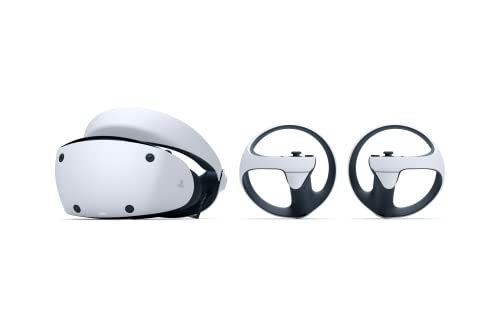
PlayStation VR2 is the only headset here that plugs into a console, and it makes that limitation feel like a feature. Its OLED panels produce true blacks and HDR highlights that the LCD headsets in this roundup cannot reproduce, and at 2000 x 2040 per eye with a 120 Hz ceiling, fast scenes stay clean. Eye tracking is standard, and the PS5 uses it for foveated rendering, prioritizing detail exactly where you look. The Sense controllers add adaptive triggers and fine haptic feedback, and a vibration motor in the headset itself sells impacts in a way no rival here attempts. Remember the dependencies, though: it needs a PlayStation 5, the cable is permanent, and the VR2 library is far smaller than Meta’s. A separate adapter also unlocks PC VR, which widens its value for households with both machines.
Specs:
- Display: 2000 x 2040 per eye, OLED with HDR
- Refresh rate: 90 Hz and 120 Hz modes
- Tracking: inside-out cameras plus eye tracking
- Connection: wired USB-C to PlayStation 5
- Controllers: Sense controllers with haptics and adaptive triggers
- Extra hardware: headset vibration feedback
- Weight: about 560 g
HTC VIVE Focus Vision

The Focus Vision is HTC’s flagship hybrid: a standalone headset designed to show off what a gaming PC can feed it. Its 2448 x 2448 per-eye resolution is the highest in this roundup, and a DisplayPort mode (via HTC’s streaming kit) carries that image from a graphics card without compression artifacts, while Wi-Fi streaming covers wireless play. Built-in eye tracking enables foveated rendering on PC and gaze-based interaction in standalone apps. The battery sits in a rear cradle, balances the visor and swaps out mid-session, so a spare pack effectively removes playtime limits. Storage expands with a microSD card, something no Meta headset offers. The Fresnel lenses and first-generation XR2 chip are the compromises: standalone graphics trail the Quest 3, and the sweet spot is narrower than pancake optics.
Specs:
- Display: 2448 x 2448 per eye, LCD with Fresnel lenses
- Refresh rate: 90 Hz
- Processor: Snapdragon XR2 Gen 1
- Memory and storage: 12 GB RAM, 128 GB storage, microSD expansion
- Tracking: inside-out cameras plus built-in eye tracking
- Battery: hot-swappable rear pack
- PC VR: DisplayPort mode and Wi-Fi streaming
HTC VIVE XR Elite

The XR Elite is the most unusual design here. Its frame splits apart: remove the rear battery cradle, attach the included temple arms, and the headset becomes a glasses-style viewer for media and light mixed reality, then clicks back together for full gaming sessions. Pancake lenses and dioptric adjustment dials mean many short-sighted users can skip their glasses entirely, a rare convenience. Its 1920 x 1920 per-eye resolution and XR2 Gen 1 chip place it behind the Focus Vision, and its standalone store is smaller than Meta’s, so this is not the pick for a games-first buyer. It earns its place for mixed reality work, travel and anyone who values a compact, modular device that can also stream PC VR over Wi-Fi.
Specs:
- Display: 1920 x 1920 per eye, LCD with pancake lenses
- Refresh rate: 90 Hz
- Processor: Snapdragon XR2 Gen 1
- Memory and storage: 12 GB RAM, 128 GB storage
- Design: modular, converts to glasses-style mode
- Optics: dioptric adjustment dials for glasses-free viewing
- Weight: 625 g with battery cradle fitted
How to Choose
Start with the hardware you already own. A PlayStation 5 makes the PSVR2 the obvious candidate and makes every other headset here a second platform purchase. A gaming PC with a modern graphics card unlocks the best versions of the two VIVE headsets. Owning neither is fine: the Quest line needs nothing else in the room.
Next, weigh the display against the lens type. Resolution figures tell only half the story; pancake lenses on the Quest 3 and XR Elite keep text readable to the edges, while Fresnel lenses on the Quest 3S and Focus Vision concentrate sharpness in the center. If you read, work or watch films in VR, lens quality matters daily. If you mostly play fast games, refresh rate and tracking stability matter more.
Then be honest about storage and session length. Large standalone libraries argue for the 512GB Quest 3 or the Focus Vision’s microSD slot. Long sessions argue for balanced weight and swappable batteries, the Focus Vision’s party trick, while short casual sessions make the Quest 3S’s limits easy to live with. Finally, check the library: a headset is only as good as the store behind it, and Meta’s catalog is currently the deepest by a wide margin.
Who Should Skip a VR Headset for Now
Skip VR entirely if your play space is tiny or shared; room-scale games ask for a clear area roughly two meters square, and passthrough does not make collisions painless. Skip it if you are prone to motion sickness and cannot return the headset easily, because comfort varies enormously between individuals and no spec sheet predicts it. Glasses wearers with strong prescriptions should also pause: only the XR Elite here offers meaningful dioptric adjustment, and everyone else is fitting frames inside a visor or buying lens inserts.
Two specific buyers should look elsewhere. Apple loyalists eyeing Vision Pro should know it is sold only through Apple’s own stores, so it cannot be part of an Amazon-based comparison like this one. And PC players chasing maximum fidelity may be better served waiting: this category moves fast, and a headset bought for one exclusive game often ends up as expensive shelf decor.
Frequently Asked Questions
Do I need a gaming PC to use a VR headset?
No. The Meta Quest 3 and Quest 3S are fully standalone, and the two HTC VIVE headsets also run their own stores without a PC. A gaming PC is only required to unlock PC VR libraries and higher graphics settings, while PlayStation VR2 needs a PlayStation 5 instead.
What is the difference between the Quest 3 and Quest 3S?
They share the same processor, controllers and game library. The Quest 3 has sharper 2064 x 2208 displays, slimmer pancake lenses and more storage in this configuration, while the Quest 3S uses 1832 x 1920 Fresnel optics and 128 GB of storage to reach a lower tier.
Can PlayStation VR2 work with a PC?
Yes, with Sony’s separate PC adapter, PSVR2 can play SteamVR titles. Out of the box it is a PlayStation 5 accessory, and features such as HDR, headset feedback and adaptive triggers are not guaranteed to carry over to PC games.
How much play space does a VR headset need?
Most games offer a standing or seated mode that works in about one meter of clear space, while room-scale titles recommend a clear area of roughly two by two meters. Every headset here can set a virtual boundary that warns you before you reach a wall.
Final Verdict
The Meta Quest 3 is the default recommendation: standalone freedom, the best mainstream optics and the deepest library in one box. The Quest 3S is the value route into that same library, PlayStation VR2 is the connoisseur’s choice for PS5 owners who prize OLED contrast and eye tracking, and HTC’s Focus Vision and XR Elite serve PC VR players who want modular, expandable hardware. Pick the ecosystem first and the model second, and any of these five will feel like the right call.
More from Amazon
Programs that pair well with the guide above. Offers and eligibility are set by Amazon and may change.
Free shipping on eligible items, Prime Video and more. Eligible new members can start with a free trial.
Start a Prime free trialAudiobooks and podcasts to listen to on the go. Eligible new members can start with a free trial.
Try Audible freeAd-free music streaming. Eligible new subscribers can start with a free trial.
Try Music Unlimited freeA free business account with business pricing and bulk-buying tools for work, shop or home office.
Create a business accountAs an Amazon Associate we earn from qualifying purchases.