Our Top Picks


For most households the BLUETTI Elite 100 V2 is the best portable power station here: it pairs 1,024Wh of LiFePO4 storage with 1,800W of AC output and a 3,600W surge rating, in a body the maker describes as 35 percent smaller than before. A portable power station is a battery with built-in inverter and outlets, so you can run lights, a laptop, a router, a mini fridge or power tools without a gas generator. Small camping users should look at the 288Wh models, while anyone planning outage backup for several appliances will want the 2,010Wh Anker SOLIX S2000.
Quick List
- Jackery Explorer 300 – best for weekend camping, phones, laptops and small gear
- Jackery Explorer 1000 v2 – best for lightweight mid-size backup and road trips
- Anker SOLIX S2000 – best for long outage runtime and multiple appliances
- BLUETTI Elite 30 V2 – best for ultra-portable desk, van and travel use with higher-wattage tolerance
- EcoFlow Delta 3 – best for fast recharging and mixed home, work-site and camping use
- BLUETTI Elite 100 V2 – best for an all-round 1 kWh unit with high output and a compact body
Which One Is Right for You?
| If you… | Choose |
|---|---|
| Want the longest runtime for a fridge and other outage loads | Anker SOLIX S2000 |
| Need a balanced 1 kWh unit for camping and home backup | BLUETTI Elite 100 V2 |
| Want fast wall charging and a flexible mid-size unit | EcoFlow Delta 3 |
| Care most about low weight at 1 kWh class capacity | Jackery Explorer 1000 v2 |
| Only power phones, a laptop and lights | Jackery Explorer 300 |
| Need a tiny UPS-style unit for a desk or a router | BLUETTI Elite 30 V2 |
Capacity and output are two different numbers, and you need both. Capacity in watt-hours is the tank size, while output in watts is how fast you can draw from it. A 288Wh unit runs a 100-watt device for under three hours, while a 2,010Wh unit runs the same device for around 17 hours.
All 6 Picks in Detail
1. Jackery Explorer 300 – Best for Weekend Camping and Small Gear
As an Amazon Associate we earn from qualifying purchases at no extra cost to you.

The Explorer 300 is a small, light power station with 292Wh of capacity according to the listing, which also names a LiFePO4 battery and solar generator use. Published specs put its AC output at 300 watts, so it can run a laptop, lights, a small fan, a phone and a camera battery charger, but not a kettle or a space heater. Its size makes it comfortable to carry in a car or tent. It is also a sensible first power station for a beginner who wants to see how the idea works before spending on a bigger one: charge it at home, take it on a weekend away, and use it to keep a phone, camera and lantern topped up. Expect it to be a convenience for devices, not a backup for household appliances. There are several versions of this model on the market, so verify the battery chemistry and outlet count on the exact listing you buy.
- Capacity: 292Wh, per the listing
- Battery: LiFePO4, per the listing
- AC output: about 300W on published specs
- Typical loads: phones, laptops, lights, small fans, camera gear
- Weight, ports and solar input: confirm on listing
Pros:
- Light enough to carry one-handed
- Right-sized for devices and short trips
- Long-life chemistry named in the listing
Cons:
- Cannot run higher-wattage appliances
- Small capacity limits outage use
Next to the BLUETTI Elite 30 V2, it has similar capacity but a lower output surge allowance.
2. Jackery Explorer 1000 v2 – Best for Lightweight Mid-Size Backup

The Explorer 1000 v2 has 1,070Wh of capacity and 1,500W of AC output, with LiFePO4 chemistry and a one-hour fast-charge claim in the listing. Published specs list three AC outlets and a 3,000W surge rating, a 100W USB-C port and about 10.8 kg (roughly 24 lb) of weight, which is light for its capacity. That combination suits road trips, van life and short outages, where it can run a refrigerator for part of a day, a laptop for days or a small electric cooker for short bursts. For a family that wants one unit that travels on vacation and stays on the shelf for storms, this is a comfortable middle ground between the small 300-class units and the heavier 2 kWh models. Its outlets cover a laptop, a monitor and a few chargers simultaneously, so a work-from-anywhere day is realistic.
- Capacity: 1,070Wh
- AC output: 1,500W, with 3,000W surge on published specs
- Battery: LiFePO4, per the listing
- Ports: AC outlets, 100W USB-C, car port (confirm exact count on listing)
- Weight: about 10.8 kg on published specs
Pros:
- Light for the 1 kWh class
- Fast charging claim of about one hour in the listing
- High USB-C output for laptops
Cons:
- Output is lower than the 1,800W rivals
- Limited AC outlets compared with larger units
Compared with the EcoFlow Delta 3, it is a little lighter but does not match the 1,800W output.
3. Anker SOLIX S2000 – Best for Long Outage Runtime
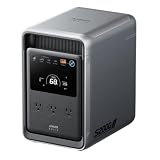
The SOLIX S2000 is the largest battery in the group at 2,010Wh, with 1,500W of output, according to the listing. Anker’s published specs describe a LiFePO4 battery rated for thousands of cycles, five AC outlets, a 3,000W peak, and about 16.2 kg of weight. It is the better choice when the goal is to keep a fridge, internet equipment and lights running through a night-long outage, because the extra capacity gives you roughly double the runtime of the 1 kWh units for the same load. Add a solar array and it becomes a multi-day system for cabins, boats and job sites; the published solar input ceiling is high enough to refill the battery in a day of good sun if enough panel area is connected. Remember it is also the heaviest of the group, so decide where it will live and whether you will carry it often.
- Capacity: 2,010Wh
- AC output: 1,500W; 3,000W peak on published specs
- Battery: LiFePO4
- Outlets: five AC outlets on published specs (confirm on listing)
- Weight: about 16.2 kg on published specs
Pros:
- Largest capacity in the group
- Multiple AC outlets for several devices at once
- Strong solar recharging potential, per published specs
Cons:
- Heavier and bulkier than the 1 kWh models
- 1,500W output limits the heaviest appliances
If you need to run more than 1,500 watts at once, the 1,800W EcoFlow Delta 3 or BLUETTI Elite 100 V2 are better, but they hold half the energy.
4. BLUETTI Elite 30 V2 – Best Ultra-Portable Unit With a Power Lifting Mode

The Elite 30 V2 is a 288Wh, 600W unit with an LFP battery that lists a Power Lifting mode up to 1,500W, a 10 ms UPS switchover and a 45-minute 0-to-80 percent fast charge. Power Lifting lets certain resistive loads such as a small kettle or hair dryer run above the rated 600W typically by reducing output voltage, so it should be used carefully and only with heating-type loads. At about 4.3 kg, it is light enough to move between desk, couch and car, and the UPS feature suits a router, a modem or a desktop PC where brief power dips matter.
- Capacity: 288Wh, LFP chemistry
- AC output: 600W; Power Lifting mode to 1,500W for resistive loads
- UPS: 10 ms switchover, per the listing
- Fast charging: 0 to 80 percent in 45 minutes, per the listing
- Weight: about 4.3 kg on published specs
Pros:
- Very light and portable
- UPS function protects short outages
- Power Lifting handles some higher-wattage heating loads
Cons:
- Small capacity drains quickly under heavy loads
- Power Lifting works only for specific resistive loads
It is a stronger choice than the Explorer 300 when you want UPS behavior and a higher surge allowance.
5. EcoFlow Delta 3 – Best for Fast Recharging and Mixed Use

EcoFlow’s Delta 3 offers 1,024Wh with 1,800W of AC output, a LiFePO4 battery and a listed full charge in 56 minutes. The listing also notes 100W USB-C output. Published specs describe a 3,600W surge and an X-Boost mode that lets it power some appliances above 1,800W by lowering output voltage, plus an expandable ecosystem and many outputs in total. Its weight is about 12.5 kg. The fast wall charge is the standout feature: it can recover from a depleted battery in about an hour, which helps if you run it every day. That makes it a good fit for tradespeople, mobile vendors and anyone who plugs in power tools between jobs, because a short lunch break can restore a useful fraction of the battery. Its range of ports also lets you run a laptop, a router and a few chargers at the same time.
- Capacity: 1,024Wh, LiFePO4
- AC output: 1,800W; 3,600W surge on published specs
- Charging: full charge in about 56 minutes, per the listing
- USB-C: 100W output, per the listing
- Weight: about 12.5 kg on published specs
Pros:
- Very fast wall charging
- High output for its size
- Many outlets and ports on published specs
Cons:
- Heavier than the Jackery 1000 v2
- X-Boost is a reduced-voltage mode, not a true higher-wattage rating
Versus the BLUETTI Elite 100 V2, the two are close, and the choice comes down to charging speed against size.
6. BLUETTI Elite 100 V2 – Best All-Round 1 kWh Unit
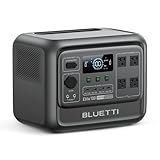
The Elite 100 V2 is the other 1,024Wh, 1,800W model, with a 3,600W surge rating, 0-to-80 percent charging in 45 minutes and 10 ms UPS switchover, all named in the listing along with the LiFePO4 battery. BLUETTI says it is 35 percent smaller than the previous generation. Published specs list four AC outlets, about 11.5 kg of weight, and a very high solar input ceiling. It makes a strong everyday backup for a router, fridge cycles, a laptop and tools, and it is easier to store than bigger units. The UPS-style switchover means that if you plug a PC or a network cabinet through it, a brief outage does not shut the equipment off, which is a practical benefit for anyone who works from home. For longer storms, consider pairing it with solar panels, or step up to the 2 kWh class.
- Capacity: 1,024Wh, LiFePO4
- AC output: 1,800W; 3,600W surge, per the listing
- Charging: 0 to 80 percent in 45 minutes, per the listing
- UPS: 10 ms switchover
- Weight and size: about 11.5 kg on published specs
Pros:
- Compact for 1 kWh with 1,800W of output
- UPS function for sensitive equipment
- Fast charging claim
Cons:
- Not as large as the S2000 for long outages
- Expansion options are limited per published information
It is the best fit for most people because it matches the Delta 3 on output while staying slightly lighter.
Specs Compared
| Product | Capacity | AC output | Battery | Charging claim | Weight |
|---|---|---|---|---|---|
| Jackery Explorer 300 | 292Wh | About 300W | LiFePO4 (per listing) | Confirm on listing | Confirm on listing |
| Jackery Explorer 1000 v2 | 1,070Wh | 1,500W | LiFePO4 | 1 hour fast charge | About 10.8 kg |
| Anker SOLIX S2000 | 2,010Wh | 1,500W | LiFePO4 | Confirm on listing | About 16.2 kg |
| BLUETTI Elite 30 V2 | 288Wh | 600W (1,500W Power Lifting) | LFP | 0-80% in 45 min | About 4.3 kg |
| EcoFlow Delta 3 | 1,024Wh | 1,800W | LiFePO4 | Full charge in 56 min | About 12.5 kg |
| BLUETTI Elite 100 V2 | 1,024Wh | 1,800W (3,600W surge) | LiFePO4 | 0-80% in 45 min | About 11.5 kg |
How We Chose These
We built this list from the capacity, output, battery chemistry, charging claims and extras that each listing states, then checked those against manufacturer specification pages and published product descriptions. We favored units with LiFePO4 or LFP cells, clear watt-hour and watt ratings, UPS or fast-charge features where named, and a sensible spread from phone-and-laptop size up to outage-backup size. Where weights, outlet counts or surge figures came from published specs rather than the listing name, this guide says so, and anything uncertain is marked to confirm on the product page.
What to Look For
Capacity in watt-hours and real runtime
Watt-hours tell you how much energy the battery holds. To estimate runtime, multiply the capacity by about 0.85 to allow for inverter losses, then divide by the load in watts. Worked example: a 1,024Wh unit running a 60-watt device gives about 1,024 times 0.85 divided by 60, which is roughly 14.5 hours. A refrigerator that averages about 100 watts over a day, because the compressor cycles on and off, would run a little over 8 hours on the same unit. That is why a 2,010Wh unit is the safer pick for an overnight outage.
Output watts, surge and special modes
Continuous AC output is the most important wattage figure, because the total of everything plugged in must stay below it. Surge rating covers brief startup spikes, such as a fridge compressor or power tool. Modes like Power Lifting or X-Boost lower the output voltage to let some resistive heating loads run above the rated wattage, but they do not suit electronics or motors. Do not assume they let you run any 1,800W appliance, and check the appliance’s label.
Battery chemistry and lifespan
LiFePO4 (also called LFP) batteries tolerate thousands of charge cycles and are generally more thermally stable than older NMC cells. Many manufacturers rate LFP packs for around 3,000 to 6,000 cycles before dropping to 80 percent capacity. At one full cycle a week, that is many years of use, but ratings are manufacturer claims. Treat them as a guide, and compare warranty terms.
Charging and solar input
Wall charging speed matters when you cycle the unit often. A 1,200W to 1,500W AC input recharges a 1 kWh battery in about an hour. Solar input is capped in watts and volts, so check that a panel’s voltage range matches the unit’s input window before connecting. If you plan to rely on solar, compare the solar input rating, not just the capacity.
Safety and placement
Run a power station only in a ventilated, dry place and keep its vents clear. Never cover it while it works, do not use it in rain, and keep it away from heaters and fuel. Do not exceed its rated watts, and use outdoor-rated, adequately sized extension cords. Never plug a portable power station into a wall outlet to power a house, because that can backfeed the grid and injure utility workers; use a properly installed transfer switch instead. For medical equipment, check the device’s power needs and consult its maker, because a power station is not a guaranteed life-support supply. Charge and store the battery within the temperature range in the manual, and avoid leaving it in a hot car.
Sizing the right unit for your household
Make a short list of the devices you want to keep running, note the wattage on each label, and add up the ones that would run at the same time. A router at 15 watts, a laptop at 60 watts, lights at 30 watts and a fridge averaging 100 watts total about 205 watts of running load, so even the 600W models handle it, but only a larger battery lasts the night. Multiply the total watts by the hours you need and add 15 percent for inverter losses. If the answer is under 300Wh, a small unit works; between 300Wh and 1,100Wh, the 1 kWh class is right; above that, look at the 2 kWh model.
Maintenance and storage
Power stations are low-maintenance, but a few habits extend their life. Store the unit indoors at a moderate temperature, ideally with the battery between roughly 40 and 80 percent if it will sit for months, and top it up every few months. Keep the vents free of dust, wipe the case with a dry cloth, and inspect cords for damage. Update the firmware through the manufacturer’s app when updates are offered, since these can improve charging behavior. Do not charge or discharge the battery in freezing or very hot conditions unless the manual explicitly allows it. If the case swells, smells or overheats, stop using it and contact the maker.
Questions
How long will a portable power station run a refrigerator?
As a rough guide, a typical refrigerator that averages around 100 watts will run about 8 to 9 hours on a 1,024Wh unit and well over 16 hours on a 2,010Wh unit. Actual numbers depend on the fridge, ambient temperature and how often the door opens.
Can I run a space heater or an air conditioner?
Usually not for long. Space heaters draw 1,500 watts, which would drain a 1 kWh unit in under an hour, and most air conditioners exceed these units’ continuous output or startup surge.
Is LiFePO4 better than other battery types?
For home and outdoor use, LiFePO4 offers longer cycle life and better thermal stability, at the cost of a slightly heavier pack. That is why most newer units use it.
Can I charge a power station with solar panels?
Yes, if the panel voltage and wattage fit the unit’s solar input range. Check the manual for the voltage window and connector type before connecting any panel.
Can I use a power station while it is charging?
Many units support pass-through charging, and some are designed as UPS devices with a 10 ms switchover. Continuous pass-through use can warm the unit, so keep it ventilated and read the manual.
Is it safe to use a power station indoors?
Yes, because it has no exhaust like a gas generator, but place it in a dry, ventilated area away from heat and flammable materials. Never run it in a sealed cabinet.
Update History
- October 20, 2026 – Initial publication; product set drawn from current catalog listings.
- Check the product page for current specifications and availability before buying.
Sources
- Manufacturer product and specification pages for Jackery, Anker SOLIX, BLUETTI and EcoFlow
- Retailer listing titles and specification fields