Key takeaways
- Mid-range pitch: C sits in the middle of the diatonic range. Lower keys (G, A) feel airy and soft; higher keys (F, Eb) are shrill and physically harder to bend.
- Lesson alignment: When a tutorial says “4 blow,” the notes you hear match yours. Learning on A or D while following C-based lessons creates constant confusion.
- Bending practice: Hole 3 draw bends (the first advanced technique most players learn) are easiest to hear and control on C.
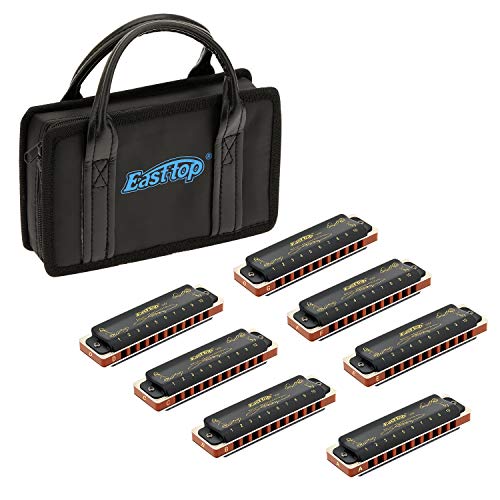
The best harmonica sets for beginners are almost always built around a key-of-C diatonic, either as a single quality harp (Hohner Special 20, ~$40–55) or a multi-key bundle (Hohner Piedmont Blues 7-key set, ~$30–40) — and the deciding factor is whether you want one harp you’ll grow with, or several keys to experiment with while you learn. Below, we break down why C is the standard, how comb materials affect comfort, and which boxed sets actually include cases and lesson access.
Our top picks



As an Amazon Associate we earn from qualifying purchases at no extra cost to you. Ratings are shown as listed on Amazon.
Why the Key of C Is the Universal Starter
Diatonic harmonicas are tuned to a single key, and roughly 90% of beginner tutorials, method books, and YouTube lessons are taught on a C harp. Three reasons:
- Mid-range pitch: C sits in the middle of the diatonic range. Lower keys (G, A) feel airy and soft; higher keys (F, Eb) are shrill and physically harder to bend.
- Lesson alignment: When a tutorial says “4 blow,” the notes you hear match yours. Learning on A or D while following C-based lessons creates constant confusion.
- Bending practice: Hole 3 draw bends (the first advanced technique most players learn) are easiest to hear and control on C.
Buy your first harp in C even if a multi-key set tempts you. Expand to G and A after 2–3 months of consistent play.
Single Harp vs. Multi-Key Sets: Which to Buy
Beginner “sets” come in two flavors, and they serve different goals:
Option 1: One Quality C Harp
A single well-made diatonic — Hohner Special 20, Hohner Marine Band Crossover, or Lee Oskar Major Diatonic — costs $40–$95 and will last years. The Special 20’s recessed plastic comb is famously gentle on lips, making it the most recommended first harp among teachers.
Option 2: A Multi-Key Boxed Set
Sets like the Hohner Piedmont Blues 7-piece set (keys A, Bb, C, D, E, F, G) run $30–40 total — under $6 per harp. The reeds are thinner and less responsive than a Special 20, but the set includes a fitted zip case and lets you explore keys immediately. Suzuki’s Folkmaster sets and Eastar multi-packs occupy a similar budget tier.
| Set / Harp | Keys Included | Comb | Case | Lesson Access | Typical Price |
|---|---|---|---|---|---|
| Hohner Special 20 (single) | C (others sold separately) | Plastic (ABS) | Plastic snap box | No | $40–55 |
| Hohner Marine Band Crossover | C (others available) | Bamboo wood (sealed) | Plastic box | No | $80–95 |
| Lee Oskar Major Diatonic | C (modular system) | Plastic | Plastic box | Replacement reed plates available | $45–55 |
| Hohner Piedmont Blues 7-set | A, Bb, C, D, E, F, G | Plastic | Padded zip case | No | $30–40 |
| Eastar Captain Blues 3-pack | C, D, G | Plastic | Canvas roll bag | Bundled beginner e-lessons | $25–35 |
Plastic vs. Wood Combs: The Comfort Difference
The comb is the body you press to your lips, and material genuinely affects how a harp plays:
| Factor | Plastic (ABS) | Wood (pear/bamboo) |
|---|---|---|
| Lip comfort | Smooth, no texture | Can feel grainy; swell at edges |
| Moisture reaction | None — dimensionally stable | Swells unless sealed/lacquered |
| Cleaning | Rinse-able, wipe-dry | Dry brush only; water warps it |
| Durability | Near-indestructible | Can crack if dropped or soaked |
| Tone character | Bright, consistent | Slightly warmer, more airy |
For a first harp, plastic wins on practicality. Wood’s swelling issue isn’t myth — a $60 Marine Band can become uncomfortable within months of heavy saliva exposure. Modern sealed bamboo (Crossover) largely solves this, but at triple the price. Get comfortable with plastic first, then audition a wooden comb once your embouchure is developed enough to hear the tonal difference.
Decision Matrix: Pick by Situation
| Your Situation | Best Choice | Why |
|---|---|---|
| Testing the waters, tight budget | Piedmont 7-set (~$35) | Under $6/harp, case included, C harp inside |
| Committed to learning properly | Special 20 in C | Responsive reeds make bending achievable in weeks, not months |
| Playing with others / different songs | Quality C + add G and A | Three keys cover most blues, folk, and rock |
| Gift for a child or teen | Multi-key budget set with lessons | Variety keeps interest; bundled tutorials help |
| Worried about germs / easy cleaning | Plastic-comb harp, any brand | Rinseable; wood cannot be wet-cleaned |
Ownership Realities Listings Don’t Mention
- What wears first: Draw reeds on holes 2 and 4 fatigue first (you bend them hardest). Expect 1–3 years of regular play before a reed goes flat — Lee Oskar’s replaceable reed plates (~$20) make it the cheapest harp to keep alive.
- Cleaning: Knock out moisture after playing, let it air-dry upright. Plastic combs can be rinsed monthly and dried fully. Never soak a wood-comb harp.
- The cheap-harp trap: Sub-$10 single harps have leaky airtightness — holes 1–3 draw barely respond, and beginners wrongly conclude they can’t bend. A $35+ harp removes the hardware variable from your progress.
- Cost per use: A $50 Special 20 played 20 minutes daily for two years = ~$0.07/session. A $10 toy harp that fights you for three months before you quit costs more per enjoyable session.
FAQ
Should beginners buy a chromatic harmonica?
Not initially. Chromatics ($150+) play every note but have steeper learning curves and don’t teach bending. Start diatonic; add chromatic later if jazz or classical appeals.
How many keys do I actually need?
One (C) for your first 2–3 months. Three (C, G, A) covers ~80% of songs with other musicians. Seven-key sets are value plays, not necessities.
Do sets with “lesson access” help?
Bundled e-lessons vary in quality, but free resources (Adam Gussow’s YouTube lessons, harmonica.com courses) are excellent — treat included lessons as a bonus, not a deciding factor.