Key takeaways
- Recreational kayaks (26-30+ inches wide): 220-240cm is standard. Most adults in 28-30 inch wide kayaks are best served by 230cm.
- Touring / sea kayaks (22-25 inches wide): 210-220cm for low-angle paddling, 205-215cm for high-angle.
- Whitewater kayaks (very narrow, constant maneuvering): 188-203cm, sized more by paddler height and boat type than width.
- Fishing kayaks / sit-on-tops (30-36 inches wide): 240-260cm to clear wide hulls and high seats.
The best kayak paddles for most paddlers are a 220-230cm lightweight carbon or fiberglass-shaft paddle with a mid-sized asymmetrical dihedral blade for recreational kayaks, while touring, whitewater, and fishing kayaks each need a more specific length, blade shape, and shaft material to match boat width and stroke style.
Our top picks
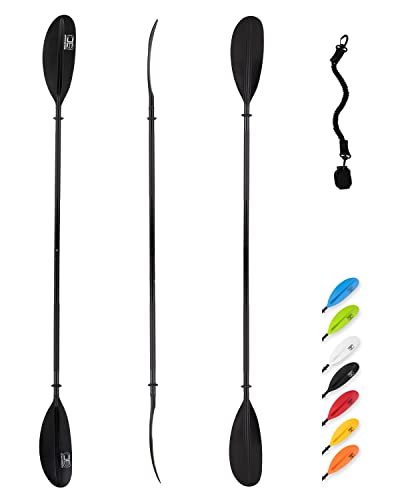


As an Amazon Associate we earn from qualifying purchases at no extra cost to you. Ratings are shown as listed on Amazon.
How to Choose the Right Length: Kayak Width Matters More Than Height
Paddle length is not about how tall you are alone — it is about the distance from your hands to the water. A wider kayak and a more relaxed, low-angle stroke require a longer paddle. A narrow sea kayak and a vertical, high-angle stroke require a shorter one.
Use this sizing baseline for the best kayak paddles, then adjust for your boat:
- Recreational kayaks (26-30+ inches wide): 220-240cm is standard. Most adults in 28-30 inch wide kayaks are best served by 230cm.
- Touring / sea kayaks (22-25 inches wide): 210-220cm for low-angle paddling, 205-215cm for high-angle.
- Whitewater kayaks (very narrow, constant maneuvering): 188-203cm, sized more by paddler height and boat type than width.
- Fishing kayaks / sit-on-tops (30-36 inches wide): 240-260cm to clear wide hulls and high seats.
Quick Fit Calculation
If you are between sizes, do this 30-second check. Sit in your kayak and hold any paddle horizontally overhead with elbows at 90 degrees. Your hands should be about shoulder-width apart with roughly 6-8 inches of shaft extending beyond each hand to the blade throat. If you have to overreach to put a blade fully in the water at a comfortable 30-45 degree shaft angle, you need a longer paddle. If you are hitting the sides of a narrow kayak or lifting water over the deck, go shorter.
For touring kayaks, paddler height shifts the recommendation by about 10cm per 6 inches of height difference when using the same boat width. Example: In a 24-inch wide touring kayak, a 5’6″ low-angle paddler often fits 220cm, while a 6’2″ paddler in the same kayak may fit 230cm for the same effortless stroke. High-angle paddlers subtract 10cm from that low-angle baseline.
Blade Shape and Size: The Biggest Performance Difference
The blade determines how the paddle feels in the water. This is where paddling style directly maps to design.
Low-Angle vs. High-Angle Blades
Low-angle blades are long, narrow, and often slightly dihedral (ridged down the middle). They enter the water at a shallow angle, pull smoothly, and reduce fatigue. Ideal for relaxed cruising, long-distance touring, and beginners who keep the shaft closer to horizontal. You get less flutter and a more forgiving stroke if your technique is not perfect.
High-angle blades are shorter, wider, and more spoon-shaped. They catch more water quickly with a vertical shaft position, delivering more power per stroke and better bracing. Ideal for aggressive paddlers, sea kayakers in wind/current, and whitewater where instant acceleration matters. They are more tiring over 4+ hours if you are not conditioned for them.
Blade Size and Paddler Strength
A large blade (around 650-700 sq cm) moves more water but loads your shoulders and elbows. A mid-size blade (550-620 sq cm) is the sweet spot for most adults and is easier on joints for trips over two hours. Smaller blades (450-550 sq cm) or narrow Greenland-style blades are best for smaller paddlers, those with prior shoulder issues, or anyone prioritizing cadence over power.
Shaft Material, Weight, and Why Grams Matter
Weight is the most underrated spec when looking for the best kayak paddles. A 6-ounce difference does not sound like much until you make 1,000 strokes per hour.
Worked calculation: At a casual pace of 30 strokes per minute, you take 1,800 strokes per hour. Lifting an extra 170g (6 oz) per stroke means lifting an additional 306kg (674 lbs) of cumulative weight per hour. Over a 4-hour paddle, that is more than 1,200kg of extra lifted weight, which is why paddlers report far less fatigue with carbon shafts even when their technique is identical.
- Aluminum shaft with plastic blades: Heaviest (950-1050g), most affordable, cold to the touch in winter, but durable. General market range $50-$120. Good for spare/loaner paddles and short rentals.
- Fiberglass shaft and blades: Middle weight (750-900g), excellent vibration damping, warmer on hands. General range $130-$300. The best value for regular recreational and touring use.
- Carbon shaft with fiberglass or carbon blades: Lightest (650-800g), stiffest power transfer, least swing weight. General range $250-$550+. Worth it if you paddle weekly or for more than 2 hours at a time.
Also consider shaft shape: A straight shaft is lighter, simpler, and suits most paddlers. A small-diameter shaft helps smaller hands maintain grip without over-squeezing. Bent shafts (ergonomic crank) keep wrists neutral and can reduce strain on long tours, but add cost and a few grams.
Two-piece paddles are standard now for transport and length adjustment. Look for a ferrule that locks without wobble. A loose ferrule creates blade flutter that no blade design can fix.
Feather Angle Explained
Feather angle is the offset between the two blades. At 0 degrees (unfeathered), both blades face the same way. At 60 degrees feathered, one blade slices through the wind while the other pulls.
- 0-15 degrees: Easiest on wrists, intuitive for beginners, fine for protected water with little wind. Most recreational paddlers leave it here.
- 30-45 degrees: Common compromise for touring. Reduces wind resistance on the recovery blade without requiring much wrist rotation.
- 60 degrees: Traditional whitewater and high-wind sea kayak setting. Cuts wind best, but requires active wrist control. If you feel wrist pain, you are over-rotating — reduce the angle.
Almost all modern two-piece paddles offer adjustable feather in 15-degree increments. Start unfeathered for your first few trips and increase only if you notice headwind pushing your recovery blade. There is no single correct angle; it is about comfort and wind.
Comparison Table: Best Kayak Paddles by Style in 2026
| Model (Type) | Lengths Available | Blade Size / Shape | Shaft / Blade Material | Weight (approx.) | Best For |
|---|---|---|---|---|---|
| Werner Shuna | 205-230cm (10cm increments) | 615 sq cm, mid-size high-angle dihedral | Carbon shaft / Fiberglass blade | 680g (24.0 oz) at 220cm | Touring and high-angle recreational use |
| Werner Camano | 210-240cm | 580 sq cm, low-angle dihedral | Carbon or fiberglass shaft / Fiberglass blade | 680-765g (24-27 oz) depending on layup | Low-angle touring, all-day comfort |
| Aqua-Bound Sting Ray Carbon | 210-240cm | ~550 sq cm, low-angle all-around | Carbon shaft / Carbon-reinforced nylon blade | 794g (28 oz) at 230cm | Recreational kayaks, lightweight on a budget |
| Bending Branches Whisper Dream | 210-240cm | ~600 sq cm, low-angle | Aluminum shaft / Fiberglass-reinforced nylon blade | 964g (34 oz) at 230cm | Entry-level and spare paddle |
| Werner Sherpa | 188-203cm | 700 sq cm, large high-angle whitewater | Fiberglass or carbon shaft / Fiberglass blade | 850-907g (30-32 oz) | Whitewater and river running |
| Bending Branches Angler Pro Carbon | 240-270cm | ~610 sq cm, wide low-angle with hook retrieval notch | Carbon shaft / Carbon blade | 765g (27 oz) at 250cm | Wide fishing kayaks and sit-on-tops |
Weights vary by length; shorter lengths in the same model will be 20-40g lighter. Carbon blades are stiffer and more efficient but chip if you push off rocks — nylon-reinforced blades are more forgiving for rocky launches.
Decision Matrix: Match Your Situation to the Right Paddle
| Your Situation | Recommended Blade & Length | Recommended Material | Why This Works |
|---|---|---|---|
| Beginner, 28-30″ recreational kayak, 1-2 hour lake paddles | 230cm low-angle, mid-size (550-600 sq cm) | Fiberglass shaft / nylon blade | Forgiving stroke, durable for bumps, low fatigue |
| Touring paddler, 22-24″ sea kayak, 4+ hour trips | 210-220cm low-angle | Carbon shaft / fiberglass blade | Lightest swing weight reduces cumulative fatigue |
| Fitness / performance paddler who likes a fast cadence | 205-215cm high-angle, mid-large | Carbon shaft / carbon or fiberglass blade | Maximum catch and power per stroke |
| Whitewater or surf zone | 191-200cm high-angle, large blade | Fiberglass shaft / fiberglass blade | Strong bracing, survives impacts better than pure carbon |
| Fishing from 32″+ wide sit-on-top, standing often | 250-260cm low-angle, mid-size | Carbon shaft / reinforced blade | Clears gunwales and high seat without banging hull |
| Tight budget or need a second paddle | Match length to your main paddle | Aluminum / nylon | Reliable backup; cold and heavy but nearly indestructible |
Durability and Ownership Realities
Paddles do not have moving parts, but they do wear in predictable places. Knowing what fails first helps you buy and maintain smarter.
- Ferrule wear: Sand and grit inside the joint is the number one cause of wobble. Always separate the paddle after paddling, rinse the ferrule with fresh water, and store it apart. Do not use lubricant on snap-button ferrules; it attracts grit.
- Blade edge chips: Carbon and fiberglass blades chip when used as a push pole off rocks or concrete ramps. Use the shaft, not the blade edge, to push off. Small chips can be sealed with marine epoxy to prevent water intrusion into the cloth.
- Shaft UV and heat: Do not store paddles in a hot car roof box for days. Prolonged heat can soften adhesives in adjustable ferrules and warp nylon blades. Keep them shaded and vertical when not in use.
- Drip rings and grips: Drip rings crack first. Keep spares — they cost a few dollars and prevent soaked laps in cold water. If your paddle came with adjustable drip rings, set them 2-3 inches above the blade throat.
- Common mistake: Buying too long to “get more reach.” An overly long paddle forces a low, sweeping stroke, bangs the sides of a narrow kayak, and soaks you with every stroke. If you are between lengths and paddle a touring kayak, choose the shorter option.
Cleaning is simple: Freshwater rinse after salt or sandy water, wipe dry, and check the ferrule button spring moves freely. No oil needed. Inspect the blade throat where shaft meets blade — hairline cracks there mean the paddle should be retired from whitewater or surf use.
FAQ
Carbon vs. fiberglass: is carbon worth the extra cost?
If you paddle more than twice a month or longer than two hours, yes. The weight savings lowers fatigue more than any other upgrade at the same price. If you paddle a few times a year on calm lakes, a fiberglass shaft with nylon blades gives you 80% of the comfort for about half the cost.
Should I get a 4-piece paddle for travel?
4-piece paddles pack down to about 60-70cm for air travel or inflatable kayaks, but they add one more joint and 30-50g. For car transport and home storage, a 2-piece is lighter, stiffer, and simpler. Choose 4-piece only if you fly or have severe storage limits.
What paddle is best for a tandem kayak?
Tandems are wide and often paddled from a higher seat. Go 10-20cm longer than you would for a solo kayak of the same width. A 240-250cm low-angle fiberglass or carbon paddle is typical for most 30-34 inch wide tandems.