Key takeaways
- For a studio or narrow room: Look for an overall width around 48–60 inches and a shallower depth. Slim arms can preserve useful seat width. Avoid choosing by width alone: a deep back or reclined silhouette can obstruct a walkway.
- For a small living room used every day: A standard model around 60–72 inches wide is often the more versatile choice. Favor resilient, replaceable cushions and a fabric that tolerates regular contact over decorative details you will rarely use.
- For a large room or long lounging sessions: Consider a 72–80-inch-wide frame, deeper seating, or a matching ottoman. Check that the loveseat relates in scale to nearby furniture; a compact piece can look lost between a large rug and full-size chairs.
- For pets, children, or frequent guests: Prioritize removable cushion covers if available, tightly woven upholstery, and a frame with clearly stated care instructions. Performance fabric can simplify cleanup, but it is not automatically snag-proof or stain-proof.
Best Loveseats for Small and Large Living Rooms
The best loveseats are sized to leave enough room for everyday movement, with supportive cushions and upholstery suited to how often you use them. For a tight room, prioritize a compact frame and clear delivery dimensions; for a large living room, choose a wider, deeper model that can hold its own without relying on oversized arms to add bulk.
Compare loveseat sizes and trade-offs
Dimensions below are approximate examples of common configurations, not guarantees for every model or fabric. Check the specific model’s product page before ordering: a brand may sell several widths, leg styles, and cushion options under one collection name.
Our top picks
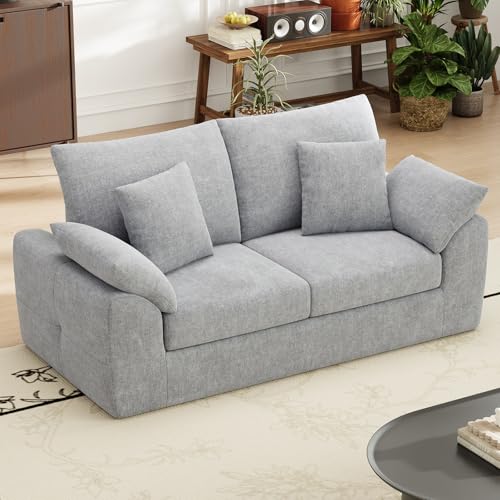
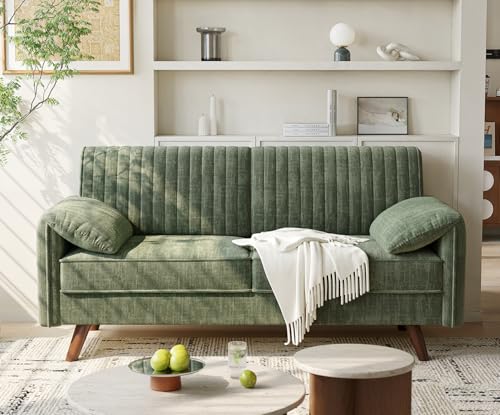


As an Amazon Associate we earn from qualifying purchases at no extra cost to you. Ratings are shown as listed on Amazon.
| Loveseat type | Typical overall width | Typical depth | Typical seat width | Best fit | Ownership trade-off |
|---|---|---|---|---|---|
| Compact two-seat | 48–60 in | 28–34 in | 40–50 in | Studio, small apartment, secondary seating | Easy to place, but less room to stretch out |
| Standard two-seat | 60–72 in | 32–38 in | 48–60 in | Small or medium living room | Balanced capacity and footprint |
| Wide, deep-seat loveseat | 72–80 in | 36–42 in | 58–68 in | Large living room or relaxed lounging | More comfortable for sprawling; harder to maneuver and fit through doors |
| Apartment sofa / oversized loveseat | 70–80 in | 30–36 in | 58–68 in | Room needing sofa-like seating without a full-size sofa | Can dominate a narrow room despite its “apartment” label |
Seat width is the usable space between the arms, not the outside width of the furniture. A loveseat with 70 inches of overall width and thick arms may offer less sitting room than a slimmer-framed model of similar size. Compare both measurements whenever the manufacturer lists them.
Choose by room and routine
- For a studio or narrow room: Look for an overall width around 48–60 inches and a shallower depth. Slim arms can preserve useful seat width. Avoid choosing by width alone: a deep back or reclined silhouette can obstruct a walkway.
- For a small living room used every day: A standard model around 60–72 inches wide is often the more versatile choice. Favor resilient, replaceable cushions and a fabric that tolerates regular contact over decorative details you will rarely use.
- For a large room or long lounging sessions: Consider a 72–80-inch-wide frame, deeper seating, or a matching ottoman. Check that the loveseat relates in scale to nearby furniture; a compact piece can look lost between a large rug and full-size chairs.
- For pets, children, or frequent guests: Prioritize removable cushion covers if available, tightly woven upholstery, and a frame with clearly stated care instructions. Performance fabric can simplify cleanup, but it is not automatically snag-proof or stain-proof.
What matters beyond the dimensions
Cushion support and shape retention
Foam cushions feel different depending on their density, construction, and surrounding wrap. A softer top layer can feel comfortable initially but may show body impressions sooner; firmer foam generally feels more supportive but can seem stiff at first. Some seats combine foam with fiber or down-like fill for a softer surface, which may need regular fluffing. Ask whether seat cushions are reversible and whether replacement inserts are available. These details can matter more over several years than a showroom-style description such as “plush.”
Upholstery durability and cleaning
Fabric construction, color, weave, and care requirements all affect day-to-day wear. Tightly woven polyester blends are common practical options, while textured or loose weaves may catch pet claws more readily. Leather and faux leather can be wiped clean, but finishes can scratch, peel, or discolor depending on quality and care. Before buying, check the maker’s cleaning code and test any cleaner on an inconspicuous spot. Rotate or swap reversible cushions periodically to spread wear, and vacuum seams where crumbs and grit can abrade fabric.
Delivery, assembly, and access
“Easy assembly” can still mean attaching legs, joining sections, or carrying a heavy frame up stairs. Measure the narrowest doorway, hallway turn, stair landing, and elevator opening—not just the room. Compare those measurements with the loveseat’s boxed dimensions and the manufacturer’s instructions for moving it. A model with removable legs or a split frame may be much easier to deliver than a one-piece loveseat of similar dimensions. Confirm whether delivery includes placement and packaging removal; those services vary by seller and price tier.
A quick fit calculation before ordering
Suppose your available wall is 90 inches wide and you want at least 18 inches on each side for visual breathing room. The maximum target width is 90 − 18 − 18 = 54 inches. A 58-inch loveseat may technically fit, but it would leave only 16 inches per side. Then account for circulation: leave roughly 30–36 inches for a comfortable main walkway where the room allows, and check that a coffee table will not make the route awkward.
These are planning guidelines, not universal rules. Door swings, windows, radiators, and the path between the entrance and seating can change what “fits” in practice. Mark the footprint on the floor with painter’s tape and walk around it before placing an order.
Bottom line
For a compact room, choose a loveseat with a narrow overall footprint, slim arms, and a delivery plan that works for your entrances. For a larger room, spend the extra width on usable seat space and cushion support rather than bulk alone. In either case, verify seat width, depth, cover-care instructions, cushion construction, and boxed dimensions before buying; those checks are more useful than the loveseat’s label or appearance in a staged photo.