Key takeaways
- NSF/ANSI 42: Primarily covers aesthetic effects, such as chlorine taste, odor, and particulate reduction. It is the baseline certification most relevant to cleaner-tasting water.
- NSF/ANSI 53: Covers reduction of specified contaminants with a potential health effect. The exact list may include lead, cysts, or other contaminants, but certification for one does not mean certification for all.
- NSF/ANSI 401: Addresses certain emerging contaminants, such as selected pharmaceuticals or chemicals. The certified substance list is essential.
Best Refrigerator Water Filters for Clean Taste
The best refrigerator water filter is the certified replacement made for your exact refrigerator model, with NSF claims that match the contaminants you want reduced; for many households, that means a genuine OEM filter rated for roughly 6 months or 200–300 gallons.
A filter that fits the housing but lacks the correct certification can provide a good taste improvement without delivering the reduction claims you expect. Before buying, check the filter code printed on the old cartridge or inside the refrigerator, then compare NSF certification, rated capacity, replacement cost, and installation method.
Our top picks



As an Amazon Associate we earn from qualifying purchases at no extra cost to you. Ratings are shown as listed on Amazon.
Best refrigerator water filters by situation
| Situation | Best choice | Typical rated life | Why it makes sense |
|---|---|---|---|
| Maximum fit certainty | Genuine OEM filter matching the refrigerator model | 6 months; commonly 170–300 gallons | Correct seal, bypass behavior, flow path, and filter-life reset procedure |
| Everyday chlorine and odor reduction | NSF/ANSI 42-certified carbon block filter | Usually 6 months | Designed primarily for aesthetic improvements such as taste and smell |
| More extensive contaminant claims | Filter with model-specific NSF/ANSI 53 or 401 claims | Often 6 months or 200 gallons | May address specified health-related or emerging contaminants, depending on the exact model |
| High-volume household | Higher-capacity cartridge, commonly rated at 300 gallons | Up to 6 months, subject to capacity | Less frequent replacement if actual use is high and the refrigerator supports it |
| Low purchase price | Compatible replacement with independently verifiable certification | Varies by product | Can reduce cost, but only if fit, certification, and capacity are confirmed |
Top refrigerator filter families to consider
EveryDrop Filter 1 and related Whirlpool-family replacements
EveryDrop Filter 1, commonly identified as EDR1RXD, is used in selected Whirlpool, Maytag, KitchenAid, and Amana refrigerators. Its commonly published rating is 200 gallons or 6 months, whichever comes first. The cartridge is typically a push-in design, making replacement quick once the correct part is confirmed.
Some EveryDrop models carry NSF/ANSI 42, 53, and 401 claims, but certification is model-specific. Do not assume that every EveryDrop cartridge reduces every contaminant covered by the brand family. Check the performance data sheet for the exact code, especially if you are shopping for lead, pharmaceutical, pesticide, or other specific reduction claims.
GE XWFE
The GE XWFE is a common replacement for newer GE refrigerators that use an internal XWFE cartridge. It is often rated for approximately 170 gallons or 6 months. The cartridge includes an RFID-based filter-recognition feature on compatible refrigerators, so an unrecognized third-party cartridge may cause a warning or fail to reset normally even when its physical dimensions appear correct.
GE publishes model-specific claims that can include NSF/ANSI 42, 53, and 401. The important buying detail is the distinction between “tested to” and “certified by.” Look for certification through NSF or another recognized certification body, and review the exact contaminant list rather than relying on a broad marketing phrase such as “multi-contaminant reduction.”
LG LT1000P
LG LT1000P is used in many LG French-door refrigerators. Its typical rated capacity is 200 gallons or 6 months. It is a push-in cartridge, although the release and installation steps depend on the refrigerator’s internal filter housing.
Genuine LT1000P cartridges are commonly associated with NSF/ANSI 42, 53, and 401 claims. LG sells several visually similar filter codes, so match the complete part number, not merely the refrigerator brand. A wrong cartridge can leak, sit too loosely, or fail to activate the filter sensor.
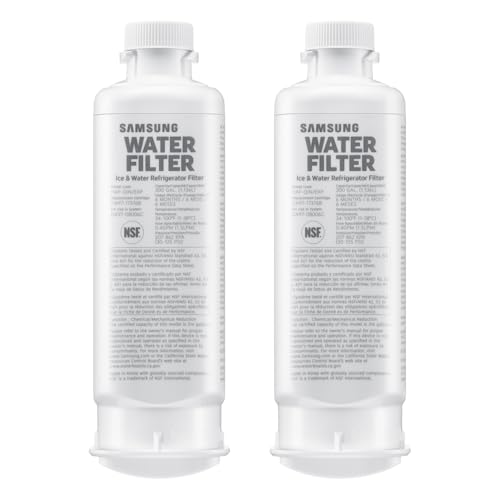
Samsung HAF-QIN
Samsung HAF-QIN is used in selected Samsung refrigerators and is generally rated for 300 gallons or 6 months. That larger capacity may suit a household that fills several bottles and glasses daily, but the six-month interval still matters because carbon media can lose effectiveness over time even when the gallon limit has not been reached.
Samsung filter housings and replacement alerts differ across refrigerator generations. Confirm the complete model code before ordering. As with other brands, certification and contaminant claims should be checked against the exact HAF-QIN performance documentation.
Frigidaire PureSource Ultra II ULTRAWF
The Frigidaire ULTRAWF is a widely used internal filter for compatible Frigidaire refrigerators. It is commonly rated for 200 gallons or 6 months. It is intended to improve taste and odor while reducing contaminants listed for that specific cartridge.
Compatibility is particularly important because Frigidaire uses several similar-looking filter families, including cartridges with different connection mechanisms. Compare the code on the installed filter and the refrigerator manual before purchasing a replacement.
What NSF certification actually tells you
- NSF/ANSI 42: Primarily covers aesthetic effects, such as chlorine taste, odor, and particulate reduction. It is the baseline certification most relevant to cleaner-tasting water.
- NSF/ANSI 53: Covers reduction of specified contaminants with a potential health effect. The exact list may include lead, cysts, or other contaminants, but certification for one does not mean certification for all.
- NSF/ANSI 401: Addresses certain emerging contaminants, such as selected pharmaceuticals or chemicals. The certified substance list is essential.
NSF certification does not mean the water is sterile, and a refrigerator filter is not automatically a substitute for a whole-house treatment system. If your water report identifies a particular contaminant, choose a filter whose performance sheet names that contaminant and follow the manufacturer’s replacement schedule.
Flow rate, taste, and filter life: the trade-offs
Refrigerator filters are usually carbon-block cartridges. They need enough contact time with the media to reduce chlorine and other listed contaminants, so the dispenser may pour more slowly immediately after installation or as the cartridge loads with sediment. A noticeable slowdown before the expected replacement date can indicate cloudy water, clogged sediment, an incompletely flushed cartridge, or a problem with household water pressure.
Rated capacity is not a promise that every household will get the same service life. A 200-gallon cartridge used for 2 gallons per day reaches its capacity in about 100 days:
200 gallons ÷ 2 gallons per day = 100 days.
That is roughly three months, even though the calendar limit may be six months. Conversely, a lightly used cartridge should usually still be replaced at the stated time limit because the manufacturer’s rating uses both capacity and elapsed time.
How to replace a refrigerator water filter correctly
- Identify the exact cartridge. Read the code on the old filter, the refrigerator label, or the owner’s manual. Do not rely only on appearance.
- Turn off the dispenser if required. Some models need the water dispenser locked or the filter housing opened in a particular position.
- Remove the old cartridge and inspect the seal. Look for a torn O-ring, loose plastic, or debris in the filter bay. These are common sources of leaks.
- Prepare the new filter. Remove protective caps and follow the package instructions. Some cartridges must be soaked or flushed before installation.
- Flush the specified volume. Many manufacturers call for several gallons to remove carbon fines and trapped air. Discard the first water rather than drinking it.
- Reset the filter indicator. Use the refrigerator’s button sequence or control-panel instructions. A reset changes the reminder; it does not restore a worn cartridge.
- Check for leaks. Dispense water, inspect the housing, and recheck it after several minutes.
Ownership issues that affect long-term value
The filter media normally wears out before the plastic housing does. Sediment can restrict flow, carbon can become exhausted, and seals can flatten or twist. Keep the filter bay clean with a damp cloth, but do not use harsh cleaners inside a compartment that contacts drinking water. If the refrigerator sits unused for an extended period, replace the cartridge or follow the manufacturer’s storage guidance before resuming use.
Do not stretch a filter indefinitely because the water still tastes acceptable. Taste is only one performance indicator. Also avoid forcing a cartridge into place: resistance usually means the filter is misaligned, a protective cap remains attached, or the part is incompatible.
Bottom line
For the easiest replacement, choose the genuine cartridge specified for your refrigerator and verify its current NSF certification and contaminant list. EveryDrop EDR1RXD, GE XWFE, LG LT1000P, Samsung HAF-QIN, and Frigidaire ULTRAWF are established filter families, but none is universally compatible. The best refrigerator water filters are the ones that seal correctly, maintain acceptable flow, carry the certification you actually need, and are replaced by gallons or by time—whichever comes first.