Key takeaways
- Choose the TP-Link Archer AX55 for the best balance of price and everyday performance. Choose the ASUS RT-AX86U Pro for a busy household, gaming, or multi-gig networking. Pick the NETGEAR Nighthawk RAX50 if you want a capable conventional router with familiar controls. Choose the Amazon…
The best wifi 6 routers for most homes are the TP-Link Archer AX55 for value, the ASUS RT-AX86U Pro for demanding households, the Amazon eero 6+ for simple whole-home coverage, and the NETGEAR Nighthawk RAX50 for a strong all-rounder with more traditional router controls.
Our top picks



As an Amazon Associate we earn from qualifying purchases at no extra cost to you. Ratings are shown as listed on Amazon.
Best Wi-Fi 6 routers at a glance
| Router | Best for | Advertised wireless class | Ethernet ports | Approximate coverage | Typical market range |
|---|---|---|---|---|---|
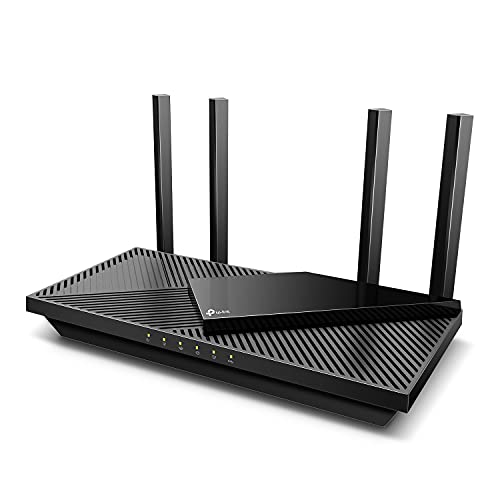
| TP-Link Archer AX55 | Most two- to three-bedroom homes | AX3000: up to 574 Mbps at 2.4 GHz, 2402 Mbps at 5 GHz | 1 × gigabit WAN, 4 × gigabit LAN | Up to about 2,500 sq ft | $90–$130 |
| ASUS RT-AX86U Pro | Gaming, fast broadband, and heavy device loads | AX5700: up to 861 Mbps at 2.4 GHz, 4804 Mbps at 5 GHz | 1 × 2.5Gbps port, 4 × gigabit LAN | Up to about 2,500 sq ft | $180–$250 |
| NETGEAR Nighthawk RAX50 | Families wanting conventional router controls | AX5400: up to 574 Mbps at 2.4 GHz, 4804 Mbps at 5 GHz | 1 × gigabit WAN, 4 × gigabit LAN | Up to about 2,500 sq ft | $150–$220 |
| Amazon eero 6+ | Simple mesh coverage | AX3000: up to 2401 Mbps at 5 GHz | 2 × gigabit Ethernet per unit | Up to about 1,500 sq ft per unit | $100–$140 per unit |
Advertised wireless figures are theoretical link rates, not internet speed. A router rated AX3000 does not deliver 3,000 Mbps to one phone. Real performance depends on the client device, channel congestion, distance, walls, and whether the connection uses 2.4 GHz or 5 GHz.
Our picks by household situation
| Your situation | Best choice | Why |
|---|---|---|
| Budget-conscious apartment or small home | TP-Link Archer AX55 | Strong 5 GHz performance, four wired LAN ports, and useful security controls without a premium price. |
| Several simultaneous 4K streams, gaming, and large downloads | ASUS RT-AX86U Pro | Faster 5 GHz capacity, a 2.5Gbps port, and extensive traffic-management settings. |
| Large or awkwardly shaped home | Amazon eero 6+ | Multiple nodes are easier to position than forcing one router through several walls. |
| Power users who want detailed configuration | NETGEAR Nighthawk RAX50 | Offers conventional router administration, parental controls, guest networking, and strong Wi-Fi 6 capacity. |
TP-Link Archer AX55: the sensible value pick
The Archer AX55 is the best wifi 6 router for many households because it balances speed, range, and price rather than overbuilding any one category. Its AX3000 rating is enough for a typical broadband connection, and four gigabit LAN ports accommodate a desktop PC, television, game console, and network switch without an immediate upgrade.
It supports WPA3 security, guest networking, beamforming, OFDMA, and MU-MIMO. TP-Link’s HomeShield features can provide device identification, basic parental controls, and security monitoring, although some advanced features may require a subscription depending on region and service tier.
Choose it for an apartment, townhouse, or moderately sized detached home. It is less suitable if you have internet service above 1 Gbps, a large wired network, or many clients transferring data at the same time.
ASUS RT-AX86U Pro: best for busy, high-speed homes
The RT-AX86U Pro is the stronger choice when the network itself is a bottleneck. Its AX5700 rating gives compatible devices more headroom on the 5 GHz band, while the 2.5Gbps Ethernet port can serve as a multi-gig internet port or a fast connection to a capable wired computer or switch.
ASUS includes AiProtection security, guest networks, VPN functions, adaptive quality of service, and gaming-oriented traffic controls. These settings are valuable in a household where one person is gaming while others are streaming, uploading photos, attending video meetings, or downloading large files.
The extra performance costs more and does not make an older phone faster. It is worth paying for when several newer Wi-Fi 6 devices are active, your broadband plan exceeds 1 Gbps, or you need detailed control over traffic priorities.
NETGEAR Nighthawk RAX50: a capable traditional router
The Nighthawk RAX50 combines an AX5400 rating with four gigabit LAN ports and a familiar web-based administration experience. It is a good fit for users who want a conventional standalone router rather than a mesh system managed primarily through a mobile app.
Its dual-band design is suitable for everyday streaming, video calls, smart-home devices, and gaming. WPA3, guest Wi-Fi, automatic firmware updates, and parental-control options help cover the basics. As with many NETGEAR products, some additional security and parental features may be tied to a paid subscription.
Its main limitation is wired connectivity: the four LAN ports are gigabit, so it is not the best long-term choice for a multi-gig home network. For broadband at 1 Gbps or below, that limitation is usually unimportant.
Amazon eero 6+: easiest path to whole-home coverage
The eero 6+ is a mesh system rather than a high-control standalone router. Each unit has two gigabit Ethernet ports, and additional nodes can extend coverage into rooms that a single router cannot reliably reach. Automatic configuration and unified network management make it approachable for people who would rather not tune channels, transmit power, or advanced routing rules.
It supports WPA3, automatic updates, guest networking, and common mesh features such as band steering. However, it provides fewer advanced controls than ASUS or many traditional routers, and some security, parental, and network-management tools require an eero Plus subscription.
Buy a multi-unit kit when walls, multiple floors, or a long floor plan are the problem. Avoid placing nodes in dead zones: each satellite needs a strong connection to the rest of the mesh. A wired Ethernet backhaul is preferable where possible because it leaves more wireless capacity for client devices.
How much coverage and capacity do you really need?
Manufacturer coverage figures are optimistic planning estimates. A single router may cover a 1,500-square-foot open apartment well but struggle in a 2,500-square-foot house with concrete, brick, foil-backed insulation, or several floors. For reliable coverage, place the router centrally and elevated, not inside a cabinet or beside a microwave.
Device capacity is more complicated than counting phones. A smart plug may use little bandwidth but still maintain a connection, while a gaming PC or 4K television can consume substantial airtime. A household with 40 connected devices may be easier to serve than one with 15 devices constantly uploading and downloading.
As a practical rule, choose an AX3000-class model for ordinary broadband and normal streaming, and step up to an AX5400- or AX5700-class router when several people regularly use high-bandwidth applications at once. If the issue is weak signal rather than congestion, use mesh nodes or wired access points instead of simply buying a faster single router.
Setup steps that improve reliability
- Update the firmware first. Security patches and stability fixes are more valuable than a small theoretical speed increase.
- Use a distinct administrator password. Do not reuse the password printed on the router or one used for email and banking.
- Enable WPA3 where compatible. Use WPA2/WPA3 transition mode if older smart-home devices cannot connect to WPA3-only Wi-Fi.
- Separate guests and smart-home devices. Guest networking limits access to computers, storage, and printers on the main network.
- Position the router centrally. Keep it in open air, above floor level, with antennas upright when the manufacturer recommends that orientation.
- Test rooms at busy times. A speed test beside the router says little about the weakest bedroom or home office.
- Use Ethernet for stationary heavy users. A television, desktop, console, or access point can free wireless airtime when wired.
Ownership realities and common mistakes
Routers have no user-replaceable consumable parts, but heat, dust, and outdated firmware shorten their useful life. Keep ventilation clear and remove dust from air openings periodically. Rebooting every night is not a substitute for fixing interference, poor placement, or an aging device; a stable router should run continuously.
Do not judge a router only by its maximum advertised number, and do not place a mesh satellite at the edge of coverage. Also check your modem or optical-network terminal: a gigabit router cannot provide multi-gig internet if the upstream equipment and Ethernet link remain limited to 1 Gbps.
Bottom line
Choose the TP-Link Archer AX55 for the best balance of price and everyday performance. Choose the ASUS RT-AX86U Pro for a busy household, gaming, or multi-gig networking. Pick the NETGEAR Nighthawk RAX50 if you want a capable conventional router with familiar controls. Choose the Amazon eero 6+ when consistent whole-home coverage and simple setup matter more than advanced configuration.