Key takeaways
- Good balance between mobility, support and moderate weight.
- Clear attachment layout for a conventional arborist setup.
- Enough gear storage for a pruning saw, ascender, throwline accessories and small hardware.
- Replacement bridges and wear components are easier to plan for than on many lower-cost harnesses.
The best arborist climbing harnesses for tree work are the Petzl Sequoia for a balanced all-round setup, the Teufelberger treeMOTION Pro for long technical climbs and heavy tool loads, and the Buckingham Ergovation for climbers who prioritize a supportive, traditional work-positioning feel.
These are not interchangeable with a general fall-arrest harness. A tree-climbing harness should support suspension and work positioning, provide attachment points that match your climbing system, and remain stable while you move around a stem or branch. Before buying, check that the specific model and configuration meet the requirements applicable to your work, such as EN 358, EN 813, and relevant regional arboricultural or workplace standards.
Our top picks
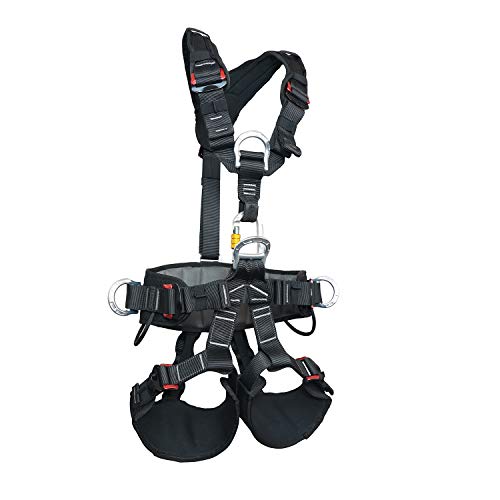


As an Amazon Associate we earn from qualifying purchases at no extra cost to you. Ratings are shown as listed on Amazon.
Quick comparison: leading arborist harnesses
| Harness | Approx. weight | Adjustment and fit | Attachment layout | Best suited to | Typical market range |
|---|---|---|---|---|---|
| Petzl Sequoia | About 1.7–2.0 kg, depending on size and configuration | Waist and leg adjustment; bridge length and position can be configured | Central bridge, side work-positioning points, rear attachment, gear loops | Daily climbing, SRT or doubled-rope systems, mixed pruning | Approximately $350–$550 |
| Teufelberger treeMOTION Pro | About 2.0–2.4 kg, depending on size and hardware | Highly adjustable waist, leg loops, bridge and seat geometry | Central bridge, side rings, rear point, multiple equipment options | Experienced climbers carrying substantial tools or changing systems often | Approximately $500–$800 |
| Buckingham Ergovation | About 2.0–2.5 kg, depending on configuration | Broad waist support and conventional leg/waist adjustment | Central suspension connection, side positioning points, rear point and tool storage | Utility-style climbing, work positioning and climbers who prefer firm support | Approximately $350–$650 |
| Lightweight professional harness type | About 1.3–1.8 kg | Usually fewer padding and adjustment options | Bridge and a smaller number of gear loops | Short pruning jobs and climbers minimizing bulk | Approximately $250–$450 |
Weights and prices vary with size, bridge length, carabiners, replacement components, and regional distribution. Treat the table as a buying comparison rather than a substitute for the manufacturer’s current technical sheet.
Best overall: Petzl Sequoia
The Petzl Sequoia is the easiest recommendation for a climber who wants one harness for regular pruning, access and work positioning. Its design balances a supportive waist belt with relatively free hip movement, so it does not feel like a rigid sit harness when you are stepping around a canopy.
Its central bridge works well with both moving-rope and stationary-rope techniques when the rest of the system is configured correctly. Side attachment points are useful for positioning lanyards, while the rear point can help keep equipment or a secondary connection out of the way. The harness is also available in configurations intended for different climbing methods, so confirm whether you need an SRT-compatible model rather than assuming two visually similar versions have identical layouts.
Why choose it
- Good balance between mobility, support and moderate weight.
- Clear attachment layout for a conventional arborist setup.
- Enough gear storage for a pruning saw, ascender, throwline accessories and small hardware.
- Replacement bridges and wear components are easier to plan for than on many lower-cost harnesses.
Limitations
It may feel too lightly padded for a climber who spends many hours suspended with a heavy saw, rigging accessories and multiple ropes. Its gear loops are practical rather than enormous, and overloading them can pull the waist belt out of its ideal position.
Best for technical climbing and heavy equipment: Teufelberger treeMOTION Pro
The treeMOTION Pro is aimed at climbers who want extensive adjustability and a harness that can be tuned closely to their body and climbing style. Its seat-like geometry and multiple adjustment options can distribute suspension pressure effectively during long periods aloft, particularly when the harness is correctly sized and the bridge is set to suit the climber’s movement.
The major advantage is configurability. A climber can refine waist tension, leg-loop position and bridge geometry rather than accepting one fixed relationship between the waist belt and suspension point. That is valuable for SRT climbers who alternate between upright ascent, hanging work and lateral movement.
Why choose it
- Strong fit adjustment for different body shapes and clothing layers.
- Comfortable platform for extended suspension and technical positioning.
- Good capacity for hardware-intensive climbing systems.
- Suitable for climbers who want to replace or customize certain wear components over time.
Limitations
More adjustment is not automatically better. A new user can spend considerable time tuning it, and an incorrectly positioned bridge or loose waist belt can make the harness feel unstable. It is also comparatively expensive and may be unnecessarily elaborate for occasional short pruning jobs.
Best for firm support and utility-style work: Buckingham Ergovation
The Buckingham Ergovation suits climbers who prefer a broad, supportive waist structure and a familiar work-positioning arrangement. It has a more substantial feel than ultralight harnesses, which can be reassuring when using a lanyard to hold position against a trunk or when carrying tools around the belt.
Its design is particularly attractive to workers whose daily tasks involve repeated positioning rather than only fast canopy movement. The trade-off is bulk: a heavily supported harness can be less noticeable during static work but more noticeable when squeezing through dense branch structure.
Why choose it
- Supportive waist structure for frequent work positioning.
- Practical attachment points for lanyards and conventional arborist hardware.
- Good choice for utility-style climbing and heavier tool arrangements.
Limitations
Check the bridge and attachment arrangement carefully if you are moving from a traditional climbing system to SRT. Also compare the actual gear-loop positions with your tool layout; a harness can have plenty of total storage but still place the most-used saw or carabiner behind your hip.
Match the harness to your climbing system
| Climbing situation | Harness features to prioritize | Potential mismatch to avoid |
|---|---|---|
| Doubled-rope technique | Stable central bridge, smooth side positioning points, moderate gear storage | A bridge or connector arrangement that forces the rope too low or twists under load |
| Stationary-rope technique | Compatible central connection, upright suspension, attachment space for ascenders | Using a harness without confirming its intended SRT configuration |
| Long pruning days | Adjustable leg loops, supportive waist belt, replaceable bridge and padding | An ultralight harness with insufficient suspension comfort |
| Climbing with a saw and rigging hardware | Several load-rated equipment loops, dedicated saw attachment, secure rear storage | Putting heavy tools on small accessory loops not intended for them |
How to choose the right fit
- Measure your waist and upper legs according to the manufacturer’s diagram. Do not choose only by trouser size; harness measurements often use different reference points.
- Try it with your actual work clothing. A winter layer can change the waist fit enough to affect stability.
- Set the waist belt above the hip bones without crushing your ribs. If it slides downward during suspension, the problem may be size or adjustment rather than padding.
- Adjust both leg loops evenly. Uneven tension can make the bridge feel off-center and cause one thigh to carry more pressure.
- Hang in the harness under controlled conditions. Check that you can reach your normal attachment points and move your legs without the waist belt rotating.
- Run a ground-based system check. Confirm that your rope, bridge, carabiners, lanyard and ascenders sit where you expect before climbing.
A useful fit test is to attach your normal bridge and lanyard, sit back gradually, and remain suspended for several minutes while checking circulation, pressure and reach. This is not a substitute for formal training, but it reveals problems that standing in a shop cannot.
Ownership realities: what wears first
The bridge is usually among the most important consumable components because it experiences repeated bending, friction and loading. Inspect it before every climb for fuzzing, glazing, cuts, discoloration, stiffness or damaged stitching. Replace it at the manufacturer’s stated interval or sooner if inspection identifies damage; do not improvise with generic cord.
Other high-wear areas include leg-loop webbing, waist-belt edges, bridge rings, buckles, gear loops and the point where a chainsaw lanyard contacts the harness. Dirt and fine sawdust can work into buckles and adjustment hardware. Follow the care instructions, usually involving mild soap and water, thorough rinsing and air drying away from heat, solvents and direct prolonged sunlight.
Do not machine-dry a harness, paint it, modify attachment points or sew on extra gear loops. Retire equipment after a major fall, chemical contamination, melting, severe abrasion or any event that makes its history uncertain. Keep inspection records for professional work, including the date, findings and any replaced components.
Final recommendation
Choose the Petzl Sequoia if you want the most broadly suitable balance for everyday arborist climbing. Choose the treeMOTION Pro if fine adjustment, extended suspension comfort and a technical SRT-oriented setup justify the added cost. Choose the Buckingham Ergovation if firm waist support and utility-style work positioning matter more than minimum weight.
Whichever harness you select, prioritize correct sizing, compatible attachment geometry, rated equipment loops and a replacement-parts pathway. A comfortable harness that does not match your rope system is a poor purchase; a correctly fitted harness maintained and used within its instructions is the foundation of a safer climbing setup.