Key takeaways
- Thermostat control: Multiple settings are more useful than maximum wattage because delicate foods can dry out or scorch on constant high heat.
- Removable pans: Stainless steel or dishwasher-safe inserts make cleanup far easier than wiping a permanently attached heating surface.
- Lid design: Hinged or roll-top lids reduce the chance of putting a hot lid on the table and help limit spills during serving.
- Cord placement: A detachable cord is easier to pack, while a long, heat-resistant cord helps keep the power connection away from spills.
- Non-skid feet: These are important on folding tables and outdoor surfaces where a crowded buffet can be bumped.
- Weight and footprint: A three-pan electric unit can weigh roughly 8–15 pounds empty and may occupy about 25–30 inches of table width.
- Spill containment: A water reservoir or deep outer tray can catch small drips, but it does not make an appliance leakproof during transport.
The best portable food warmer for parties is usually an electric buffet warmer or insulated catering carrier for serving several people; individual heated lunch boxes are better for one or two portions, while chafing dishes are the most practical choice when no outlet is available.
The right choice depends less on maximum heat than on serving capacity, safe transport, temperature control, spill resistance, and whether your venue provides reliable electricity. A compact lunch warmer may be convenient for a family gathering, but it becomes inefficient when guests need to serve themselves from a large dish.
Our top picks


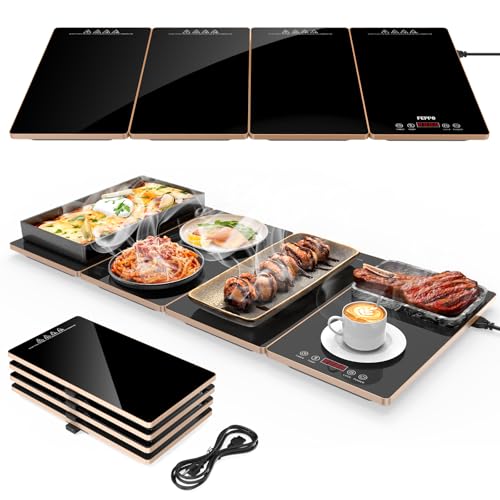

As an Amazon Associate we earn from qualifying purchases at no extra cost to you. Ratings are shown as listed on Amazon.
Quick comparison: which warmer fits your party?
| Type | Typical capacity | Heating method | Temperature control | Power requirement | Best use |
|---|---|---|---|---|---|
| Electric buffet warming tray | 2–3 food pans, approximately 6–12 qt total | Plug-in heated surface or water bath | Usually adjustable, approximately 140–200°F | 120V outlet, commonly 200–400W | Home parties with a nearby outlet |
| Insulated catering carrier | One to four full-size pans | Passive insulation | No active control | None | Transporting already-hot food |
| Chafing dish | One full-size 4–8 qt pan | Sterno-style gel or liquid fuel | Adjusted by fuel placement and lid use | No outlet; requires fuel | Outdoor or venue events without electricity |
| Rechargeable heated lunch box | Approximately 16–40 oz | Low-power electric heating element | Preset or timed heating | Internal battery; often also USB or vehicle charging | One-person portions and small gatherings |
| Portable electric lunch box | Approximately 20–60 oz | Plug-in heating plate | Often one heat setting | 120V, 12V vehicle power, or both | Keeping one dish warm during travel |
Best overall for most indoor parties: an electric buffet warmer
A plug-in buffet warmer is the most balanced option for birthdays, holiday meals, potlucks, and open-house gatherings. Models with two or three removable food pans let guests serve themselves without repeatedly opening a casserole dish. Look for stainless-steel pans, a tempered-glass lid, cool-touch handles, and a thermostat rather than a simple on/off switch.
A typical three-pan design holds roughly 9 quarts in total. If each guest takes about 8 ounces of a side dish, that is enough for approximately 36 small servings before allowing for empty space and serving losses. For a meal with several dishes, use one pan for a main course and the others for sides rather than trying to place all the food in one deep container.
Electric warming trays are not intended to cook chilled food quickly. Preheat the warmer, bring food to a safe serving temperature by using an oven or stovetop, and then use the tray to maintain warmth. A water-bath design distributes heat more gently and is less likely to scorch sauces, while a dry heated surface heats faster but requires more attention with thick foods.
Best when there is no outlet: a chafing dish
A chafing dish is the practical winner for gardens, community halls, tailgates, and venues where electrical sockets are unavailable. A standard full-size pan generally holds about 8 quarts, although the useful capacity is lower when food needs room for a serving utensil and a lid.
Fuel-based warmers are portable and inexpensive to set up, but temperature control is less precise. Wind, cold weather, and the distance between the flame and water pan all affect performance. Use the water pan specified by the manufacturer, keep the flame on a stable nonflammable surface, and extinguish fuel completely before packing the unit.
Chafing dishes are also less suitable for unattended indoor use. They need ventilation, a clear area around the flame, and supervision throughout the event. For a small apartment or a crowded buffet table, an electric unit is usually easier to control.
Best for transporting food: an insulated catering carrier
If the food is already hot and the party is somewhere else, an insulated carrier may be more useful than a powered warmer. Professional-style carriers are commonly made from molded plastic with thick foam insulation or from insulated fabric with rigid inserts. They hold one or more food pans and avoid the search for an outlet at the destination.
The limitation is that they maintain heat rather than add heat. A well-insulated carrier can often keep food warm for several hours, but the result depends on the starting temperature, how full it is, and how often the door is opened. Preheat the carrier with hot water or a heat-safe warming pack if the manufacturer permits it, then drain and dry it before loading food.
For spill resistance, choose a carrier with a rigid, level base, a full-length zipper or latches, and removable washable liners. Soft bags are easier to store but can flex when carried, making soup and gravy more likely to leak if the inner containers are not sealed.
Best for one or two portions: LunchEAZE, Hot Logic, or Crock-Pot Lunch Crock
Individual warmers make sense when the party involves a few separate meals rather than a shared buffet. LunchEAZE rechargeable warmers are designed for scheduled, battery-powered heating and are available in compact meal-container formats. Their main advantage is timing: food can be loaded earlier and heated closer to mealtime. Capacity is still generally in the single-serving range, so several units are needed for a group.
Hot Logic products are compact insulated heating cases available in plug-in versions for household outlets, vehicles, or both, depending on the model. They are useful for reheating a sealed container gradually and for keeping one meal warm in a car or office. They typically have less capacity and less precise temperature control than a buffet warmer.
The Crock-Pot Lunch Crock Food Warmer is another small-format option, with a container commonly listed at about 20 ounces. It is convenient for soup, pasta, rice, and similar single portions, but it is not a party buffet appliance. It generally needs an outlet while heating, so it is best for a serving station with accessible power.
These personal warmers are easier to transport than catering equipment, but check the container seal before placing one in a bag. A heating case may contain a spill but cannot prevent leakage from a loose lid or overfilled food container.
Decision matrix by party situation
| Your situation | Best format | Why | What to avoid |
|---|---|---|---|
| 4–8 guests, indoor, modest budget | Two-pan electric warmer | Enough capacity without occupying a full buffet table | A battery model designed for one serving |
| 10–25 guests with a reliable outlet | Three-pan electric buffet warmer | Separate main and side dishes with adjustable heat | One deep pan that forces frequent lid opening |
| Outdoor event with no electricity | Chafing dishes or insulated carriers | Independent of mains power and easy to arrange in stations | USB warmers expecting a high-capacity power bank |
| Frequent catering or repeated transport | Rigid insulated catering carrier | Fewer electrical and fuel concerns during travel | Thin soft bags with no rigid base |
| One person, desk, car, or hotel room | Rechargeable or vehicle-powered lunch warmer | Compact and designed around a single portion | Large buffet equipment with bulky pans |
Capacity calculation: how much warmer do you need?
Start with the number of portions, then allow for seconds. For a side dish, estimate 6–8 ounces per guest; for a main dish, estimate 8–12 ounces. For example, 16 guests eating 8 ounces of a main dish require 128 ounces, or 8 quarts. Adding a 20 percent allowance gives 9.6 quarts, so a three-pan warmer advertised at 9 quarts would be borderline once empty space is considered. Two 6-quart pans, or a larger full-size catering setup, would provide a more comfortable margin.
Do not fill pans to the rim. Leave space for stirring, serving, and the expansion of liquid foods. A nominal 2-quart pan may hold closer to 1.5 quarts usefully during a busy buffet.
Features that matter more than a high wattage number
- Thermostat control: Multiple settings are more useful than maximum wattage because delicate foods can dry out or scorch on constant high heat.
- Removable pans: Stainless steel or dishwasher-safe inserts make cleanup far easier than wiping a permanently attached heating surface.
- Lid design: Hinged or roll-top lids reduce the chance of putting a hot lid on the table and help limit spills during serving.
- Cord placement: A detachable cord is easier to pack, while a long, heat-resistant cord helps keep the power connection away from spills.
- Non-skid feet: These are important on folding tables and outdoor surfaces where a crowded buffet can be bumped.
- Weight and footprint: A three-pan electric unit can weigh roughly 8–15 pounds empty and may occupy about 25–30 inches of table width.
- Spill containment: A water reservoir or deep outer tray can catch small drips, but it does not make an appliance leakproof during transport.
Ownership realities: cleaning, wear, and common mistakes
The parts most likely to wear first are silicone seals, plastic handles, hinges, zippers, and nonstick coatings. Replacement parts may be difficult to find on inexpensive warmers, so a stainless-steel pan and simple mechanical controls can be preferable for frequent use. Inspect cords for cracking, especially after storage in a hot car.
Clean the unit after it has cooled and unplugged. Remove pans and wash them separately; never immerse the electrical base unless the instructions specifically permit it. Wipe dried sauce promptly, because burned residue can create hot spots and unpleasant odors at the next event. For insulated carriers, dry every seam and liner completely before closing the bag to prevent mildew.
A common mistake is using a warmer as a slow cooker or relying on it to bring refrigerated food to serving temperature. Another is covering a heated tray with a towel, which can trap heat around the controls and cord. Load hot food, use the intended pan, keep the lid closed between servings, and use a food thermometer when temperature safety matters.
Bottom line
Choose a two- or three-pan electric buffet warmer for an indoor party with an outlet, a chafing dish for an outdoor event without power, and an insulated catering carrier when transport is the main challenge. Rechargeable and plug-in lunch warmers are excellent for individual portions but rarely make sense as the main food service for a crowd. Capacity, stable placement, washable parts, and realistic power access should decide the purchase before extra heating modes or decorative features.