Key takeaways
- PPS listed on the USB-C port, at 25W or higher.
- USB-C in and out, so the same cable recharges the bank.
- A 3A or 5A USB-C cable; a 3A cable is enough up to 60W.
- Capacity in Wh printed on the case for airline checks (100Wh limit for carry-on without approval; never in checked bags).
- Combined-output figures: many banks drop to 15-20W per port when two devices are connected.
The best power bank for a Google Pixel is a 10,000mAh USB-C bank that supports USB Power Delivery with PPS (Programmable Power Supply) at 30W or more, because recent Pixels only reach their fastest wired speeds on PPS, and 10,000mAh gives about one and a half full charges for a Pixel 9 or Pixel 10. Pixel 10 owners who want cable-free top-ups can add a Qi2 magnetic power bank, since the Pixel 10 series has magnets built in.
Pixels are pickier about chargers than many phones. A bank that fast-charges an iPhone can still land a Pixel at 10-15W if it lacks PPS. Here is how to avoid that.
Our top picks



As an Amazon Associate we earn from qualifying purchases at no extra cost to you. Ratings are shown as listed on Amazon.
Why PPS Matters for Pixel
Since the Pixel 6, Google has used USB PD PPS for fast charging. PPS lets the phone request small, precise voltage steps, which keeps the battery cooler at high power. A bank that only offers fixed PD profiles (5V, 9V, 15V) will still charge a Pixel, but usually slower. Look for “PPS” in the specifications; Anker, Ugreen, Baseus, Belkin and Samsung banks rated 25W and above commonly list it, but not universally.
Pixel Charging Specs at a Glance
Figures below are approximate peak values from Google’s published specifications; real charging tapers as the battery fills and as the phone warms up.
| Model | Battery (typical) | Peak wired | Wireless | Power bank output to aim for |
|---|---|---|---|---|
| Pixel 8 / 8a | about 4,500-4,600mAh | about 18-27W | Qi, up to 12-18W (non-magnetic) | 25-30W PPS |
| Pixel 9 / 9 Pro | about 4,700mAh | about 27W | Qi, non-magnetic | 30W PPS |
| Pixel 9 Pro XL | about 5,060mAh | about 37W | Qi, non-magnetic | 45W PPS |
| Pixel 10 / 10 Pro | about 4,870-4,970mAh | about 29-30W | Qi2 magnetic, 15W | 30W PPS, or Qi2 bank |
| Pixel 10 Pro XL | about 5,200mAh | about 39W | Qi2.2 magnetic, up to 25W | 45W PPS, or 25W Qi2.2 bank |
How Many Charges per Capacity
Phone batteries hold roughly 18-20Wh (a 5,000mAh cell at about 3.9V). Power banks are rated at 3.6-3.7V and lose roughly 30-35% in conversion over a cable, more over wireless.
| Power bank | Rated energy | Usable via cable (~65%) | Pixel 9 (≈18Wh) | Pixel 10 Pro XL (≈20Wh) | Usable via Qi2 (~50%) |
|---|---|---|---|---|---|
| 5,000mAh | 18.5Wh | ~12Wh | about 65% | about 60% | about 45-50% of a Pixel 10 |
| 10,000mAh | 37Wh | ~24Wh | about 1.3-1.4 charges | about 1.2 charges | about 0.9-1 charge |
| 20,000mAh | 74Wh | ~48Wh | about 2.6 charges | about 2.4 charges | n/a (few magnetic banks this size) |
Worked example: a Pixel 9 Pro XL at 15% at 6 p.m. needs about 15Wh to reach full. A 10,000mAh 45W PPS bank delivers that in roughly 60-70 minutes and still has around a third of its energy left.
Picks by Pixel Owner
Any Pixel, best all-rounder: 10,000mAh, 30W PPS
A slim 10,000mAh bank with a 30W USB-C PD PPS port from Anker, Ugreen or Baseus covers every Pixel except the Pro XL models at near top speed. Weight is about 180-220 g. Prices fall in the budget-to-midrange band.
Pixel 9 Pro XL and 10 Pro XL: 45W PPS
To approach the Pro XL’s higher wired peaks, look for a bank that explicitly lists 45W PPS. Samsung’s 25W/45W power banks are built around PPS for Galaxy Super Fast Charging and pair well with Pixels; Anker and Ugreen also sell 45W-capable PPS banks. A 20,000mAh unit makes sense if you also charge a tablet or earbuds.
Pixel 10 series: Qi2 magnetic bank
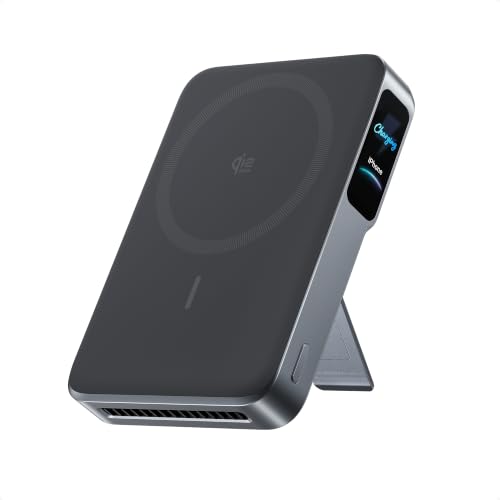
The Pixel 10 line added built-in magnets, branded Pixelsnap, so standard Qi2 magnetic power banks snap on without a special case. Qi2 banks typically charge at 15W; the Pixel 10 Pro XL can go faster on a Qi2.2-capable 25W bank. Magnetic charging wastes more energy as heat, so treat it as convenience, not efficiency.
Pixel 8 and 9 owners who want magnetic charging
These models have no magnets, so a Qi2 bank needs a magnetic ring or a Pixel-compatible magnetic case. Alignment matters; a slightly off-center bank can drop to 5W or stop charging entirely.
Pixel Watch and Pixel Buds users
A bank with two outputs lets you charge the phone and buds together. The Pixel Watch needs its own USB-C puck charger, so make sure the bank has a USB-C port free for it.
Spec Checklist
- PPS listed on the USB-C port, at 25W or higher.
- USB-C in and out, so the same cable recharges the bank.
- A 3A or 5A USB-C cable; a 3A cable is enough up to 60W.
- Capacity in Wh printed on the case for airline checks (100Wh limit for carry-on without approval; never in checked bags).
- Combined-output figures: many banks drop to 15-20W per port when two devices are connected.
Battery Health Considerations
Pixels include Adaptive Charging and, on newer models, a Battery Health Assistance and charge limit option that caps charging at around 80% to reduce long-term wear. These features apply to power banks too, so if your phone seems to stop at 80% on a bank, check Settings > Battery before blaming the bank. Heat is the bigger enemy: charging a Pixel on a magnetic bank in a hot car or a pocket can trigger heavy throttling. Wired charging from a PPS bank runs cooler than wireless at the same speed.
Bottom Line
For most Pixel owners, a 10,000mAh USB-C bank with 30W PPS is the sweet spot of size, speed and price. Step up to 45W PPS for Pro XL models, and add a Qi2 magnetic bank only if you own a Pixel 10 and value snap-on convenience over charging efficiency.