Key takeaways
- Wattage rating: 60W cables are capped at 20V/3A. To get 100W, 140W, or 240W you need a 5A cable with E-Marker. A MacBook Pro 16-inch, Galaxy Book, or 140W power bank will fall back to slow charging on a 60W cable.
- Length: Every extra 3ft adds resistance. At 6.6ft (2m) or less, a good 100W cable holds 92-96W sustained from a 100W charger. At 10ft, that same load often drops to 78-85W and runs hotter.
- Connector fit: Connector housing length matters. Housings over 32mm long or over 12mm wide often do not seat fully in rugged cases from OtterBox, Spigen Tough Armor, or thick gaming phone cases, which breaks PD negotiation.
- Data vs. charge-only: Most of the best usb c charge cable options are USB 2.0 (480 Mbps) because thicker power conductors leave less room for high-speed data pairs. If you transfer video from SSDs, you need a separate 10Gbps or 40Gbps cable.
The best USB Type C cables for fast charging in 2026 are 100W to 240W USB-IF certified USB-C to USB-C cables with an E-Marker chip, 6ft or shorter, and a braided nylon or silicone jacket — models like the Anker 765 USB-C Cable, UGREEN 100W PD Cable, Belkin BoostCharge Pro Flex, and Cable Matters 100W E-Marker Cable cover almost every phone, tablet and laptop need without throttling wattage.
If you searched for the best usb c cable for fast charging or best usb c charging cable, the short rule is this: match the cable wattage to your charger wattage, then choose jacket type by where you use it. Most charging slowdowns are not defective phones, they are 60W cables plugged into 100W+ chargers, or 10ft cables used for laptops.
Our top picks
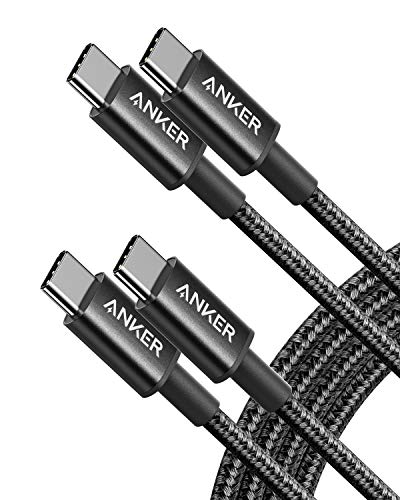


As an Amazon Associate we earn from qualifying purchases at no extra cost to you. Ratings are shown as listed on Amazon.
Why some Type-C cables fast charge and others do not
USB-C fast charging is negotiated between three parts: the best usb type c charger, the cable, and the device. The cable has to advertise what it can safely carry. That is why the best usb c fast charge cable almost always lists PD 3.0 or PD 3.1 support and an E-Marker chip for anything above 60W.
- Wattage rating: 60W cables are capped at 20V/3A. To get 100W, 140W, or 240W you need a 5A cable with E-Marker. A MacBook Pro 16-inch, Galaxy Book, or 140W power bank will fall back to slow charging on a 60W cable.
- Length: Every extra 3ft adds resistance. At 6.6ft (2m) or less, a good 100W cable holds 92-96W sustained from a 100W charger. At 10ft, that same load often drops to 78-85W and runs hotter.
- Connector fit: Connector housing length matters. Housings over 32mm long or over 12mm wide often do not seat fully in rugged cases from OtterBox, Spigen Tough Armor, or thick gaming phone cases, which breaks PD negotiation.
- Data vs. charge-only: Most of the best usb c charge cable options are USB 2.0 (480 Mbps) because thicker power conductors leave less room for high-speed data pairs. If you transfer video from SSDs, you need a separate 10Gbps or 40Gbps cable.
Spec comparison: cables that hold full wattage
The table below uses published manufacturer specs and USB-IF certification listings, not marketing wattage claims. Bend life is the manufacturer’s flex-test rating, typically 180-degree bends under load.
| Cable type | Rated power | Length options | Data speed | Jacket | Bend rating | Connector housing |
|---|---|---|---|---|---|---|
| Anker 765 USB-C to USB-C, 140W PD 3.1 | 140W, 28V/5A, E-Marker | 3ft / 6ft | 480 Mbps | Bio-nylon braided | 35,000 bends | 26.5mm x 11.8mm |
| UGREEN USB-C 100W PD braided | 100W, 20V/5A, E-Marker | 3.3ft / 6.6ft / 10ft | 480 Mbps | Nylon braided, aluminum shell | 30,000 bends | 28mm x 12mm |
| Belkin BoostCharge Pro Flex, silicone | 60W, 20V/3A and 100W version available | 3.3ft / 6.6ft | 480 Mbps | Liquid silicone + TPE | 30,000+ bends, tangle-free | 25mm x 11mm, low profile |
| Cable Matters 100W E-Marker, braided | 100W, 20V/5A, E-Marker | 3.3ft / 6.6ft | 480 Mbps | Ballistic nylon | 25,000 bends | 30mm x 13mm |
| Baseus 100W right-angle USB-C | 100W, 20V/5A, E-Marker | 3.3ft / 6.6ft | 480 Mbps | Nylon + zinc alloy | 20,000 bends | L-shaped, 22mm depth |
| Apple USB-C Charge Cable, 240W | 240W, 48V/5A, E-Marker, PD 3.1 EPR | 3.3ft / 6.6ft | 480 Mbps | Woven | Not published | 27mm x 11.5mm |
For anyone looking specifically for the best 100w usb c cable, the Anker 765, UGREEN 100W, and Cable Matters 100W are interchangeable on wattage — the real difference is jacket stiffness and connector size. Silicone wins for pockets and cars, braided nylon wins for desk abrasion and pets.
Pick by situation, not by wattage alone
A 240W cable does not charge a Pixel 8 or iPhone 15 faster than a good 60W cable, because those phones pull 25-30W maximum. Laptop and handheld gaming is where 100W+ matters.
| Your situation | Best choice | Why |
|---|---|---|
| Phone + 30W to 65W wall charger, daily carry | 3.3ft silicone 60W-100W cable, e.g. Belkin Flex type | Coils small, does not kink in pocket, full speed for phones and tablets |
| MacBook Air / XPS 13 / 65W-100W laptop at desk | 6.6ft braided 100W E-Marker, e.g. UGREEN or Cable Matters type | Holds 90W+ sustained, strain relief survives chair wheels and desk edges |
| MacBook Pro 16 / 140W-240W charging station | 3-6ft 140W-240W PD 3.1 EPR, e.g. Anker 765 or Apple 240W type | Only PD 3.1 EPR cables sustain 28V and 48V profiles |
| Car with best usb type c car charger | 3.3ft silicone 100W cable | Silicone stays flexible in heat and cold, short length avoids tangles around shifter |
| Travel with best usb type c power bank (20,000-25,000 mAh) | 1ft to 3.3ft braided 100W cable | Short cable loses less power and packs flat with the bank |
| Gaming phone, Steam Deck, handheld | Right-angle 100W cable | L-shape reduces port stress during landscape play |
The companion matters as much as the cable. Pairing a 100W cable with an old 18W charger will still give you 18W. If you are also upgrading, look for the best usb type c charger in the 65W to 100W GaN range for laptops, or a 30W to 45W compact GaN charger for phones and tablets. In a vehicle, the best usb type c car charger is typically a 48W to 100W dual-port PD model wired to the car battery circuit — a 100W cable will only deliver what that car port can output. Similarly, the best usb type c power bank for laptop top-ups is a 100W+ PD bank with a digital wattage readout, so you can see if the cable is the bottleneck.
How much speed you lose with the wrong length
Wattage loss can be estimated with a simple calculation:
Example: 100W GaN charger + laptop requesting 20V/5A = 100W. A quality 6.6ft 100W cable has about 0.18 to 0.22 ohm loop resistance. Power lost as heat = I² x R = 25 x 0.2 = 5W, so the laptop receives about 95W. That is normal and still full speed.
Switch to a thin, unmarked 10ft cable at 0.45 ohm: loss = 25 x 0.45 = 11.25W, delivered power drops to about 88W before thermal throttling. Many laptops then step down to 65W or 60W profile to stay stable. That is why a 6.6ft best usb c charging cable consistently outperforms a 10ft cable on the same charger, even if both say 100W on the package.
Practical takeaway: buy 3.3ft for power banks and cars, 6.6ft for wall and desk. Only buy 10ft for phones and tablets where the draw is under 30W and voltage drop is negligible.
Durability: what actually wears out first
Braided nylon does not make the copper inside immortal. In repair data and warranty return descriptions, the failure order is consistent:
- 1. Strain relief at the phone end: Repeated 90-degree bends from scrolling in bed crack the solder joint. Right-angle or silicone cables with 12mm+ flexible relief last longer here.
- 2. Connector lint and pocket debris: USB-C ports collect lint, preventing full insertion. PD then fails and charging falls to 5W to 7.5W. Cleaning the phone port with a wooden toothpick and wiping the cable plug with isopropyl restores full speed in many cases.
- 3. Jacket fray at desk edges: Braided jackets resist abrasion but trap dust and coffee. Silicone resists tangles but cuts more easily on sharp metal desk grommets. Route cables with a 1-inch service loop instead of a tight 90-degree pull.
- 4. E-Marker dropouts: Cheap no-name 100W cables without USB-IF certification often lose the 5A handshake after a few months. The charger then limits to 60W for safety. Certified cables include over-voltage and thermal protection that prevents this fallback.
Do not coil braided cables tightly around a charger. Loose 3-inch loops prevent internal conductor fatigue. Avoid yanking by the jacket — pull by the aluminum or plastic shell. General market ranges in 2026 are roughly 12 to 20 dollars for a certified 100W braided cable and 15 to 25 dollars for 140W to 240W PD 3.1 cables; significantly cheaper 100W claims without certification tend to be 60W conductors with misleading packaging.
How to verify you are actually fast charging
Use the phone or laptop battery screen or a 10 to 15 dollar USB-C power meter dongle. With a proper best usb c charge cable you should see: iPhone 15/16 series 20-27W, Samsung S24/S25 series 25-45W, Pixel 8/9 series 27-30W, 13-inch laptops 60-67W, 16-inch laptops 96-140W. If you see under 15W on a PD charger, reseat the connector, flip the cable, remove the case, and try the shorter cable before replacing the charger.
Bottom line for 2026
Buy wattage for your largest device, length for your smallest space. Most people are best served by one 3.3ft silicone 100W cable for car and power bank use and one 6.6ft braided best 100w usb c cable or 140W cable for desk and travel charging. That two-cable set covers phones, tablets, handhelds and USB-C laptops without paying for fragile 10ft runs or uncertified high-wattage claims.