Key takeaways
- For speakers around 86–88 dB sensitivity in a small room, target at least 40 watts per channel.
- For 86–88 dB speakers in a medium or large room, 80–100 watts is safer.
- For speakers around 92 dB sensitivity, 15–30 watts may be sufficient in a small or medium room.
- For speakers above 94 dB sensitivity, a 7–15 watt amplifier can work, provided impedance does not collapse at particular frequencies.
The best tube amps in 2026 are not simply the highest-powered models: they are the ones whose output stage, impedance options, noise performance, and features suit your speakers and room. For most listeners, the strongest choices are the PrimaLuna EVO 100 for flexible all-round use, the Rogue Audio Cronus Magnum III for difficult speakers and larger rooms, and the Line Magnetic LM-211IA for efficient speakers and an especially direct, spacious presentation.
Our top picks
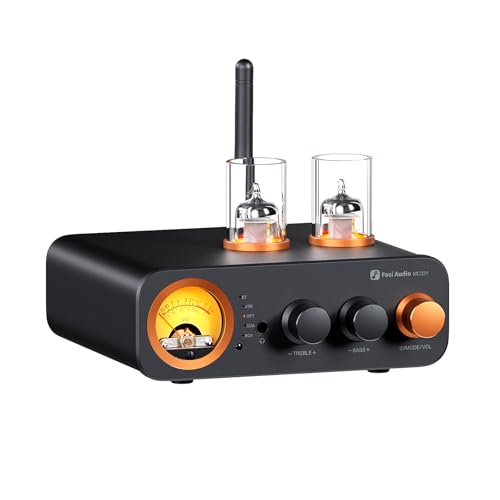

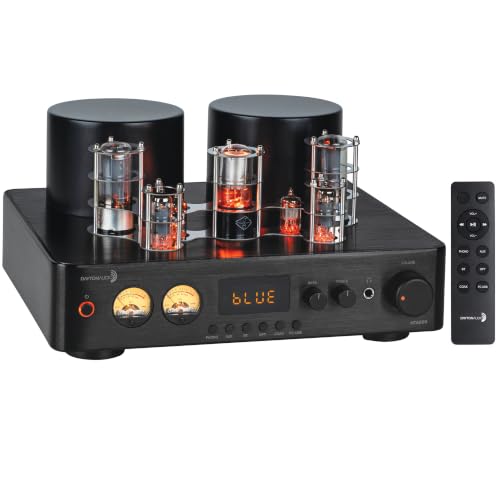
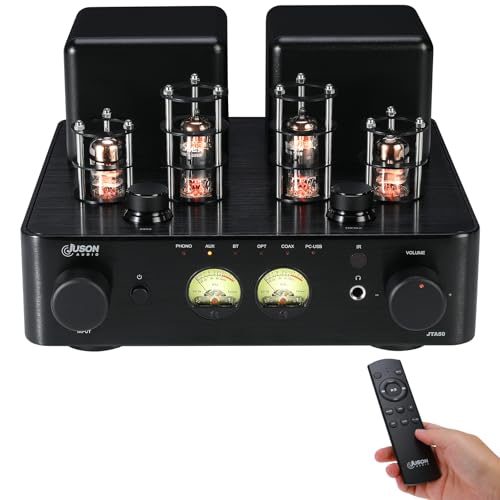
As an Amazon Associate we earn from qualifying purchases at no extra cost to you. Ratings are shown as listed on Amazon.
Best tube amps at a glance
| Model | Approx. output | Power tubes | Speaker options | Useful connectivity | Best suited to | Typical market range |
|---|---|---|---|---|---|---|
| PrimaLuna EVO 100 Integrated | About 40–42 watts per channel | EL34 or KT88, depending on configuration | 4 and 8 ohms | Multiple line inputs, home-theater bypass, headphone output | Medium rooms, mixed music, first serious tube system | $3,000–$4,000 |
| Rogue Audio Cronus Magnum III | About 100 watts per channel | Four EL34 output tubes | 4 and 8 ohms | Line inputs, preamp output, subwoofer-friendly integration | Large rooms, lower-sensitivity speakers, rock and orchestral music | $3,500–$5,000 |
| Line Magnetic LM-211IA | About 15 watts per channel | 300B directly heated triodes | 4 and 8 ohms | Several line-level inputs | Efficient speakers, intimate rooms, vocal and acoustic music | $4,000–$6,000 |
| Leben CS600X | About 30–35 watts per channel | Compatible with tubes including EL34 and 6L6GC | Multiple impedance taps | Line inputs, tape loop, headphone output | Nearfield listening, compact high-quality systems | $6,000–$8,000 |
| McIntosh MA352 | About 200 watts per channel | 12AX7A tube preamplifier with solid-state output stage | 4 and 8 ohms | Balanced and unbalanced inputs, DAC, phono, subwoofer integration | Listeners wanting tube voicing with high power and modern convenience | $6,500–$8,500 |
Specifications can vary by production revision and regional configuration, so confirm the current manual before ordering. The McIntosh MA352 is included as a hybrid amplifier rather than a full tube power amplifier; it is an important alternative for buyers who want warmth without accepting the output limitations of many valve designs.
Our picks by listening situation
Best all-rounder: PrimaLuna EVO 100
The PrimaLuna EVO 100 is the easiest recommendation for a listener who wants tube character without making the system difficult to live with. Its automatic biasing reduces setup work, and its protection circuitry is more reassuring for newcomers than the minimal-control design of many traditional valve amplifiers. Depending on the fitted output tubes, it can deliver roughly 40 watts per channel, enough for most speakers rated around 88 dB sensitivity or higher in a small or medium room.
Its presentation is typically smooth and dimensional rather than aggressively romantic. Vocals gain body, cymbals remain rounded, and stereo depth is more apparent than with many inexpensive solid-state amplifiers. The trade-off is that it is not the last word in bass grip. With a difficult four-ohm speaker, the low end may sound less controlled than it would from a high-current solid-state amplifier.
Best for large rooms or demanding speakers: Rogue Audio Cronus Magnum III
The Cronus Magnum III is the practical high-power choice among these traditional tube designs. Its approximately 100 watts per channel give it substantially more headroom than a 15- or 40-watt amplifier. That matters when listening from several metres away, using a large floorstander, or reproducing dynamic recordings at realistic volume.
EL34 output tubes contribute the familiar midrange presence associated with classic British valve amplifiers, while the larger power supply helps prevent bass from becoming soft or compressed. It remains a tube amplifier, so it will not have the instantaneous low-frequency damping of every powerful transistor design. Nevertheless, it is better matched to demanding speakers than low-powered single-ended amplifiers.
Best for efficient speakers and small rooms: Line Magnetic LM-211IA
The LM-211IA is a specialist choice built around 300B tubes and roughly 15 watts per channel. That figure sounds modest, but it can be entirely adequate with speakers rated at approximately 94 dB sensitivity or more. Horn speakers and other efficient designs can produce satisfying levels with very little amplifier power.
Its appeal is the sound of a single-ended-triode architecture: a focused central image, natural vocal texture, and a strong sense of flow at moderate volume. It is less appropriate for inefficient bookshelf speakers, planar magnetic speakers, or large rooms where sustained peaks demand considerable current. Buy it for the right speaker, not because a low wattage appears inherently purer.
Best premium compact-system option: Leben CS600X
The Leben CS600X combines moderate power with a compact footprint and unusually broad tube compatibility. It is a strong match for a carefully assembled two-channel system, especially when the amplifier sits close to the listener and the speakers are reasonably sensitive. Its multiple impedance choices make speaker matching less restrictive than with some vintage-inspired designs.
The sonic balance is generally more refined than overtly thick: clean treble, dense midrange, and a stable image. Its limitations are practical rather than musical. It has fewer digital facilities than modern hybrid amplifiers, and replacement tubes are costly because premium compatible sets can command a significant portion of the amplifier’s purchase price.
Best modern connectivity: McIntosh MA352
The MA352 is the choice for listeners who want tube-derived texture but do not want a low-powered valve power stage. Its 200-watt solid-state output section offers strong speaker control, while the tube preamplifier contributes a warmer tonal character. Balanced inputs, a built-in digital converter, phono compatibility, and subwoofer-friendly connections make it easier to place in a contemporary system.
It will not produce exactly the same harmonic profile or compression behaviour as a full tube amplifier. The sound is more controlled and authoritative, especially in the bass, but some listeners may find it less saturated and less intimate than the Line Magnetic or Leben designs.
How to match a tube amp to your room
Start with speaker sensitivity, listening distance, and desired volume rather than amplifier wattage alone. A useful conservative rule is:
- For speakers around 86–88 dB sensitivity in a small room, target at least 40 watts per channel.
- For 86–88 dB speakers in a medium or large room, 80–100 watts is safer.
- For speakers around 92 dB sensitivity, 15–30 watts may be sufficient in a small or medium room.
- For speakers above 94 dB sensitivity, a 7–15 watt amplifier can work, provided impedance does not collapse at particular frequencies.
As a simplified example, increasing amplifier power from 15 watts to 60 watts provides two additional doublings of power, equivalent to roughly 6 dB more peak capability. That is useful headroom, but it does not compensate for a speaker with a severe impedance dip. Check the speaker’s minimum impedance and phase angle, then use the amplifier’s correct 4-ohm, 8-ohm, or other available output tap.
| Situation | Recommended direction | Reason |
|---|---|---|
| Small room, efficient speakers, mostly vocals and jazz | Line Magnetic LM-211IA | Low power is adequate and the single-ended design emphasizes texture and image focus |
| Medium room, mixed music, minimal technical fuss | PrimaLuna EVO 100 | Automatic biasing, flexible tubes, and moderate output simplify ownership |
| Large room or low-sensitivity floorstanders | Rogue Audio Cronus Magnum III | Higher valve output provides more dynamic headroom |
| Digital-heavy system with subwoofer or home cinema | McIntosh MA352 | High power and broader modern connectivity |
| Compact premium system and experienced owner | Leben CS600X | Flexible tube compatibility and refined low-to-moderate-power performance |
What measured performance tells you
Frequency response is only one part of a tube amplifier’s behaviour. A well-designed modern integrated amplifier should normally remain close to flat through the audible band, but its response can change slightly with speaker impedance because the output transformer interacts with the load. Total harmonic distortion also rises as the amplifier approaches clipping. Tube amplifiers often produce a gradual blend of low-order harmonics, which many listeners perceive as smoothness, but that does not mean distortion is absent.
Pay particular attention to continuous power, clipping power, output impedance, signal-to-noise ratio, and channel separation. Published figures around 0.1% distortion at normal output are not directly comparable with figures measured at full rated power. A low noise floor matters with high-sensitivity horn speakers, where transformer hum or tube rush can be audible from the listening position.
For this reason, a 15-watt 300B amplifier can sound more dynamic than expected with a 95 dB speaker, while a nominally more powerful 40-watt amplifier may sound strained with a difficult 84 dB design. Measured numbers are most useful when interpreted alongside the speaker’s real impedance curve and the room’s listening distance.
Maintenance and ownership costs
Tube amplifiers are not maintenance-free. Output tubes are usually the first consumable, and small-signal tubes can also become noisy or microphonic. With regular use, a reasonable planning assumption is roughly 2,000–5,000 hours for output tubes, although service life varies with operating temperature, bias, transport, and tube quality. A listener using an amplifier for three hours a day reaches about 1,095 hours per year, so a replacement set may last several years rather than several months.
- Allow ventilation above and beside the amplifier; heat shortens component and tube life.
- Never operate a conventional tube amplifier without connected speakers or a suitable load.
- Let tubes cool before moving the amplifier or cleaning around the sockets.
- Use the correct impedance tap and never swap output tubes without following the manufacturer’s bias procedure.
- Expect a matched output-tube set to cost roughly $150–$500, with premium or rare tubes costing more.
- Have persistent hum, red-plating tubes, crackling, or blown fuses diagnosed by a qualified technician.
For most buyers, the final decision is simple: choose the PrimaLuna EVO 100 for flexibility, the Cronus Magnum III for power, the LM-211IA for efficient-speaker intimacy, the Leben CS600X for a premium compact system, or the MA352 when connectivity and speaker control matter more than an all-tube signal path.